

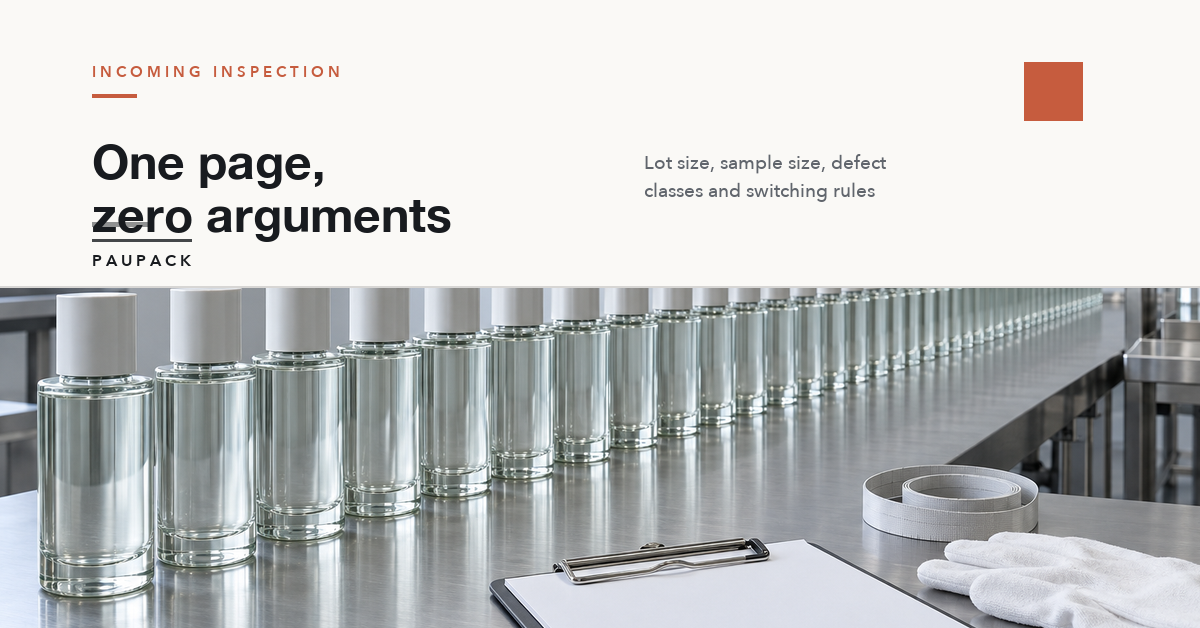
A packaging AQL sampling plan is the document that turns "the shipment looks fine" into a number, and it is the cheapest quality tool a brand can put in place before the first container leaves the factory. It costs one page and an hour of decision-making, and it prevents the two most expensive arguments in packaging: the brand says the lot is unusable, the factory says the lot is normal, and neither side has a written standard to appeal to.
PauPack ships glass and plastic containers to brands in Europe, North America and Australia, and every one of those shipments is inspected against a plan rather than an opinion. Below is how a packaging AQL sampling plan is built: lot sizing, sample sizing, defect classes, switching rules, and the parts of packaging quality that a sampling table cannot see at all.
What a Packaging AQL Sampling Plan Actually Decides
Acceptable quality limit sampling answers three questions. How many units do I look at? How many defects am I allowed to find? And what do I do when I find more? Everything else, including the tables, the code letters and the switching rules, exists to make those three answers consistent between inspectors, shifts and suppliers.
The logic behind it is statistical. You cannot open every carton, so you accept a defined risk: with a given sample size and acceptance number, a lot that is worse than the limit has a known chance of being rejected. A packaging AQL sampling plan simply states that risk out loud.
Start With the Lot, Not the Sample
A lot is a defined quantity produced under the same conditions, and defining it correctly is half the work. If a factory packs three days of output into one shipping lot, the plan cannot detect a bad Tuesday. PauPack asks suppliers to keep lots to one production run per mould and one colour batch, and to label the pallets accordingly.
The practical rule is that a lot should be small enough that a single cause could explain every defect inside it. If two different machines, two shifts and two glass furnaces contributed, it is not one lot, and the inspection result will be an average that hides the problem. A packaging AQL sampling plan inherits every weakness in that definition, which is why the definition is written down before any sample size is chosen.
Lot Size to Sample Size: Reading the Code Letter
The tables work off a code letter derived from the lot size and the inspection level. General inspection level II is the default for packaging, and the numbers below cover the range where most container orders sit.
| Lot size (units) | Code letter | Sample size | Notes for packaging |
|---|---|---|---|
| 151 to 500 | G | 32 | Small decorated runs and sample lots |
| 501 to 1,200 | H | 50 | Single-pallet decorative work |
| 1,201 to 3,200 | J | 80 | Small bottle orders, gift sets |
| 3,201 to 10,000 | K | 125 | Typical mixed container order |
| 10,001 to 35,000 | L | 200 | Full container loads of jars or bottles |
| 35,001 to 150,000 | M | 315 | Multi-container programmes |
| 150,001 to 500,000 | N | 500 | High-volume line feed |
Two adjustments matter in practice. Inspection level I is acceptable when the supplier has a long accepted history and the defect class is visual only, and tightened inspection adds roughly half again to the sample size without changing the limit.
Critical, Major and Minor: Sorting Packaging Defects
The sampling plan is only as good as the defect definitions attached to it. A packaging AQL sampling plan without a written defect list produces inspectors who classify by mood, and a supplier who disputes every call.
| Class | Typical limit | Packaging examples |
|---|---|---|
| Critical | Zero | Broken finish, missing liner, contamination, closure that fails to seal, child-resistant cap that opens in one motion |
| Major | 0.65 | Cord or stone in the glass wall, crack at the shoulder, wrong neck finish, print registration off by more than 1 mm |
| Minor | 1.5 | Light mould seam, faint scuff on an unprinted area, small bubble away from the sealing surface, label edge lift |
PauPack writes the defect list from the mould drawings rather than from a generic template, because a bubble near the finish and a bubble in the base carry completely different risk. That single distinction prevents a healthy percentage of the disputes we see between brands and third-party factories.

Reading the Ac/Re Column Correctly
Each code letter pairs with an acceptance number and a rejection number. For a sample of 125 at AQL 0.65 the pair is 2 and 3, which means two defects are accepted and three reject the lot. That pair is the working heart of a packaging AQL sampling plan, and the subtlety is that the numbers apply per defect class, not per sample as a whole.
That is why one critical defect rejects a lot of 10,000 units while two major defects do not. If a brand's plan does not say that out loud, an inspector will usually add classes together and reject a lot that the plan would have accepted, which is expensive for everyone.
The Switching Rules Most Brands Skip
Sampling tables are designed to move, and a packaging AQL sampling plan that never moves is being used at a fraction of its value. The standard sequence is straightforward: normal inspection by default, tightened after two consecutive lots that fail, back to normal after five consecutive lots that pass, and reduced after ten consecutive lots that pass with no defects at all.
For a brand importing containers, tightened inspection is the cheapest early warning available. It costs a few extra inspected units from the next order and it catches a supplier drift before the following three containers repeat it. PauPack reports which state the plan is in on the inspection sheet, so the buyer does not have to reconstruct it.
What AQL Cannot See on a Bottle or Jar
A packaging AQL sampling plan counts what an inspector can see. It does not measure what the customer experiences, and the gap is worth naming before the plan is signed.
Torque, leak rate, drop performance, coating adhesion, label placement under load, and how a cap feels on the tenth opening are all outside the table. A jar can pass a visual inspection at zero defects and still leak in transit because the liner was compressed once too often during capping. That is not a sampling failure but a sampling boundary, and the PauPack inspection sheet names it before the first pallet is drawn.
Pairing AQL With Functional Tests
The practical answer is to bolt three measurements onto the same sample. Torque on ten units, a leak test on five, and a drop test on three. Those eighteen extra readings take about twenty minutes and cover the defects a visual table cannot express.
The USP packaging and storage requirements make the same point from the regulated side: container, closure and contents are qualified as one system. Where the pack also carries a safety function, the CPSC testing and certification framework is a useful reminder that a documented test, not an inspection opinion, is what a regulator or a retailer will ask for.
How Many Containers to Pull From Each Pallet Layer
Random sampling is easy to get wrong on a pallet of glass. Pulling 125 units from the two cartons nearest the loading door is not a random sample; it is a sample of the door. Split the draw across at least five cartons, three layers and both pallet faces, and record which carton each unit came from, because that carton map is what a packaging AQL sampling plan is actually built on.

Defects in glass cluster by mould cavity and by furnace time, and both of those follow the carton sequence. When a defect is found, the carton map is what tells the factory which cavity to inspect next, and it is the difference between a two-day fix and a three-week argument.
Writing the Plan Into the Purchase Order
A packaging AQL sampling plan that lives in a quality manual has no commercial force. PauPack asks brands to put five lines into the purchase order: the inspection level, the defect classes with their AQL values, the sample size for the expected lot, the functional tests to be performed, and the remedy if the lot is rejected.
That last line matters most. Replacement, rework at the factory, or a credit note should be chosen before the container is loaded, not after it arrives. Brands running this discipline across a wider programme usually pair it with our packaging quality control checklist and the dimensional envelope agreed at glass bottle prototyping.
Records, Photos and the Release Decision
A release pack should let a stranger reconstruct the decision. PauPack supplies the inspection sheet, the lot codes, the defect photographs with a scale reference, the torque and leak data, and the name of the person who signed the release.
Photographs carry more weight than they should, so they need discipline: one shot of the defect on the pallet, one close-up with a ruler, and one of an accepted unit from the same carton for comparison. Three photographs per defect class is enough, and it ends most disputes inside a day.
Where Packaging AQL Sampling Plans Fail in Practice
The failures are predictable enough to list, and every one of them is a documentation problem rather than a statistical one.
| Failure | What it looks like | Fix |
|---|---|---|
| Lot too broad | Three shifts averaged into one result | Cap the lot at one run per mould and colour |
| Defects undefined | Inspectors disagree on the same unit | Attach photographs to each defect class |
| Classes added together | Healthy lots rejected | State that limits apply per class |
| Plan never switches | Same sample size after a failed lot | Apply tightened and reduced rules on the sheet |
| Visual only | Leakers pass inspection and fail in transit | Add torque, leak and drop to the same sample |
What PauPack Ships With Every Inspection
Every PauPack order leaves with an inspection pack: the plan used, the sample size drawn, the defect log with photographs, torque and dimensional readings where the closure or the neck finish is critical, and the release signature. For decorated work the log also carries a colour reading against the approved standard.
Brands that compare suppliers usually find the plan is the same and the definitions are not. Our glass bottle MOQ and custom bottle mould cost pages explain how the tooling side affects what a first lot can hold, and the closure-specific checks are covered in pharmaceutical bottle sample testing.
Packaging AQL Sampling Plan: The Questions Buyers Ask
What is an AQL sampling plan for packaging?
It is a written rule that says how many bottles or jars to pull from a lot, how many defects are allowed, and what happens when that number is exceeded. The plan turns a subjective look at a pallet into a repeatable decision that a second inspector would reach independently.
Which AQL level should a packaging buyer choose?
Most PauPack customers work to 0.65 for major defects and 1.5 or 2.5 for minor ones, with a zero-tolerance line for critical defects such as a closure that will not seal. The level is a commercial choice, not a legal one, so it should be written into the purchase order rather than assumed.
How many units should be inspected from a lot?
Use the general inspection level II column of the sampling table as the default. That gives 125 units from a lot of 3,201 to 10,000 pieces, and 200 units from 10,001 to 35,000, which is the range most container shipments sit in.
Do I need an AQL sampling plan for glass bottles?
Yes, and it should be split into visual and dimensional sections. Glass brings mould seams, cord, stones and check marks that a generic visual table does not describe, so the plan needs its own wording for each of those before the inspector sees a pallet.
What counts as a critical defect in packaging?
Anything that breaks the seal, exposes the product to contamination or creates a safety risk. A cracked finish, a missing gasket, a cap that strips before reaching torque and a child-resistant closure that opens with one motion all belong in the zero-tolerance column.
How does AQL relate to torque and leak testing?
It does not replace them. AQL sampling plans count defects; they do not measure a closure. PauPack pairs the visual plan with a torque check on the same sample and a leak test on a smaller subset, because a cap can look perfect and still hold 40 percent of its specified torque.
Should the sample be taken from the top of the pallet?
No. Draw units from four corners and the centre, and from the bottom, middle and top layers of the pallet. Defects cluster by mould cavity and by layer, so a top-layer sample can miss a cavity that ran hot for the whole shift.
When should inspection switch to tightened or reduced?
After two consecutive lots with defects above the acceptance number, switch to tightened inspection until five lots pass. Ten consecutive accepted lots allow reduced inspection. Writing those two sentences into the plan is what makes the sampling plan a system rather than a one-off.
What paperwork should come with a packaging inspection?
The plan itself, the lot and batch codes, the number of units drawn, the defect found per category, the measurement data for torque and dimensions, and a signed release with photographs of any defect. A buyer should be able to reconstruct the decision years later from that pack.
Can an AQL sampling plan reduce incoming inspection?
It can, and that is usually the point. Once ten consecutive lots pass under the plan, reduced inspection is defensible, and incoming inspection can move from full check to a small audit. PauPack supplies the historical data that makes that switch honest.