

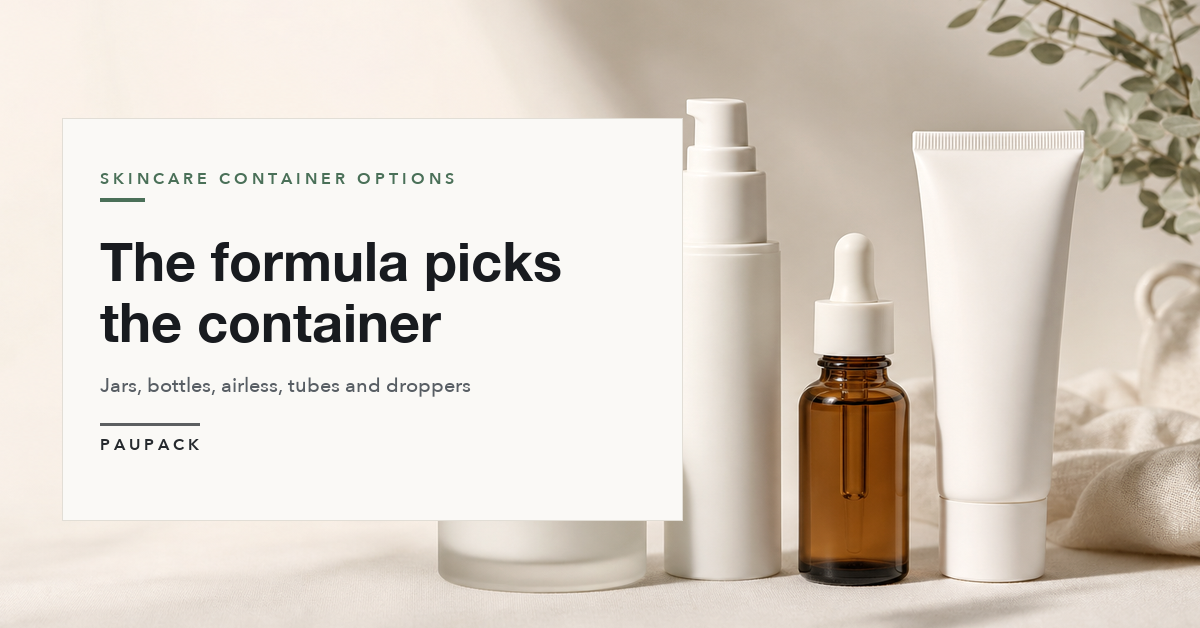
Skincare container options are usually argued on a mood board and decided by a filling line that was bought three years ago. The format that wins is the one the formula, the line and a bathroom shelf can all tolerate, and those three rarely agree on the first pass.
PauPack builds glass and plastic primary packaging for skincare brands, and most selection meetings we sit in start with five candidates and end with two. The work is not choosing the prettiest pack. It is finding which of the skincare container options survives the formula, the dose, the transit and the price the brand needs. This guide follows the order we use in that meeting.
Four Questions That Cut the List to Two
Before any sample is ordered, answer four questions in writing. How is the product dispensed: fingers, spatula, pump or dropper? How sensitive is the formula to air and light? What temperature does the line fill at? And what volume does the customer actually use per application?
Those four answers remove more skincare container options than any aesthetic discussion. A vitamin C serum answered honestly scores airless or a well-sealed dropper, and a thick body butter answers a jar. The rest of this page explains why those verdicts hold up in production.
Start With the Formula, Not the Shelf
Viscosity decides the neck, and the neck decides the rest of the pack. Below roughly 3,000 cP a product flows and wants a bottle with a pump or a dropper. Above 20,000 cP it needs width, which means a jar and a wide lid that a two-finger grip can open.
Between those bands sits the awkward middle, where a lotion is too loose for a spatula and too thick for a fine mist. Brands often try to force a serum into a jar for a premium look, then discover that customers pour it onto a palm because the jar gives them nothing to work with. That complain usually arrives three weeks after launch.
Jars: The Default, and Where They Stop Working
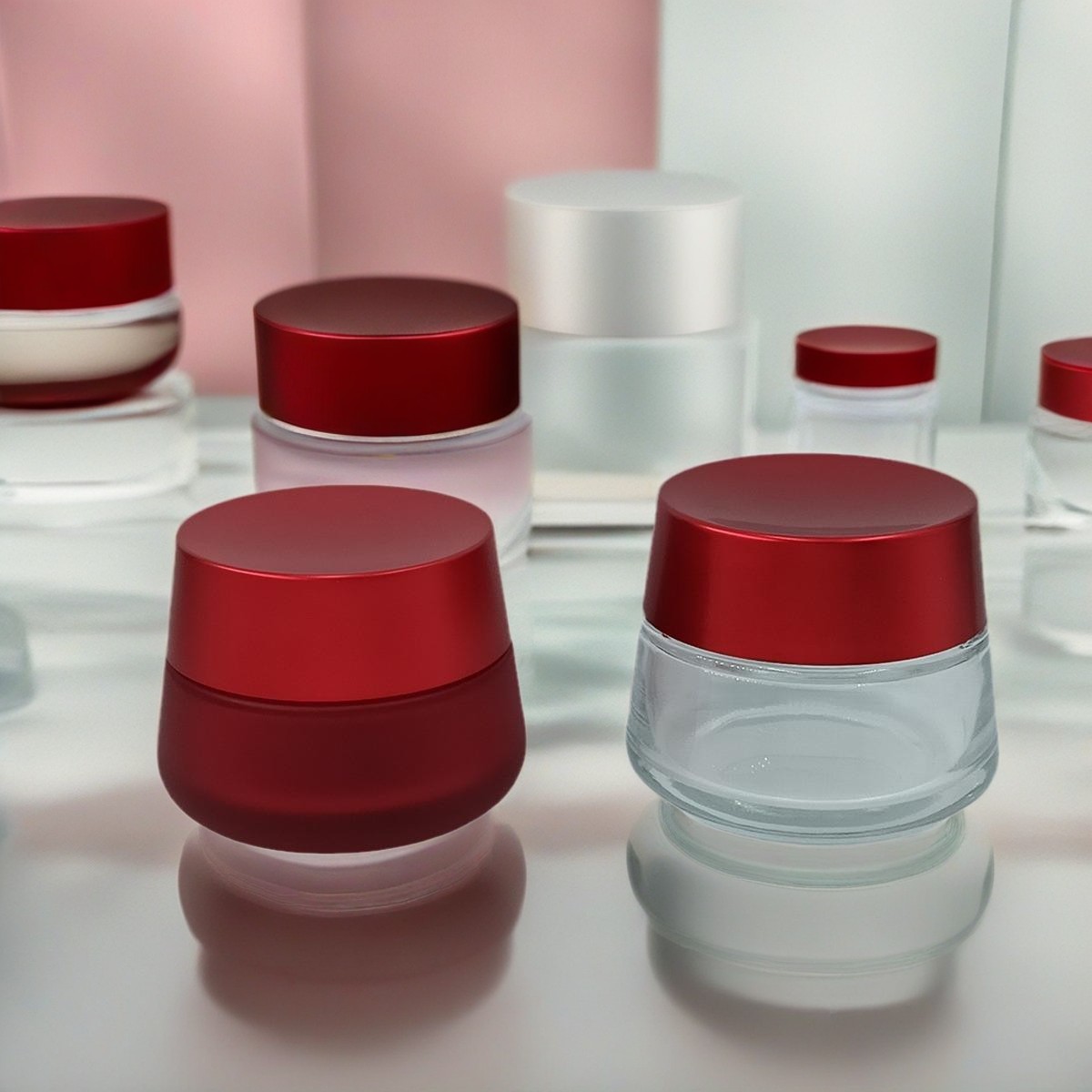
A jar is the most forgiving of the skincare container options. Fill accuracy matters less, the decoration area is generous, and the same body can carry a cream, a balm or a mask with only a lid change. PauPack keeps a wide glass cream jar range for exactly this reason.
Jars fail when the formula is air sensitive or dosed in small amounts. Every opening exchanges the headspace air, so an antioxidant blend in a wide-mouth jar degrades faster than the same blend behind a pump. If the label promises a stable 1 percent retinol, the jar has to earn that claim.
Bottles and Pumps: When Flow Beats Access
A bottle wins as soon as the product pours. Lotions, toners, cleansing gels and micellar waters all behave better through a shoulder and a pump than they do on a spatula, and the closure can be specified to deliver a repeatable shot.
The variable most brands miss is dose volume. A pump that outputs 0.5 ml per stroke turns a 100 ml bottle into a 200-day product; a 1.2 ml output makes the same bottle feel cheap. PauPack measures output on filled production units, because pump output drifts with the viscosity it is asked to move.
Airless: The Option That Earns Its Premium
Airless packs protect expensive actives and deliver the most consistent dose among the skincare container options on this list. The follower piston keeps the formula away from air and lets the pack empty to within a few percent, which matters when a 15 ml serum retails at a high price.
The cost is real: a tooled airless pack can be several times a simple jar, and not every filling line can handle bottom fill. PauPack advises brands to reserve airless for concentrated or oxygen sensitive formulas, then compare it against an airless pump claim audit before publishing protection claims that the pack cannot prove.
Tubes: The Cheapest Way to Test a Formula in Public
A laminate or PE tube is usually the lowest-cost of the skincare container options at small volume, and it travels better than glass. For a seasonal launch, a limited edition or a travel size, the tube gets the product to market without tooling for a rigid pack.
Two constraints decide whether the tube route holds. The seal has to suit the formula chemistry, and the orifice has to suit its viscosity. A runny serum in a wide orifice tube evacuates on the first squeeze, which reads as a manufacturing fault even when the fill weight is perfect.

Droppers and Roll-Ons for Concentrated Formats
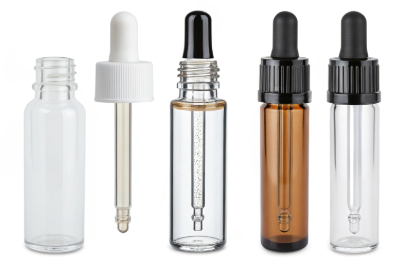
Droppers suit oils, serums and treatments where the customer wants control, and they give a small volume a presence on the shelf. The detail that decides quality is the insert: the glass pipette grade, the bulb material and the drop size consistency across the fill.
Roll-ons sit at the other end of the dispensing range and are the least forgiving when the formula is thin. PauPack asks for a two week trial on the roller ball before approving the pack, because a ball that rattles at week one can leak at week four after the formula has warmed and cooled a few times.
The Compatibility Test Every Option Must Pass
Format preference does not excuse a compatibility test. Fill thirty units at production temperature, hold a set at 40 degrees Celsius for four weeks and another at room temperature for twelve, then inspect the pack and the product together.
| Check | What it catches | Typical pass line |
|---|---|---|
| Weight loss over time | Diffusion through the wall or the seal | Under 2 percent in the hold period |
| Cap torque, before and after | Liner swell and thread creep | Within the agreed window on both reads |
| Colour and odour | Interaction with the liner or the glass | No shift against the reference photo |
| Panel and base | Softening or panelling on the shelf | No visible distortion by eye and gauge |
| Pump or dropper output | Dose drift once the pack is filled | Within the printed tolerance on ten strokes |
Run the test on the shortest shelf life you plan to claim, not on the launch date. A pack that survives twelve weeks is not evidence for a two year claim, and the difference is exactly the kind of gap that turns into a recall.
Fill, Headspace and the Line You Already Own
The best of the skincare container options is useless if the filling line cannot handle it. Ask three questions of the line: does it fill by weight or volume, can it handle the closure type, and what neck diameter does the change parts support?
Headspace follows the fill method. A hot fill needs room for contraction; a cold fill with a foil seal needs a clean sealing band and almost no air. PauPack sizes the jar or bottle around the actual fill line and confirms it after a transit simulation, because headspace computed on a bench is a different number after a pallet has crossed a border.
What Each Option Costs, and Where MOQ Sits
Cost per unit is the last question, not the first, because the answer moves with volume. A stock mould with a label starts at a fraction of a custom mould, and the crossover usually arrives when a brand is confident enough about the volume to amortise tooling.
| Format | Typical MOQ direction | Tooling weight | Best suited to |
|---|---|---|---|
| Stock glass jar with label | Lowest | None to minimal | First launch, testing a formula |
| Custom jar or bottle | Depends on the mould | Heaviest | Core range with a long life |
| Airless pack | Higher than stock | Heavy, split across parts | Actives, premium serums |
| Laminate tube | Low | Print cylinder only | Seasonal and travel sizes |
| Dropper bottle | Low to mid | Light, insert included | Oils and treatments |
Freight belongs in the same comparison. Glass is heavy, which is why a glass jar quoted at a slightly higher unit price can lose to a plastic pack once a full container is priced. PauPack quotes landed cost on a pallet quantity so the comparison is honest.
Decoration and the Second Purchase
Decoration narrows skincare container options faster than most briefs expect. A sprayed jar can carry a screen print, a frosted jar carries an etched mark, and a tube carries print that has to survive being squeezed for months.
Refill and reuse add a second round of requirements. If the pack is meant to be kept, the decoration has to survive handling and cleaning, and the refill has to seat without tools. That is a separate design problem, and it is better solved on the refill skincare packaging notes than inside a launch timeline that has no room for it.
What PauPack Needs to Narrow Your Options
Send the formula type and viscosity, the fill volume, the market, the annual volume and the decoration direction. PauPack replies with two or three pack routes, the tooling each one needs, and the sample plan that proves the choice.
Where the pack has to be food-grade, cosmetic or pharmacy ready, the paperwork matters as much as the mould. The quality management process keeps the test records with the project so a repeat order starts from evidence rather than memory, and the accessories supply team quotes liner, pump and dropper against the same drawing.
One closing note from the sample room. Labels and regulation follow the format you choose: the FDA cosmetics pages explain how cosmetic products and their labelling are treated in the United States, and the food ingredients and packaging section covers how contact materials are regulated when a pack crosses into food use. Both are worth reading before a claim is printed on a pack that cannot support it. If you would rather skip ahead, send the brief and let PauPack narrow the shortlist for you.
Questions Buyers Ask About Skincare Container Options
How many skincare container options should a brand compare at once?
Five is workable, two is decisive. PauPack asks brands to bring every candidate to the same short brief, then scores them on fill compatibility, dose control, transit risk and cost per unit. Options that lose on two of those rarely deserve the sample budget.
Do skincare container options change with the viscosity of the formula?
They change more with viscosity than with anything else in the brief. A 40,000 cP cream lifts out of a jar with a spatula but will not travel through a 24 mm orifice, while a 1,500 cP serum pours cleanly from a bottle and looks watery in a wide-mouth jar.
When is an airless pack worth the extra cost?
When the formula is expensive, oxygen sensitive or dosed in small amounts. Airless protects retinol, vitamin C and probiotic blends better than a jar, and the pump delivers a repeatable shot. If the formula is a simple body butter, the premium buys protection the product does not need.
Can one skincare container option serve a whole range?
Sometimes, and it is the cheapest way to launch. A single 50 ml jar body with different lids and decorations carries a cream, a balm and a mask without new tooling. The range looks coherent and the print runs stay large enough to keep unit cost down.
What does headspace do to a cream in a jar?
Air above the fill line drives oxidation and can let the emulsion move in transit. PauPack sizes headspace for the fill method, not for the artwork, and checks it after a shaker table run. A jar that looks comfortably full on a bench can look half empty after a truck ride.
Are plastic skincare container options cheaper than glass?
The bottle usually is, the total pack sometimes is not. PET and HDPE cut freight weight sharply and survive drops, but they need thicker walls for the same perceived quality, and some recycled grades limit the decoration methods available.
How do I test whether the pack suits the formula?
Fill thirty units at production temperature, hold them at 40 degrees Celsius for four weeks and at room temperature for twelve, then inspect weight loss, colour, odour, cap torque and any deformation. That single matrix catches most compatibility problems before tooling money is spent.
Does the closure have to change when the container changes?
Very often, yes. A pump specified for a 24/410 neck will not fit a 20/410 jar, and a dropper insert that works on a 3 ml orifice will not meter a thick serum. When a brand swaps format, PauPack quotes neck finish and closure as one line item.
What is the minimum order for a custom skincare container?
It depends on whether the mould exists. Stock moulds with a printed or labelled decoration start far lower than a new glass mould, where the tooling is amortised over the first run. PauPack quotes both routes so the brand can see the crossover volume.
What should be settled before ordering samples?
Fill volume, formula viscosity, the market and the decoration target. With those four, PauPack can send a comparable set of skincare container options rather than a catalogue, and the sample review becomes a decision instead of another round of opinions.