

Bottle minimum order quantity is the number a buyer asks for first and understands last. It looks like a policy, arrives as a single figure and turns out to be the sum of five separate calculations that all move independently.
PauPack quotes glass bottles, closures and decoration for brands at every stage, from a first launch shipping out of a spare room to a range that reorders quarterly. The pattern is consistent: brands that ask which driver set the number negotiate successfully, and brands that only ask for it to be lower usually end up paying somewhere else. This page separates the five dials behind bottle minimum order quantity and shows what each one costs to turn.
What Bottle Minimum Order Quantity Actually Buys
An MOQ is not a favour and not a punishment. It is the smallest run that covers the fixed cost sitting in front of the variable cost, whether that fixed cost is a mould, a colour melt, a print screen or a machine changeover.
A moulded glass bottle carries the fixed cost of tooling; a stock bottle carries almost none and instead carries a finishing minimum. Two suppliers quoting the same figure for a stock bottle and a bespoke one are not quoting the same thing, even when the number on the page matches.
The Five Dials That Move the Number
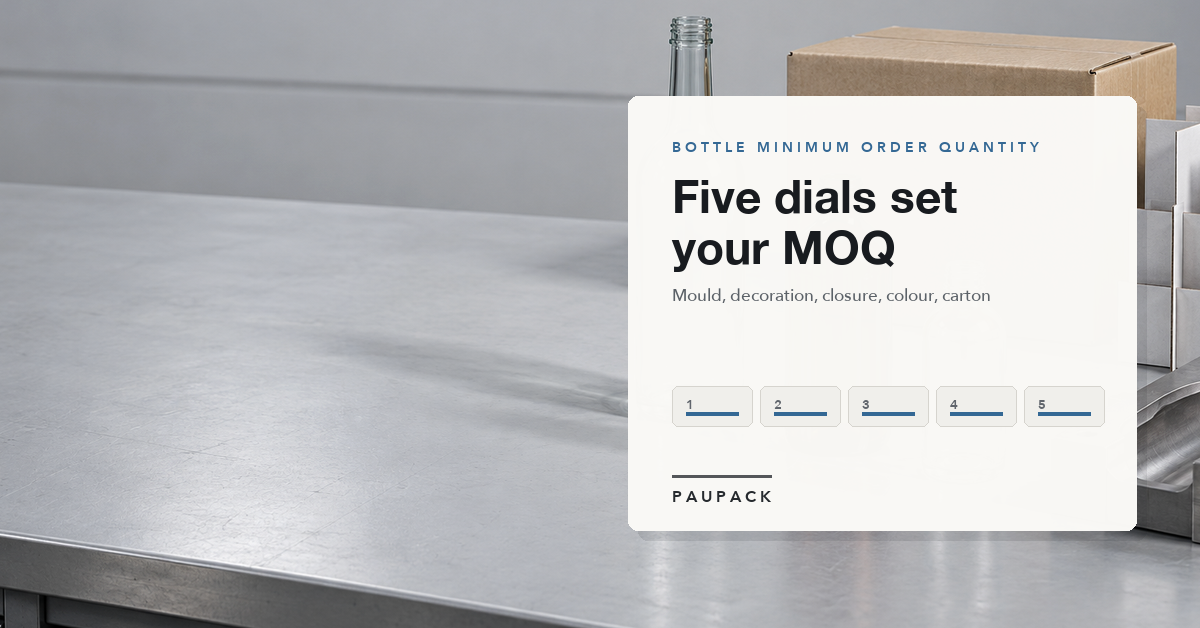
Every bottle MOQ we have quoted reduces to five inputs: the mould, the decoration, the closure, the glass colour and quality grade, and the packaging unit the bottle ships in. Change one and the number moves; change the wrong one and it moves the wrong way.
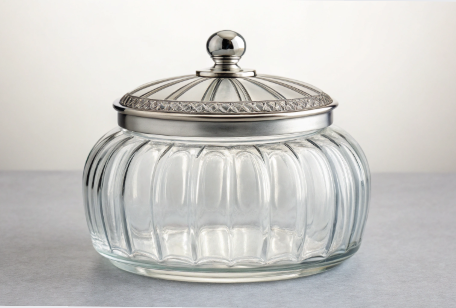
Before any of that, the brief has to be stable. A bottle minimum order quantity quoted against a drawing that then changes is a number that has to be withdrawn, and that conversation costs both sides a week.
Dial One: The Mould
A mould is the heaviest fixed cost in a glass project. If a suitable shape already exists in the supplier's library, the mould dial is effectively at zero and the MOQ is set by the finishing line instead. If the shape is new, the MOQ becomes whatever amortises the tooling over the first run.
The useful question is not "what is your MOQ" but "how many units does this mould need before the tooling stops being a penalty". PauPack quotes the stock route and the custom route with the crossover volume printed between them, so a brand can compare an expensive small run today against a cheaper larger run later. The design service works on that comparison before tooling is committed.
Dial Two: The Decoration
Decoration raises MOQ because it adds passes, and each pass has its own economic minimum. One screen print is a modest addition; spray plus print plus hot stamp plus a sleeve triples the handling and multiplies the smallest sensible run.
Decoration is also the dial that can be split across time. A brand can launch on a stock bottle with one printed band and add a second pass at the second reorder, when volume supports it. PauPack plans decoration in that sequence often enough to know which passes are worth deferring and which ones look unfinished when they arrive late.
Dial Three: The Closure and Fitment
The closure carries its own minimum, and it is quoted on a different line. A pump, a dropper assembly, a fine mist sprayer or a lined metal cap can each have a production minimum that sits above or below the bottle's.
This is where a launch plan breaks most often. A brand budgets for 5,000 bottles, orders them, then discovers the pump it wanted starts at 10,000. PauPack lists both numbers together and marks the higher one as the planning figure, so the purchase order is built on the real constraint rather than the more attractive half of it.
Dial Four: The Colour and Glass Quality Grade
Colour behaves like a mould in miniature. Standard flint, amber and green run continuously and carry the lowest entry point. A tint that has to be melted to order raises the minimum to whatever that melt must justify, and a colour match held to a tight band raises it again.
Quality grade works the same way. A bottle that carries a drug or a food product may need documented wall thickness, a specified liner and a container closure record rather than a visual inspection alone. The USP container closure chapter shows the kind of specification a regulated pack is measured against, and it is the reference our quality team keeps on the table when a pharma brand asks why its entry volume is higher than a cosmetic brand's.
Dial Five: The Packaging Unit the Bottle Ships In
Glass is fragile and heavy, so the shipping unit is part of the MOQ calculation rather than an afterthought. A divider carton, a tray, a wrap and a pallet pattern all have their own minimums at the packaging supplier, and a small run can be blocked by a carton that only becomes economical at a larger quantity.
PauPack quotes the inner packaging on the same sheet as the bottle for this reason. When the carton minimum is the binding constraint, the honest answer is to change the carton rather than to push the brand into a larger glass order it does not need.
A Worked Example: One Bottle, Three Volumes
The table below shows the same 50 ml glass bottle quoted at three volumes through the same route: stock mould, one screen print, stock lined cap. Figures are illustrative rather than a quotation, but the shape of the curve is exactly what brands see.
| Volume | Unit price direction | Setup treatment | What changes |
|---|---|---|---|
| 3,000 units | Highest | Setup visible per unit | Screen and changeover spread over few pieces |
| 10,000 units | Mid | Setup absorbed | Print pass becomes efficient |
| 30,000 units | Lowest | Setup negligible | Glass and print both run at rate |
Notice that the decoration behaves differently from the glass. Glass cost per unit falls gently with volume, while a print pass falls sharply at the point where a screen stops being changed between small lots. That single step is why two quotes for the same bottle can differ at 3,000 units and converge at 30,000.
Where Bottle Minimum Order Quantity Hides in a Quote
When two quotations disagree, the reason is usually in one of five lines. Read them in this order.
| Line | What to check | Why it matters |
|---|---|---|
| Tooling | Charged once or rebuilt per colour | Repeat orders should not repay the same mould |
| Scrap allowance | Stated as a percentage of the run | A blank allowance turns into a short delivery |
| Print passes | Counted per colour and per surface | Pass count drives both cost and lead time |
| Closure MOQ | Quoted by the closure line | The higher of the two numbers is the plan |
| Delivery term | Said plainly, with freight included or excluded | Freight can outweigh a unit price difference |
A quotation that leaves the scrap allowance vague is the one that arrives short, and a short delivery on a fixed launch date is more expensive than the difference the buyer was negotiating over.
Why a Lower MOQ Can Cost More
Buying under the economic minimum is possible, and it is priced accordingly. The supplier spreads the same setup across fewer pieces, so the unit price rises even though the invoice total falls. That is a rational trade for a test launch and a poor trade for a core line.
The test is simple. Multiply the unit price difference by the annual volume and compare it with the cash saved by ordering less today. If the annual figure is larger, the small order was a loan with an expensive interest rate.
Stock or Custom: The Crossover Volume
Brands usually have two viable routes, and the decision is arithmetic rather than taste. Both are legitimate; they simply carry different versions of bottle minimum order quantity.
A stock bottle lowers the entry point, lets a launch happen quickly, and can still look distinct once decoration is applied. A custom mould costs more up front, gives the shape exclusivity, and becomes the cheaper route per unit once volume is high enough to carry the tooling. PauPack publishes the crossover volume with the quotation so the choice can be made on numbers, and the glass bottle MOQ breakdown works through a live example.

Reducing the Number Without Damaging the Pack
Four levers lower a bottle minimum order quantity honestly. Move the shape to an existing mould. Reduce the print passes to the one that carries the brand mark. Share a colour that is already scheduled rather than specifying a bespoke tint. And let the brand apply its own label instead of asking the supplier to print one.
Each of those changes the pack in a visible way, so the brand should decide which trade it is willing to make. What none of them does is remove the fixed cost, because the fixed cost is real; the levers only move it somewhere else. The small batch production notes cover the sequence we recommend when a launch has to start small.
What to Put in the First Purchase Order
Once the volume is agreed, the order should carry the specification that the price assumed: the bottle drawing revision, the glass colour reference, the decoration pass list, the closure part number, the scrap allowance and the delivery term.
Two further lines save arguments later. One names the person who signs a decoration or glass deviation, and one records how the golden sample is held. A first order that arrives with a photograph, a drawing and a signed sample attached is a first order that can be repeated without a conversation about what the two sides remember.
Quality documents belong in the same folder. The quality management record travels with the project, which is what makes the second order behave like the first rather than like a fresh quotation.
What PauPack Needs Before It Quotes an MOQ
Send five things: the bottle shape or drawing, the fill volume, the annual volume, the decoration direction and the market the product enters. PauPack returns the stock route, the custom route, the MOQ behind each, the closure minimum beside it and the crossover volume between them.
The bottle manufacturing page explains how the two routes are run in our own lines, and the bottle prototype sample walkthrough shows what is approved before any mould is cut. When the pack touches food, the FDA food ingredients and packaging pages explain what contact material questions are asked in the United States, and the food contact substances section covers the notification route when a new material is involved.
Send the five points through the inquiry form and PauPack will answer with the drivers rather than a single figure, so the next conversation can be about which dial to turn.
Bottle Minimum Order Quantity: The Questions That Come Up First
Why is bottle minimum order quantity different for every supplier?
Because the number is not a policy, it is a calculation. It reflects the smallest run a mould, a print pass or a glass furnace can accept without losing money. PauPack quotes the driver behind the number so a brand can see which one to change.
Can bottle minimum order quantity be lowered without paying more?
Sometimes. Moving from a custom mould to a stock mould, dropping one print pass, or sharing a colour with a run already scheduled can all lower it at no cost. Asking for a smaller run on a fully custom decorated bottle almost always raises the unit price instead.
Does the closure have a separate minimum order quantity?
Usually yes. A bottle can start at one volume while the pump, dropper or cap inside it starts at another, and the two are quoted by different lines. PauPack always lists the closure MOQ next to the bottle MOQ so the planning number is the larger of the two.
How is bottle minimum order quantity affected by glass colour?
A standard flint, amber or green glass runs continuously, so it carries the lowest entry point. A custom tint has to be melted against a specific batch, and the minimum rises to whatever that melt has to justify. Bespoke colour is the quiet cost driver in most quotations.
Is there a minimum for samples?
Sampling and production are separate. Samples are usually quoted in single units from an existing mould, while production MOQ applies once a purchase order is placed. PauPack keeps the sample list and the production quotation on the same sheet so the two numbers are not confused.
What happens if I order below the stated MOQ?
The supplier either refuses, or accepts at a higher unit cost that covers the same setup. Both are honest answers. What is not honest is an MOQ that quietly disappears at quotation and reappears as a line item called setup once the order is placed.
How long does a first order take at MOQ?
Allow the decoration and mould lead time plus the production window. A stock bottle with one print pass moves quickly, while a new mould adds tooling weeks before any glass is run. PauPack quotes the calendar alongside the price so a launch date can be tested.
Do decoration and labelling change the MOQ?
Decoration adds a pass, and a pass has its own minimum. A label applied by the brand carries no supplier minimum at all, which is why a low-volume launch often ships blank glass and labels it in-house. The accessories supply option covers closures only and leaves the label to the brand.
Can several bottle sizes share one MOQ?
They can share one mould family, which is the practical route. Bodies of the same neck finish with different heights often come from shared tooling, so a brand can launch two sizes and put the volume behind the one that sells.
What should be in writing before I confirm an MOQ?
The unit price at that volume, the setup or tooling charge, the scrap allowance, the decoration pass count, the closure MOQ and the delivery term. Six lines, agreed in writing, remove almost every disagreement that follows.