

Cobalt blue glass UV protection gets repeated in every pitch deck, and measured in almost none of them.
Brands move from clear to blue for the same reason each time. The oil is expensive, the shelf is bright, and blue looks like a decision. Sometimes it is one.
PauPack moulds and decorates dropper bottles for aromatherapy and wellness brands across Europe and North America, and the question lands in nearly every project. Does the colour protect the oil? Or does it just protect the mood board?
The answer is a curve. Not a claim. Here is the curve we work from, the numbers under it, and the test that settles it for your oil instead of someone else's.
Why Colour Is Not Protection
Glass colour works by eating part of the spectrum as light passes through. The colorant does not read your label.
Cobalt oxide hits hard in the violet and near-UV. Amber, built on iron and sulphur, absorbs across a wider band on the same side. Flint mostly stays out of the way.
So the useful question is not blue or amber. It is: what damages your product, what does each glass remove, and how much of the rest reaches the oil on a shelf lit for twelve hours? That is the question PauPack builds a sample review around.
Same colour, different wall thickness, different answer. Light protection is a path-length problem before it is a colour problem.
What Light Actually Does Inside the Bottle
Oils degrade by oxidation, and light is the match, not the fuel. Photons kick off free-radical chains. Oxygen finishes them.
The symptoms arrive in order. Paler liquid, or darker. Flatter top note. Then a sour or waxy edge that a customer notices long before a lab does.
And it is not only ultraviolet. Plenty of citrus and floral damage is driven by blue and violet light around 400 to 450 nm, which happens to be the band cobalt blue passes most freely. One glass can be a strong UV filter and a mediocre visible-light filter at the same time. Worth sitting with that for a second.
Heat does the same work twice as fast. A bottle at 30 C on a sunny shelf goes off before the same bottle at 18 C in a drawer, and no colour of glass changes that.
So cobalt blue glass UV protection earns its keep here. It also overreaches here.
The Transmission Numbers: Clear, Amber, Cobalt
Working figures from 2 mm wall sections of production glass. A comparison, not a specification. These are the numbers PauPack measures with, and you should still re-measure on your own mould before writing anything into a claim.
| Wavelength band | Clear flint | Amber | Cobalt blue | What it damages |
|---|---|---|---|---|
| 290 to 320 nm | Blocked | Blocked | Blocked | Nothing, all three are safe |
| 320 to 350 nm | 60 to 80% | 6 to 12% | 10 to 20% | Base oils, carrier blends |
| 350 to 400 nm | 88 to 92% | 35 to 50% | 45 to 60% | Citrus and floral top notes |
| 400 to 500 nm | 91 to 93% | 78 to 86% | 70 to 82% | The main driver of colour loss |
| 500 to 700 nm | 92% | 85 to 90% | 82 to 88% | Heat load inside the bottle |
Amber does more work in the violet. Cobalt blue is a real filter rather than a placebo, and it is slightly ahead near 350 nm, where a lot of formulations take their worst hit. Neither one is a wall.
Read the same table the other way and cobalt blue glass UV protection looks smaller. At 350 to 400 nm, 45 to 60 percent of the light still walks in. A claim written as though the oil sits in darkness will not survive a buyer's question.
Where Blue Wins, Where It Loses
Cobalt blue glass UV protection pays off under bright retail lighting when the liquid should stay visible through the wall. It also suits pale oils, where blue reads clean instead of warning. That is most of the aromatherapy shelf.
It loses when the oil is genuinely light-sensitive and sits in direct sun for months, because amber removes more of the 400 nm region. It loses again when natural colour is part of the story, since a blue wall re-tints a golden oil, a green extract or a milky serum.
Sell in a carton, reach the customer in a drawer, and the whole argument becomes decorative. Say that in the specification. It saves money on the next order.
Where Else Blue Lands in a Range
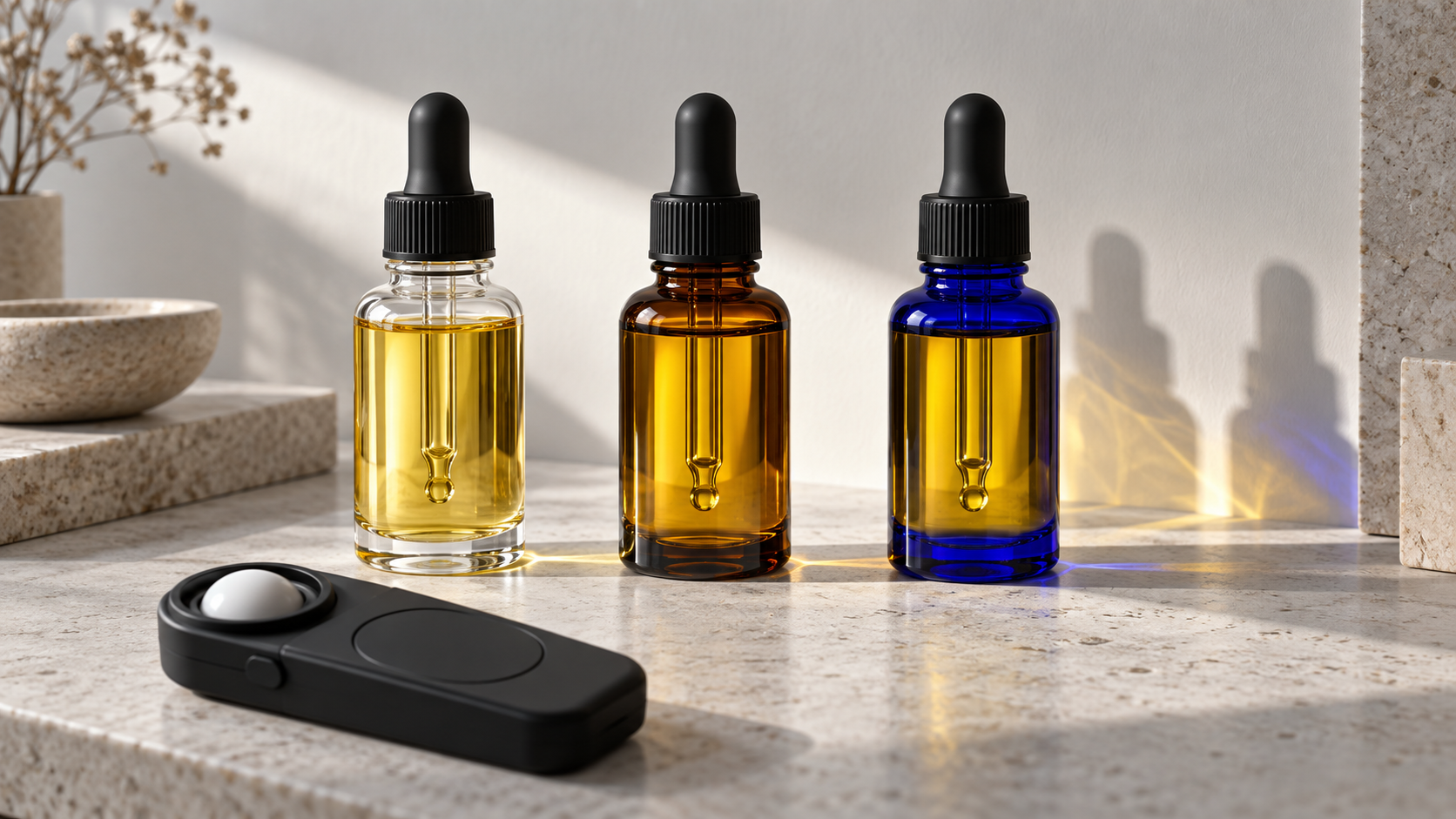
Colour decisions are never made once. Pick cobalt for the 30 ml dropper and the 10 ml trial size wants the same face. So does the roll-on and the gift set. Each format behaves differently, because the wall and the surface area both change.
Small bottles protect less per unit of oil. Thinner glass, bigger headspace proportion. A range built on one colour needs cobalt blue glass UV protection measured at both ends of the size run, not in the middle.
PauPack keeps one transmission record per mould rather than one per colour. That turns the second and third format into a check instead of a project.
What You Can and Cannot Say
"UV protected" reads as a performance promise, and performance promises need a method. A claim that holds up names the wavelength range, the wall thickness and the test behind the numbers.
Colour alone is the claim that cracks. Another supplier measures a different mould, gets a different curve, and the sentence on your carton is suddenly arguable. Put the curve in the specification, keep the retention sample, and the claim survives a change of factory.
Cobalt Blue Glass UV Protection and Wall Thickness
Longer path, less transmission. The effect is not marginal. Take a cobalt wall from 1.2 mm to 2.4 mm and the protected band widens measurably. A 5 ml sample and a 50 ml bottle in the same colour are not the same product.
PauPack records wall thickness band by band on the mould drawing and checks it on the first shot, not the tenth. A parison that runs thin in the shoulder protects unevenly down the body. When a brand asks for cobalt blue glass UV protection on a small bottle, the honest answer usually includes a heavier wall and a slightly higher unit price, and both get quoted so the choice is visible.
The Light Test You Can Run Yourself
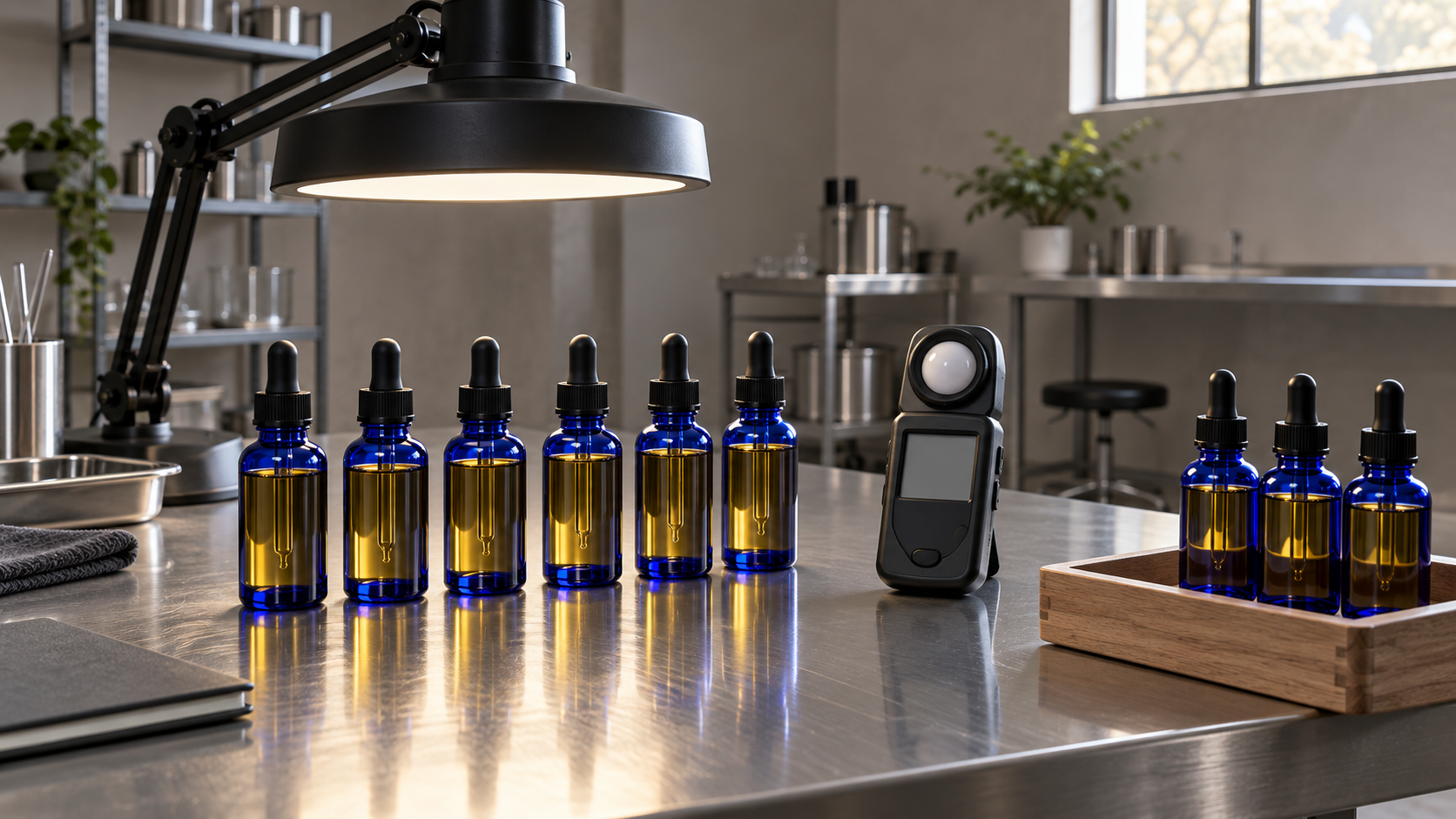
No laboratory needed. A lamp with a known output, a calibrated meter, and three fills of the same oil.
- Fill one clear, one amber and one cobalt bottle from the same batch, to the same level, with the production closure.
- Sweep transmission from 290 to 700 nm in 10 nm steps on a wall section of each colour at production thickness.
- Stand all three under the same lamp at 40 cm. Keep a fourth bottle in the dark as the control.
- Hold for 21 days at 22 C. Photograph the four side by side every seven days under identical lighting.
- Weigh weekly, so evaporation and oxidation are separated instead of blended into one complaint.
- Write colour, thickness, closure and lamp spectrum into the specification. Keep the bottles as the retention sample.
PauPack runs this with the brand's own oil. Two citrus oils at the same viscosity can disagree about light by a wide margin, and only the real product shows which side of the curve you are on.
Decoration and the Real Claim
Most bottles that look opaque are not coloured through the melt. They are clear glass with a lacquer, a soft-touch coat or a sleeve. That changes the light story completely.
A dense lacquer can beat cobalt blue glass UV protection at 350 nm and still fail in service if it chips at the shoulder. Sleeves cover the body and leave the neck naked. Screen print adds almost nothing. Ask what the decoration does to transmission, then test it after abrasion rather than on day one. Our review of glass bottle decoration methods covers where each finish earns its cost.
Storage Beats Glass Every Time
No bottle wins against a hot, bright room, and no amount of cobalt blue glass UV protection compensates for one. PauPack keeps retained samples at 22 C in a closed cupboard, and they still look like the reference batch a year later. The same oil on a south-facing shelf turns in a season.
Three habits. Keep the fill level high so the headspace is small. Keep the closure qualified for the oil. Keep storage under 25 C. Where a retailer insists on window display, rotate the unit on a schedule. That is what we recommend to brands selling through pharmacy and spa accounts.
Bottle, closure and fill level get planned together here, the same logic behind our leakage and closure testing and the storage checks in glass bottle quality standards.
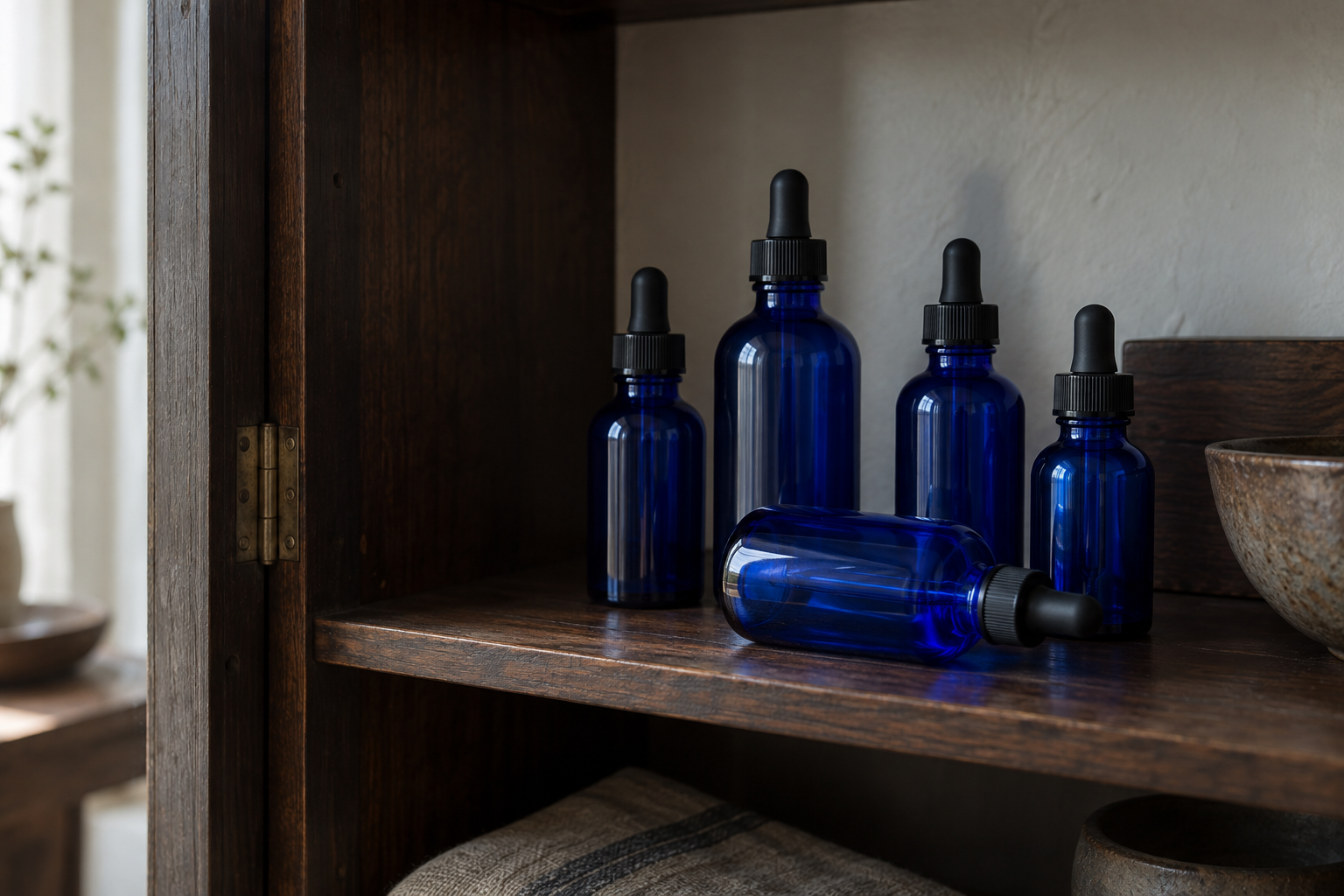
The Sample Review Sheet
One sheet per colour, so the comparison is a document instead of a memory. This is the sheet PauPack files whenever a colour changes.
| What you record | Why it decides the colour | Typical finding |
|---|---|---|
| Transmission curve, 290 to 700 nm | Shows which bands each glass removes | Blue is ahead near 350 nm, behind amber near 420 nm |
| Wall thickness at body and shoulder | Sets the light path through the glass | Shoulder runs 15 to 20% thinner than the body |
| Oil colour at 0, 30 and 90 days | Visible loss appears before the nose notices | Clear fades first, amber holds longest |
| Weekly weight change | Separates evaporation from oxidation | Liner choice moves this more than colour |
| Storage temperature log | Heat multiplies every light effect | Above 28 C the colour comparison narrows |
What PauPack Prepares Before a Cobalt Blue Run
A coloured dropper bottle is a mould, a finish, a decoration and a closure that have to agree. PauPack prepares essential oil bottles wholesale in the colour, wall and neck the brand's pump or dropper needs, and supplies reference bottles from the same mould so the light result can be repeated later.
Most brands look at amber glass dropper bottles and 10 ml essential oil bottles first, because those two decisions settle the range. If the closure is still open, the comparison in our closure and leakage notes closes it fastest.
Need a specific colour before a mould exists? That is a colour-matched melt on an existing mould, and the run size is set by glass bottle MOQ rather than by the palette. PauPack quotes both routes so the trade-off shows up before the artwork is finished.
One last thing if the bottle ships into the United States with a consumer use case. Check the packaging rules before the artwork is signed. The CPSC voluntary standards pages are a sensible start, and that question is far cheaper at sample stage than after tooling is cut.
Cobalt Blue Glass UV Protection: The Questions Brands Ask
Does cobalt blue glass actually block UV light?
Some of it, yes. Below 350 nm it is doing real work, and it edges out amber right about there. Above 400 nm it stops being a filter and starts being a colour. If your oil is damaged by visible light, blue will not save it.
Is amber or cobalt blue better for essential oils?
Different jobs. Amber soaks up more of the violet and blue end, which is where a lot of oxidation starts. Blue reads cooler on a shelf and looks cleaner over a pale oil. Pick the one that matches the failure you are actually trying to prevent.
How much light does a clear glass dropper bottle let through?
Most of it. Flint at 2 mm gives you well over 80 percent from 350 nm upward, and the UV cut-off sits near 320 nm. Fine inside a carton. Not fine on a lit shelf for six months.
Does the thickness of the bottle wall change UV protection?
More than people expect. A 30 ml bottle with a 2.4 mm wall blocks measurably more than a 10 ml with 1.2 mm, same colour, same melt. So compare colours on the real mould. A swatch tells you almost nothing.
Can a coating give clear glass the same protection as cobalt blue?
Often yes, and it is usually cheaper than colouring the melt. The catch is what happens in month three. Coatings chip at the shoulder and scuff in a carton, so test after abrasion, not on the day the sample arrives.
Why did my blue bottles fade after a month in the window?
The glass did not fade. The oil did. Oxidation and natural colour loss show up first as a paler liquid or a darker one, and the bottle takes the blame. Photograph a retained sample next to the shelf unit at day 0, 30 and 90. Memory is not a measurement.
What wavelength should a light test cover?
Sweep 290 to 700 nm in 10 nm steps and report the curve. A single number taken at 254 nm describes a germicidal lamp, not a shop window. Most of the damage you care about lives between 350 and 450 nm.
Do cobalt blue bottles cost more than amber?
Usually. Cobalt oxide costs more than the iron and sulphur that make amber, and blue cullet is harder to source in a closed loop. On a 30 ml bottle the difference is pennies. On the shelf it is a design decision, not an engineering one.
Should the closure be tested as well as the glass?
Always. Light protection means nothing if the pack is quietly losing weight every week, and that is what our essential oil bottle leakage test is for. The USP packaging and storage requirements treat container and closure as one qualified system, and they are right to.
What belongs on a cobalt blue glass UV protection record?
Colour, wall thickness, the transmission curve, closure type and liner, fill weight, storage temperature, and photos of the retention sample at 0, 30 and 90 days. Eight lines. PauPack files that sheet with the mould drawing, so a reorder starts from evidence instead of folklore.