

PLA bottle compostability is the most over-promised phrase in sustainable packaging, and the material is only half of the sentence.
Polylactic acid really does break down. In a specific place, at a specific temperature, for a specific number of weeks. That place is almost never somebody's garden.
PauPack moulds PLA and blended resin bottles for brands across Europe and North America, and the projects that go wrong are rarely about the resin. They go wrong because the pack was designed for a disposal route the market does not have.
Here is what the standard actually requires, where polylactic acid is genuinely strong, where it quietly fails, and how to write a claim that still holds two years later.
What PLA Bottle Compostability Actually Means
Compostable is a performance word, not a material word. A pack earns it by meeting a defined standard in a defined environment: EN 13432 in Europe, ASTM D6400 in the United States.
Both standards ask for the same three things. Disintegration into fragments inside twelve weeks. Biodegradation of at least 90 percent inside six months. And a finished compost that passes an ecotoxicity test.
Notice what is missing from that list. Anything about a heap at the end of a garden.
So when a brand asks whether a PLA bottle is compostable, the first honest question back is: collected where? Everything else follows from that answer, and nothing else does.
Why Polylactic Acid Needs Heat
Polylactic acid hydrolyses first, then gets consumed by microorganisms. Both steps want water and warmth, and the rate climbs steeply with temperature. At 58 C, where industrial windrows run, a thin wall is gone in weeks. At 20 C, the same chemistry crawls.
That is design intent, not a defect. A bottle that dissolved on a shelf would be useless, so the material was engineered to hold until conditions change. The problem is that conditions rarely change in a kitchen bin.
Which is why PauPack tests at the real wall thickness of the mould rather than on laboratory film. A 1 mm bottle in a compost trial and a 0.1 mm film in a resin brochure are not describing the same object, even when the resin is identical.
The Four Streams a PLA Bottle Actually Meets
Nearly every sustainability argument collapses into this table. Strip the marketing away and ask which stream the pack will enter.
| Disposal stream | What happens to PLA | Typical outcome | Defensible on a label? |
|---|---|---|---|
| Industrial composting | Breaks down in 8 to 12 weeks at 58 C | Clean result, where a facility accepts the pack | Yes, with the standard named |
| Home composting | Barely moves at 20 to 30 C | Intact, cloudy, still a bottle after a year | No |
| Soil and marine litter | Behaves much like conventional plastic | No measurable benefit in a year | No |
| Mechanical recycling | Contaminates the PET stream | Bale value drops, sorters complain | No, and keep it out of the bin |
One row in four is a strong result for a bio-based material. The mistake is letting the other three inherit the credit.
The Conditions Behind the Word
Certification bodies do not certify a resin in the abstract. They certify a finished article, at a stated thickness, against a stated standard. Change the mould and the certificate is void. That one sentence decides most PLA bottle compostability arguments.
Same resin, different fate. It can be certified in a 250 ml thin-wall cup and fail in a 500 ml bottle with a heavy shoulder, because thickness drives the timeline and the timeline is what the standard measures.
When PauPack quotes a PLA project, the disposal route comes first and the wall second. Reverse that order and the sample usually comes back wearing a logo the brand cannot legally print.
The Timeline Test Behind a Claim
The test is a schedule, not a verdict. A laboratory holds the article at a set temperature, measures how much survives, then checks what the residue does to a plant. Four checkpoints matter.
| Checkpoint | Condition | Pass mark | Where PLA struggles |
|---|---|---|---|
| Disintegration | 58 C, controlled humidity | Fragments under 2 mm in 12 weeks | Walls above 1.5 mm |
| Biodegradation | Same conditions, 180 days | 90% of carbon converted | Heavy fillers and mineral colourants |
| Ecotoxicity | Finished compost, plant growth | No growth inhibition | Inks and adhesives travelling with the pack |
| Heavy metals | Digestate analysis | Below the listed limits | Cheap pigments |
Look at the third row again. A pack can pass degradation and still lose the claim because of a label adhesive. A PLA bottle compostability review catches that at sample stage, which is a much cheaper place to catch it than a laboratory invoice.
Where Polylactic Acid Wins
PLA is at its best on short-life, room-temperature, dry or mildly aqueous products. Dry supplements. Single-dose refills. Travel sizes. Secondary parts like caps, collars and shaker inserts.
It is also the right answer when the brand controls the disposal route. A refill scheme with a return bin, or a venue with industrial composting on site, turns an abstract claim into working infrastructure. That is where PLA bottle compostability stops being a story.
Weight counts too. A PLA bottle ships lighter than glass and prints a lower transport figure in a sustainability report, which is often the number a brand gets judged on by its own customers. In a return loop, PLA bottle compostability becomes a working cycle instead of a one-way promise.
Where It Fails, and What to Use Instead
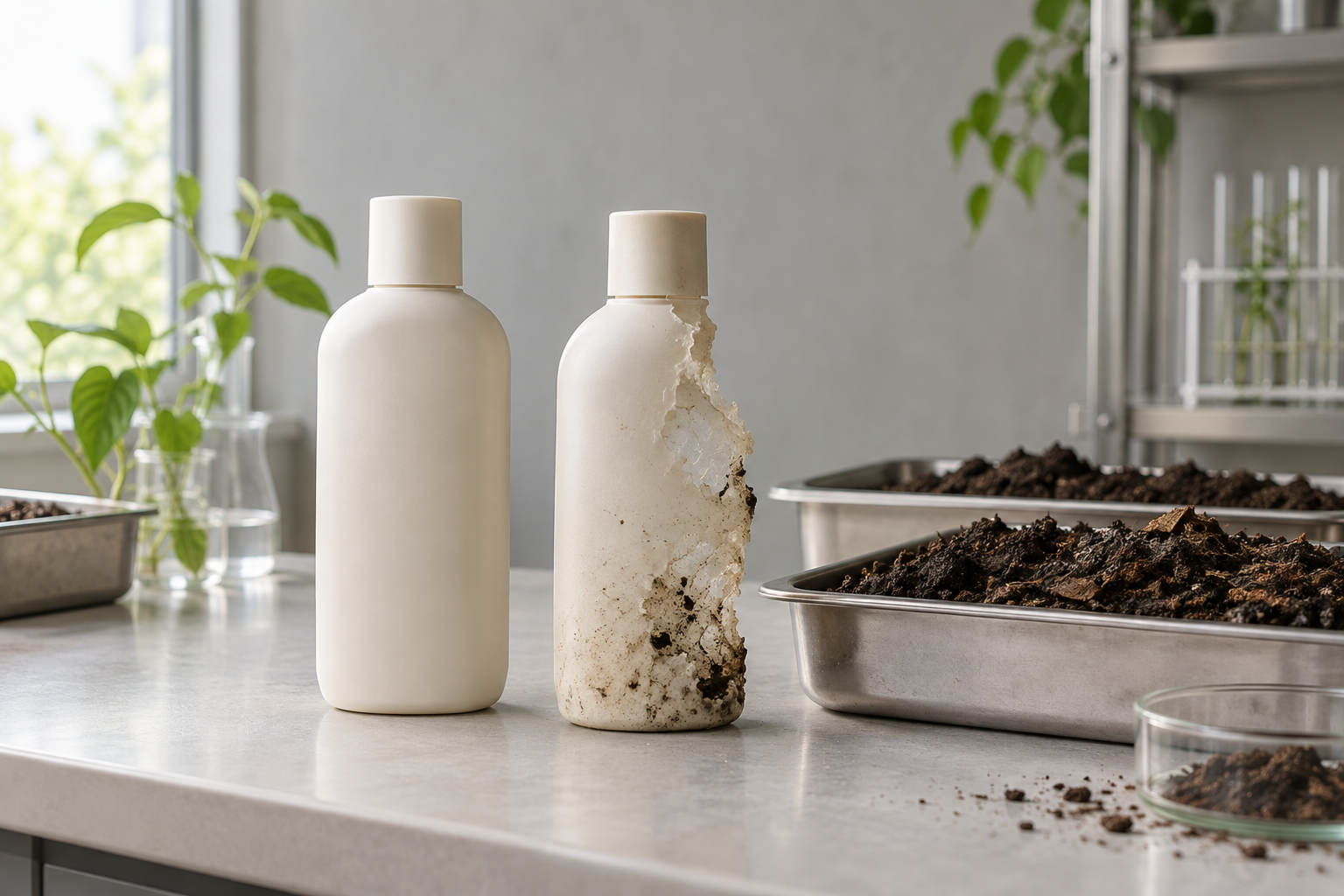
Three failures repeat often enough to plan around, and each one is a limit on PLA bottle compostability rather than on the resin. Hot filling deforms the wall. A summer container softens the base under stack load. And a recycling-minded market drops the bottle in the wrong bin, because it looks exactly like PET.
Where those risks matter, the alternatives usually win on the same brief. PCR resin keeps a recycled-content claim without a composting requirement. Glass carries an open-loop story with no temperature ceiling at all.
PauPack moulds PCR bottles on the same platforms as polylactic acid, so swapping one for the other is a mould decision rather than a redesign. The wider comparison sits in sustainable glass packaging and in our notes on glass versus plastic.
Certification Marks and Their Fine Print
A certification mark is a promise about conditions, and it should only be printed with the condition attached. "Compostable in industrial facilities" survives scrutiny. "Compostable" on its own is the wording that draws complaints.
Keep the certificate with the mould number, the wall thickness and the test report. When a buyer asks in year three, the answer should take minutes rather than a new trial.
PauPack files that paperwork with the production record and passes a copy with the first shipment, which is worth more than a logo the day a retailer's compliance team asks a direct question.
Shelf Life, Heat and Product Compatibility
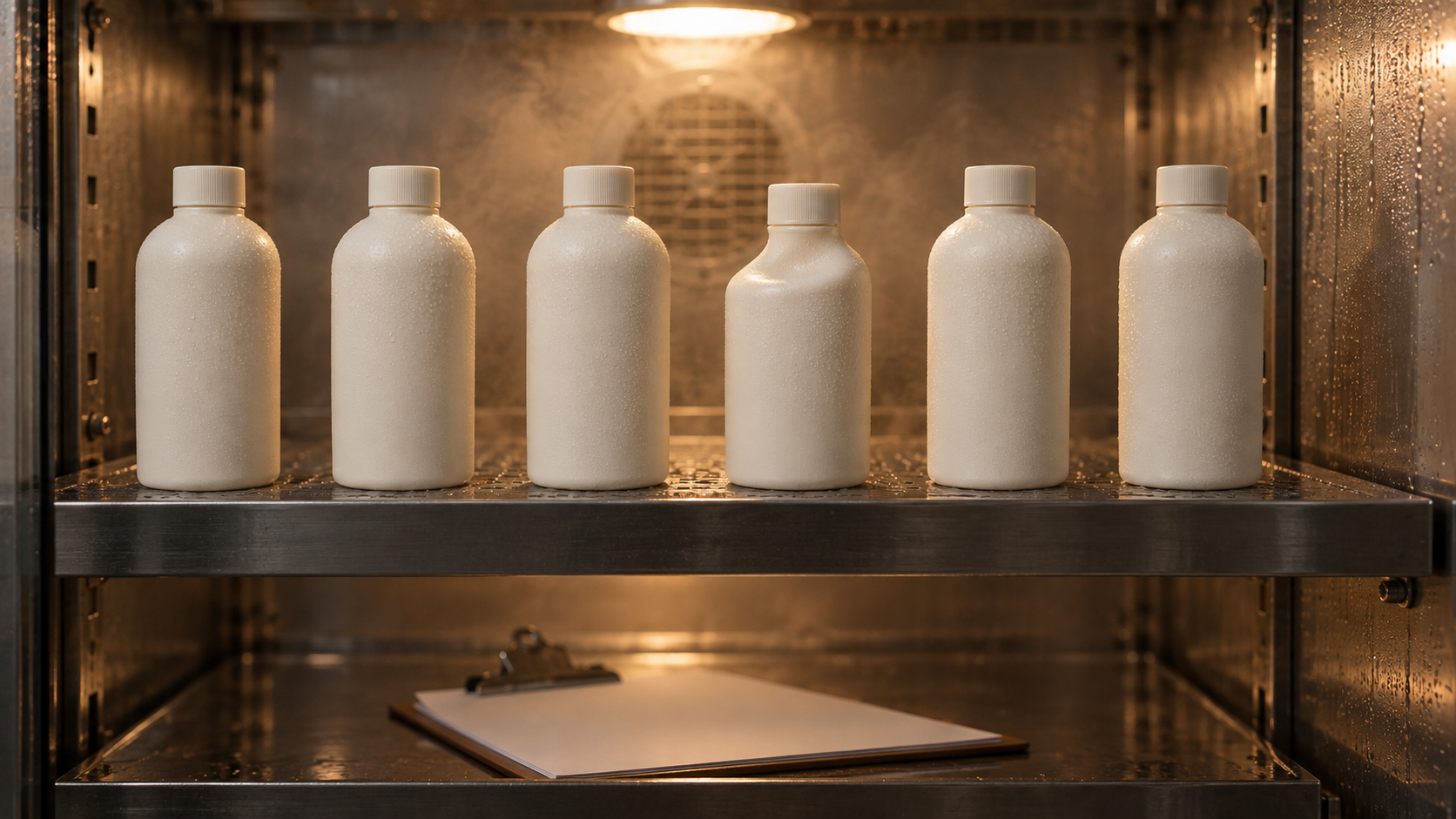
Polylactic acid is comfortable in a shop and fragile in a hot container. Glass transition sits near 60 C, and useful stiffness drops well before that. A pallet left on tarmac in August is a realistic failure case, and a poor place to learn the limits of PLA bottle compostability.
Moisture is the second variable. A water-based formula held for months against a polylactic wall can begin the same hydrolysis composting relies on, which shows up as a soft shoulder or haze at the fill line. Barrier coatings and liners help, and they usually mean the article is no longer certified as compostable.
Set the storage limit at 40 C. Keep the fill level away from the shoulder. Test one carton in a warm room for two weeks before the first container ships. PauPack runs that check on the brand's own formula rather than on water.
Design Choices That Change the Outcome
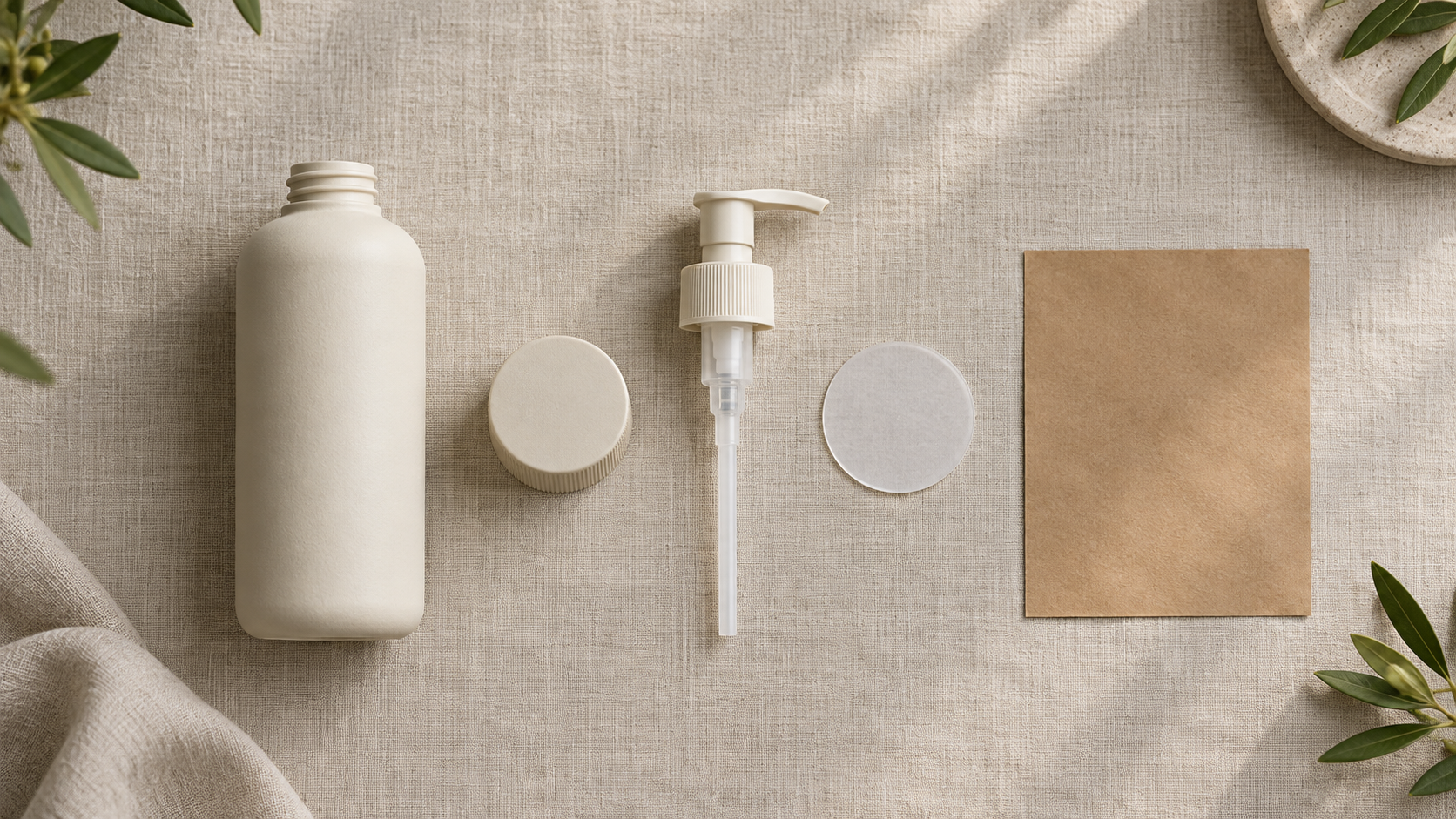
Small decisions move the result as much as the resin does. Wall thickness sets the timeline that governs PLA bottle compostability. Colourants and fillers can slow biodegradation or break certification. Labels and adhesives have to break down in the same facility, which rules out a laminated film and points at paper with a compostable adhesive.
The closure is usually the weak point. A polylactic cap can be certified while the liner is not, and a decorated pump almost never is. If the claim matters, keep the number of materials in the pack small and name every one of them.
PauPack designs PLA packs against the disposal route the brand has actually secured, which is why the quotation starts with a question about collection rather than a question about colour.
How to Talk About PLA on a Label
Write what is true, then write the condition. The strongest wording on PLA bottle compostability names the standard, the facility type and the thickness, and it is shorter than most brands expect: "Certified industrially compostable to EN 13432 at 1 mm wall."
Pair the claim with a disposal instruction. A claim without an instruction leaves the customer guessing, and guessing usually means the bin. Where a market has no industrial composting collection, saying so beats implying a service that does not exist.
PauPack reviews that wording during sampling, so the artwork and the test report agree before the first print run rather than after a retailer query lands.
What PauPack Prepares Before a PLA Run
Polylactic acid behaves differently from PET on the same machine. It runs cooler, dries more carefully, and gets quoted with a tighter wall tolerance, because the wall is now a performance variable as well as a structural one.
PauPack prepares PLA bottles and the matching closures on the mould the brand will run, and supplies samples with the certification copy attached. Brands building a wider sustainable range usually pair this with eco friendly packaging manufacturing and the quality checks in glass bottle quality standards, which apply unchanged to resin packs.
If the range also ships into the United States as a consumer product, the environmental wording belongs on the same review list as the safety wording. The CPSC statutes pages are a useful starting point, and it is a cheap question at sample stage.
PLA Bottle Compostability: The Questions Brands Ask
Is a PLA bottle compostable at home?
Practically never. A garden heap rarely holds 58 C for weeks, and polylactic acid needs sustained heat, moisture and microbial activity. Drop one in and you will find it a year later, cloudy and stiff, essentially unchanged. That is not failure. It is the material doing what it was designed to do.
How long does PLA take in industrial composting?
Eight to twelve weeks at 58 C for a 1 mm wall, under EN 13432 conditions. Thicker sections take longer. And the test is run on the finished bottle, not the resin pellet, which is the detail most data sheets leave out.
Does PLA break down in the ocean?
Not on any useful timescale. Marine studies put polylactic acid close to conventional plastic below 30 C, with minimal mass loss over a year of immersion. A bottle sold as ocean friendly on the strength of its resin is promising something the material cannot deliver.
Can PLA bottles go in the recycling bin?
No. Polylactic acid contaminates the PET stream, because the two look alike and separate badly. A few percent can spoil a bale. Until a dedicated stream exists, the honest instruction on the pack is industrial compost or general waste.
Why do so many PLA bottles carry a compostability logo?
The logo points at a certification scheme, not at your customer's kitchen. Marks like the seedling logo are granted against a standard with defined temperature and duration, and the fine print says industrial. PauPack prints the mark only when the brand can print the condition next to it.
Does PLA hold up on a shelf?
For most room-temperature products, yes. Glass transition sits near 60 C, so a shop at 22 C is comfortable and anything above 50 C starts to soften the wall. A pallet in a summer container is the case that catches people out.
What is the heat limit for a PLA bottle?
Keep the filled pack under 40 C in storage and transport, and below 50 C anywhere in the chain. Past that the wall deforms under its own stack load. Hot filling, or distribution through a hot climate, points you at glass or PCR instead.
Is PLA better for the environment than glass?
Depends what you count. Glass recycles endlessly and weighs a lot to ship. Polylactic acid is lighter and plant-based, and it only closes the loop in a facility that accepts it. Our side-by-side in glass versus plastic packaging lays the trade-off out properly.
What should a compostability claim include?
The standard tested, the thickness tested, the temperature and duration, the certifying body, and a disposal instruction. The CPSC statutes pages show how closely US regulators read environmental wording, and the USP packaging and storage requirements apply the same discipline to container qualification.
Can PauPack supply both PLA and PCR for one range?
Yes, and plenty of brands do. Polylactic acid for the refill or the single-use trial size, PCR or glass for the hero bottle. PauPack quotes both on the same mould, so the decision rests on the distribution plan instead of a supplier's preference.