

Perfume bottle evaporation loss is the quiet failure that reaches a customer as a half-empty bottle and a complaint about value, three months after everyone signed off the sample.
Nothing looks wrong at the launch. The crimp sits square, the collar is straight, and the carton is dry. Then the bottle loses a fraction of a gram a week through a path nobody can see.
PauPack supplies fragrance bottles and closures to brands across Europe, North America and the Middle East, and this measurement is always the one that separates a sample that photographs well from a pack that survives a container.
What follows is the weigh-loss protocol we use, the numbers behind it, and the closure decisions that move them.
What Perfume Bottle Evaporation Loss Actually Measures
The test measures mass leaving a sealed pack over time. It does not care whether the vapour crosses a liner, a crimp skirt or a pump body, and it does not distinguish between alcohol, water and the aromatic fraction. That is why a perfume bottle evaporation loss figure is a property of the pack rather than of the juice.
That is a strength rather than a limitation. A customer judges the bottle by weight and by nose, so a single number that captures both is the one worth controlling.
PauPack treats perfume bottle evaporation loss as a closure metric rather than a formulation metric, because the same juice in a better seal reads differently, while the same closure on a thinner liner does not.
Why the Closure Decides the Number
A fragrance pack has three possible vapour paths: through the liner, around the crimp, and through the pump body itself. The last one is small but real, because most pump stems carry a vapour-sealing ring that is designed to slow loss rather than stop it.
That leaves the neck interface as the deciding surface. On a crimped pack, the seal is a metal skirt compressed onto glass, and its quality depends on neck tolerance, glaze and crimp depth. On a screw pack, the seal is a liner compressed by torque, and it depends on liner material and how well the torque survived a week on a pallet.
This is why a pump that tests perfectly on a reference bottle can fail on a production mould. The closure did not change. The neck did, and perfume bottle evaporation loss moved with it.
Screw Neck or Crimp: Choosing for the Number
Crimped packs win on loss and lose on flexibility. A crimp is permanent, so a refillable or travel-friendly design usually means a screw neck and a liner, which trades a predictable 0.1 percent loss for a number that depends on torque retention.
Where the brand needs both, the common answer is a crimped hero bottle and a screw-neck travel spray, with the travel format held to a looser loss target because its life in a bag is measured in weeks rather than years.
PauPack quotes both routes on the same mould so the trade-off is visible, and records the expected perfume bottle evaporation loss for each route on the specification sheet.
Travel Sprays and Sample Vials: The Hardest Formats
Small formats lose proportionally more, because the surface area around the neck stays roughly the same while the fill weight falls. A 5 ml vial with a screw cap can lose 0.5 percent a month and still be a sound product, as long as nobody compares its perfume bottle evaporation loss with the 100 ml bottle beside it on the same chart.
Sample vials add a second problem: they are handled, opened and re-closed. Every opening exchanges saturated vapour for dry air, so a travel format should be assessed with an opening cycle in the test rather than with the pack left sealed.
PauPack runs the secondary panel with openings at day 7 and day 21 when the format is a sample or a travel spray, and reports both the sealed and the handled perfume bottle evaporation loss figures.
The Baseline: What a Sound Perfume Pack Loses
These figures come from 50 ml packs filled to the working level and held at 22 C and 50 percent relative humidity. They are means from comparative trials, so use them as a starting point and re-measure your own combination.
| Closure type | Monthly loss | Typical cause of variation | Notes |
|---|---|---|---|
| Crimped pump, flame-glazed neck | 0.05 to 0.15% | Crimp depth, neck ovality | The reference for a premium pack |
| Crimped pump, plain neck | 0.12 to 0.25% | Glaze and mould seam quality | Improves sharply with a glaze step |
| Screw neck with PE liner | 0.20 to 0.40% | Torque retention, liner hardness | Re-measure torque at 24 hours |
| Screw neck with thin foam liner | 0.35 to 0.60% | Liner compression set | Common on travel sprays |
| Roll-on with ball and cup | 0.30 to 0.55% | Cup fit, ball seat | Oil-based formulas lose less |
Two columns matter more than the numbers. The spread inside a single row is usually wider than the gap between rows, and the cause is almost always a dimensional detail that was never held on the drawing.
Setting Up a Weigh-Loss Test
The protocol is deliberately simple, and that is the point. Anyone on a quality team can run it without new equipment beyond a good balance and a controlled cabinet.
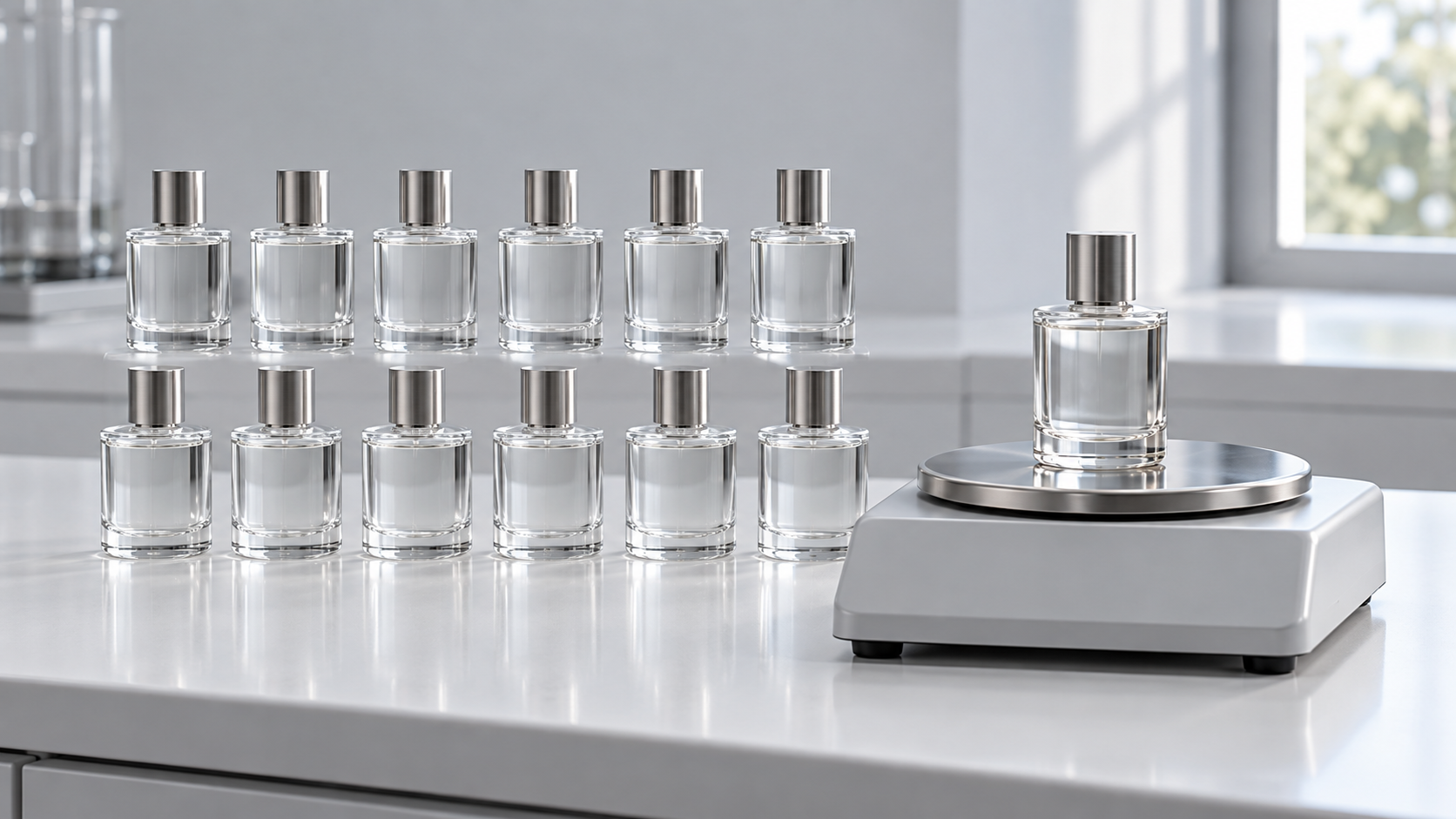
- Fill twelve bottles from one batch to the working level, using the production closure, crimp setting or torque figure.
- Weigh each bottle on a balance readable to 0.01 g and write the starting weight on the record sheet.
- Hold the samples upright at 22 C and 50 percent relative humidity, in the dark, with no air movement across the bench.
- Weigh at day 1, day 7, day 14, week 6 and week 12, always at the same time of day and on the same balance.
- Convert each reading to a percentage of the starting fill weight so bottles of different sizes can be compared on one chart.
- Inspect the collar, the pump body and the carton base at every weigh-in and photograph anything that changes.
- Repeat the whole run at 32 C to see how far the number moves before the pack reaches a warm market.
Twelve bottles rather than one, because a single bottle tells you what happened once. PauPack runs the panel with the brand's own juice and the production closure, then keeps three bottles as retention samples.
Temperature and Humidity: The Two Multipliers
Loss rate rises with temperature because vapour pressure does, and the relationship is close enough to a doubling every 10 C to be useful for planning. Relative humidity acts on the liner and on any water in the formula, and it changes the shape of the curve rather than only its height.
| Condition | Effect on monthly loss | What it tells you |
|---|---|---|
| 22 C, 50% RH | Reference figure | The number you put in the specification |
| 32 C, 50% RH | Roughly 1.8 to 2.2 times the reference | Warm-market risk and shipping exposure |
| 22 C, 80% RH | Slower for alcohol formulas, faster for water-based | Which fraction is actually leaving |
| Fluctuating 18 to 30 C | Highest reading of the set | Real container behaviour, and the case worth testing |
Ports and warehouses are rarely steady. A pack that lives through a 12 C swing every day will lose more than a pack held at the mean of those two temperatures, which is why the fluctuating row is usually the one that matters in a real launch. PauPack reports perfume bottle evaporation loss for that case rather than for the easiest one.
Reading the Curve: What Each Shape Means
A steady straight line says the seal is doing its job and the loss is dominated by the pump ring. A curve that is steep in week one and then flattens usually means the pack outgassed at the fill and then stabilised.
The shape to worry about is a straight line that steepens after week four. That is a liner taking a compression set, or a crimp relaxing as the glass and the aluminium move at different rates. Neither improves with time, and both are cheap to catch at sample stage. A perfume bottle evaporation loss curve that bends upward is the only one that should stop a launch.

If the curve is noisy rather than smooth, look at the method before the pack: temperature swings on the bench, a balance that was moved, or bottles weighed at different times of day will all show up as scatter.
Where the Loss Actually Happens
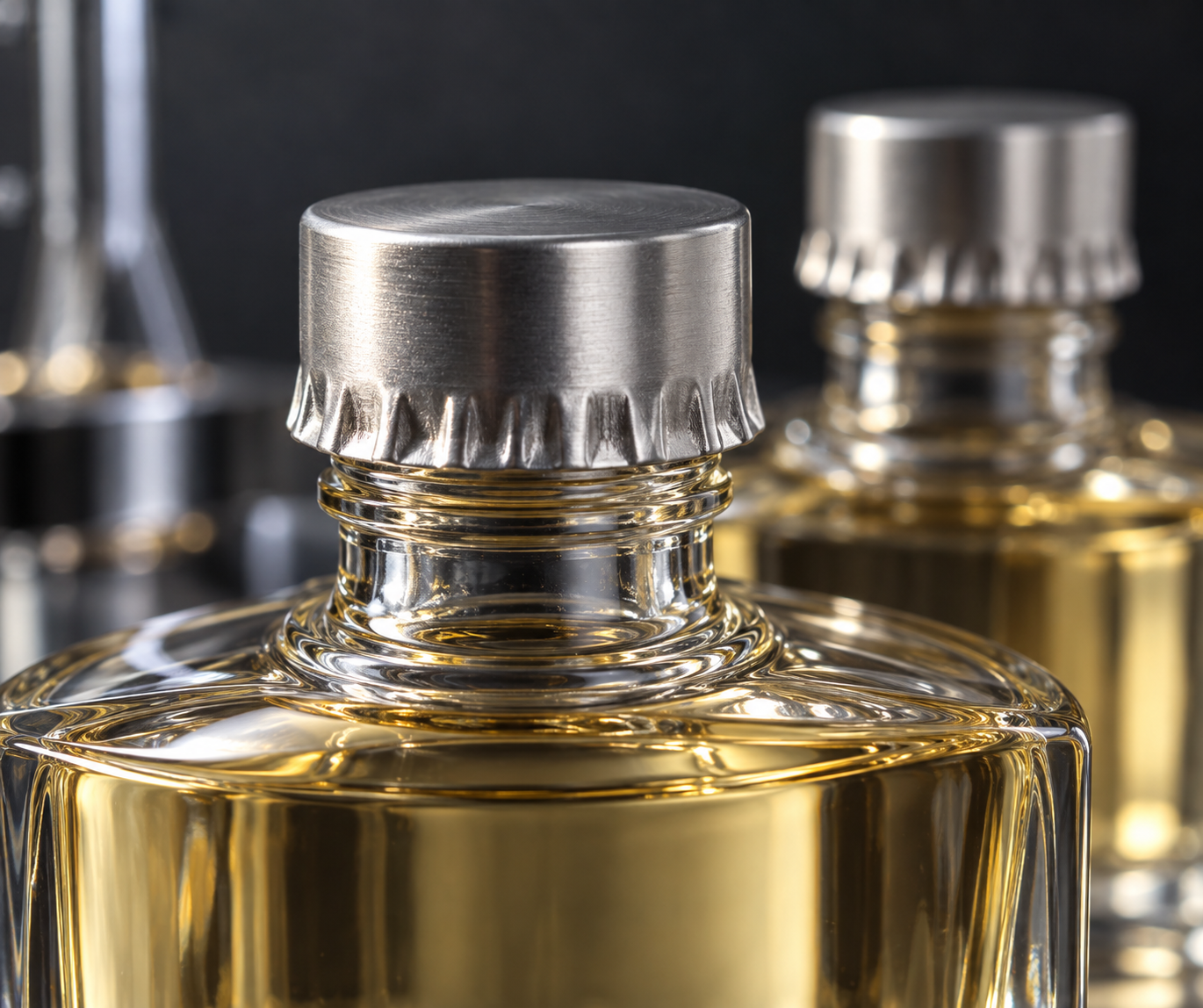
Four places account for nearly all of it. The crimp skirt, where the seal depends on how the aluminium was formed onto the glass. The liner, where compression set reduces the sealing force over weeks. The pump body, where the stem seal passes a trickle of vapour by design. And the neck itself, where ovality or a mould seam creates a path the closure cannot close.
Neck tolerance is the one most often missed. A two-cavity mould can deliver necks a tenth of a millimetre apart, and a closure qualified on one cavity will read differently on the other. PauPack measures both cavities on the first shot and keeps the numbers with the mould record rather than with the batch file.
Where a formulation is unusually volatile, the answer is usually a heavier crimp, a glazed neck and a pump with a tighter stem seal, in that order and in that cost order too.
Evaporation Loss and the Label Claim
Fill volume and evaporation loss are related in a way that appears on the label. If a 50 ml pack loses 0.4 percent a month, then a bottle that sits in a warehouse for a year before purchase is no longer holding the volume the artwork promises.
That is a legal exposure before it is a customer-service one. Most markets regulate net content at the point of sale, and a pack that was legal on the filling line can drift out of tolerance in storage.
PauPack builds the fill target with that drift in mind and states the storage condition on the specification, so the label claim survives a slow container rather than only a fast one.
Six Weeks That Save a Container Load
The economics are easy. A six-week weigh-loss run costs a few hundred dollars in time and a cabinet slot. A container of 40,000 packs that arrives under-filled costs the freight, the replacement, the retail slot and the story.
Run the panel before the tooling is cut if possible, and again on the production mould if the neck finish changed. If only one of those two is practical, run it on the production mould, because that is where the variation lives.
PauPack schedules the weigh-loss panel as part of sample approval rather than as a separate project, which is why the pack and the record arrive together, and why perfume bottle evaporation loss is quoted as a number on the specification instead of a promise.
What PauPack Prepares Before a Fragrance Launch
A fragrance bottle is a system: mould, neck, glaze, closure, pump and fill level. PauPack prepares perfume bottles wholesale in the neck and decoration the brand has chosen, and supplies reference bottles from the production cavity so the crimp result can be reproduced on the next order.
Brands building a range usually start with luxury perfume bottles and 50 ml perfume bottles, then add a travel format. Where the closure is still open, our notes on empty perfume bottles in bulk cover the liner options, and the run quantity is set by perfume bottle MOQ rather than by the palette.
If the pack ships into the United States alongside a consumer product, the closure may fall under federal packaging rules as well. The CPSC recall database is a useful reminder of how often a leak, rather than a formula, ends a listing, and it is a cheap check at sample stage.
Perfume Bottle Evaporation Loss: The Questions Brands Ask
What is a normal evaporation loss for a perfume bottle?
For a well-seated crimp on a 50 ml bottle, expect 0.05 to 0.15 percent of fill weight per month at 22 C. A screw-neck travel spray with a soft liner can run three times that figure, and anything above 0.5 percent a month is a closure problem rather than a formulation one.
How is evaporation loss measured?
By weight, on a balance readable to 0.01 g. Weigh the sealed bottle, hold it under controlled temperature and humidity, weigh it again at fixed intervals, and divide the loss by the fill weight to get a percentage. PauPack runs this on the production closure rather than on a laboratory cap.
Does evaporation loss mean the bottle is leaking?
Not in the usual sense. A leak produces a visible film or a wet carton. Evaporation loss is vapour crossing the liner or the crimp skirt, and it is invisible in the short term, which is why it needs a balance rather than an eye.
Which closure loses the most?
Screw-neck aluminium shells with a thin liner, followed by low-cost crimp pumps with a short skirt. A properly seated crimp on a flame-glazed neck consistently outperforms both, because the seal is a metal-to-glass interference rather than a compressed plastic disc.
How much does temperature change the loss rate?
It roughly doubles for every 10 C above 22 C. A bottle reading 0.10 percent a month in a laboratory cabinet can read 0.25 percent in a warm warehouse, which is why the storage temperature belongs on the test record as a fixed condition.
Can headspace affect the reading?
Yes, in two ways. A large headspace holds more vapour and slows the initial rate, while a small headspace pushes vapour pressure up. Fill to the working level on every sample, otherwise you are comparing air volumes rather than closures.
How long should the test run?
Six weeks minimum for a decision, twelve weeks for a customer-facing claim. Most of the useful difference between closures appears in the first three weighings, but a slow liner failure often shows up between week six and week twelve.
Does the fragrance itself change the loss?
It does. High-alcohol, high-top-note formulas evaporate faster than heavy amber bases at the same temperature, and a formula with more water behaves differently again. PauPack tests the brand's own juice, because a laboratory simulant answers a question nobody asked.
What should the record sheet include?
Fill weight, closure type and lot, crimp or torque setting, cabinet temperature and humidity, the weighing schedule, and a photograph of the collar after the final weigh-in. The USP packaging and storage requirements treat container and closure as one qualified system, which is exactly what the sheet documents.
When should the test be repeated?
Whenever the closure lot, the crimp setting, the neck finish or the glass supplier changes. A neck tolerance shift of 0.1 mm is enough to move a perfume bottle evaporation loss result, and it is far cheaper to reweigh twelve bottles than to replace a container load.