

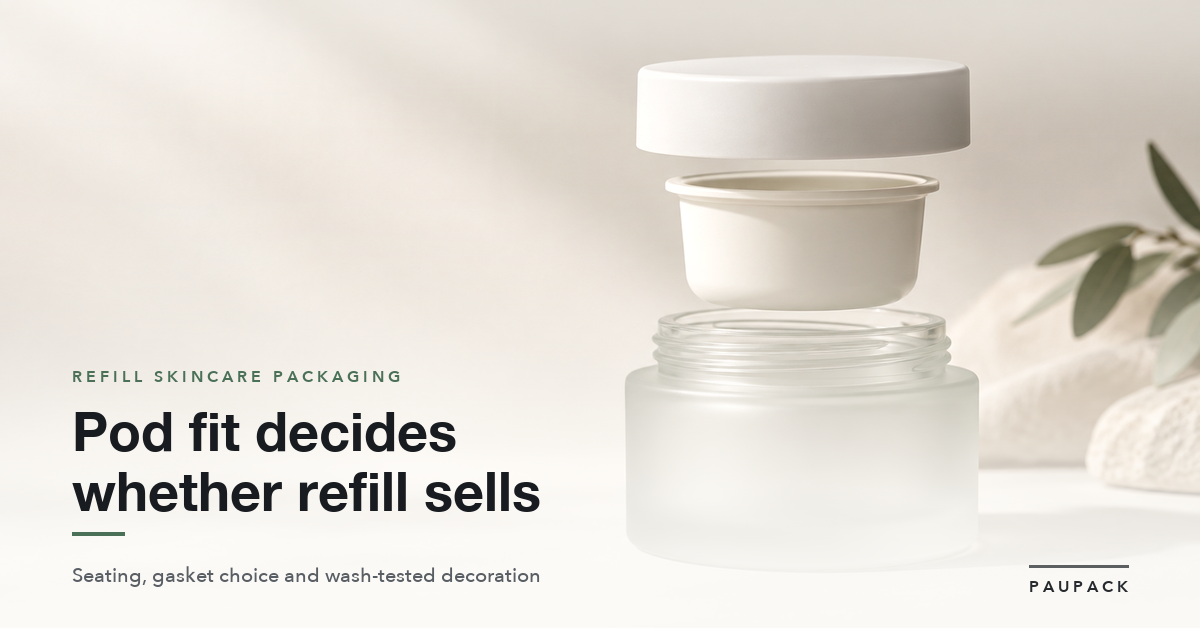
Refill skincare packaging is sold on the shelf as a promise and judged at home on a bathroom counter, and those two moments rarely agree. A jar that photographs well can still fail on the second fill, when the pod arrives slightly oval, the gasket has taken a set, and the customer pushes it home with a thumb instead of a torque head.
PauPack builds refill programs for skincare brands, so this page follows what we check before tooling is cut: how the pod seats, how the thread behaves after ten washes, what the decoration has to survive, and what a refill really does to freight and label space. Take the fit questions first. They decide whether the project is a mould change or a new pack.
Refill Skincare Packaging Begins With the Jar You Already Sell
The cheapest refill is usually the one that keeps the jar body you already have in the warehouse. Before anyone sketches a pod, put the existing drawing on the table and read three numbers off it: the neck finish, the rim height above the shoulder, and the jar bore below the thread.
Those three values decide how much work is left. A jar built for a screw lid has a thread and a sealing land, which is most of what a refill needs. A jar built for a push lid usually does not, and then the honest options are a new finish on the same mould or a cartridge that hangs on the outside of the shoulder instead of sealing inside the neck.
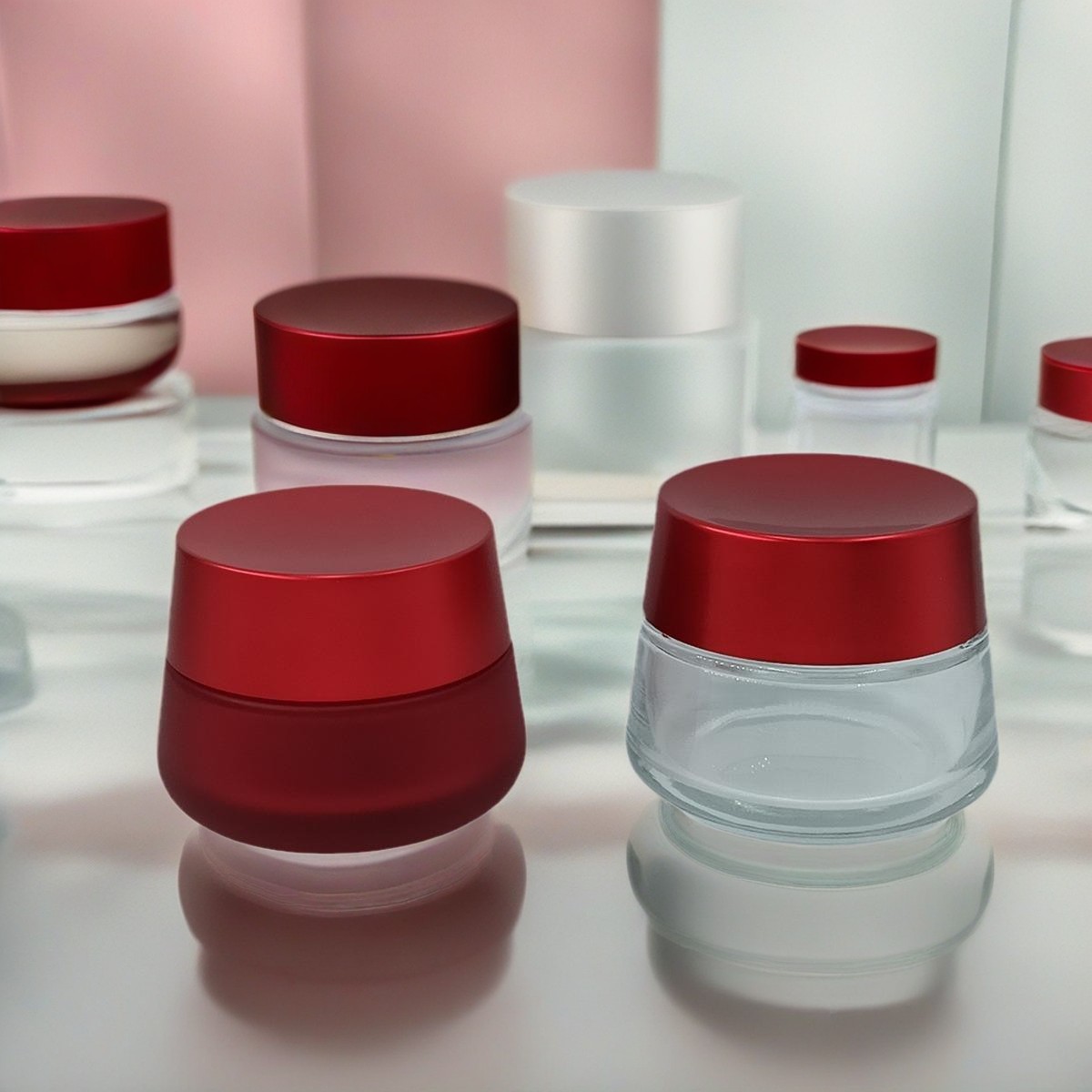
PauPack runs the glass cream jar range for exactly this reason: a finish that suits a screw lid and a pod can be specified from the start, which keeps refill skincare packaging inside the same bill of materials as the standard pack.
Three Refill Architectures and Three Different Failure Points
Drop-in pods are moulded in PP or PCR-PP, filled upside down or right side up, and sealed with a foil or film lid. The failure point is seating: if the customer cannot feel the pod drop to the bottom, they assume the refill skincare packaging did not fit.
Top-up pouches are the cheapest way to sell the second unit, and the messiest in use. Pouring a lotion or a cream from a flexible pouch into a glass jar needs a spout that controls flow at the viscosity you actually fill, not at the viscosity in the marketing brief.
Twist-lock cartridges carry the highest perceived value, because the outer body is the product and the refill disappears inside it. They also carry the highest tooling bill and the tightest tolerance chain, since the lock has to work after the body has been emptied, washed and reassembled by a person in a hurry. PauPack quotes them last for that reason, after the simpler refill skincare packaging routes have been ruled out on volume.
Pod Seating: the 0.2 mm Question
On a 63 mm finish, a pod skirt that sits within roughly 0.2 mm of the jar bore usually seats by hand and seals at the gasket. Wider than that and it rattles. Tighter and a moulding batch at the top of its tolerance will not go in at all, which is a customer service problem that no inspection standard catches.
| Feature | Typical working window | What it changes |
|---|---|---|
| Pod skirt to jar bore | About 0.2 mm clearance | Hand seating against rattle |
| Gasket compression | Around 20 to 30 percent of thickness | Seal integrity against opening force |
| Pod flange height | Flush to 1 mm above the rim | Whether the original lid still closes |
| Wall thickness | 0.8 to 1.2 mm in PP | Panelling when the pod cools |
The fourth row is the one that surprises people. A thin wall saves grams and looks elegant in a render, then panels on cooling and leaves a gap at the gasket that no amount of torque closes.
Thread, Gasket and the Torque Window
Refill skincare packaging inherits the torque question from the primary pack and adds a second one: the pod has to release without tools. That means the engagement has to be shallow enough to break by hand and deep enough to hold through transport. PauPack measures both ends on the same sample set instead of setting torque from the sealing requirement alone.
Liner choice follows the formula. Silicone holds compression better across repeated washing, foam is cheaper and behaves well on a single-use pack, and an induction seal has no place in a refill unless the customer is expected to break it, which most will not do cleanly. Ask for the compatibility sheet against your actual emulsion or anhydrous base, because a general statement that the material is cosmetic grade tells you nothing about swelling.
Decoration That Survives Ten Washes
A reusable jar meets warm water, a cloth and a determined customer. Frosting, metallising and organic inks all behave differently under that treatment, and the difference shows up after the sale rather than in the lab.
| Decoration | Wash resistance | Note for refill packs |
|---|---|---|
| Acid-etched frosting | High | Surface treatment, not a coating, so it cannot peel |
| Spray frosting | Medium | Scratches at the shoulder where the hand grips |
| Metallising | Low to medium | Keep it above the waterline or on the lid only |
| Screen or pad printing | Medium | Survives longer when cured for the substrate, not the press |
| Decal with a top coat | High | Costs the most, and the most defensible against washing |
Set the target number with the brand and write it into the specification. Ten hand washes is a sensible floor. A decoration that passes ten and fails at thirty has not failed the supplier, it has failed a target that nobody agreed.
Weight, Freight and the Honest Economics of a Refill
The commercial case is strongest when the saving is measured on a pallet. A filled 50 ml glass jar weighs far more than the concentrate that replaces it, and the difference repeats on every case, every layer and every container. Model it that way and the refill pays for its tooling sooner than the unit price suggests.
Then subtract what the refill adds: a second label, a card explaining the routine, a pouch or pod that still has to be printed, and a retail display that has to hold both formats at once. Refill skincare packaging earns its margin on repeat purchase, so the pack has to be pleasant enough that the customer does the second fill at all.
Label Space After the Second Fill
Once the jar becomes a permanent object, the refill carries the batch, the fill quantity and often the ingredient declaration. Those panels are small on a pod and cramped on a pouch, and the text still has to be legible at the size a market expects.
Plan the layout before the artwork stage. PauPack asks brands for the longest ingredient list they expect over the next two years, then sizes the refill label around that rather than around the launch formula. It is a dull conversation that saves a reprint.
Instructions, Cleaning and What Consumer Law Expects
Where a pack invites reuse, the instruction changes from decoration to compliance. Cleaning steps, water temperature, drying and how often the gasket should be replaced all belong on the card. Skin contact products carry more scrutiny than a diffuser refill, so keep the wording plain and test it with people who have not read the brief.
The reference points are public. The FDA cosmetics pages set out how the agency treats cosmetic products and their labelling, the food ingredients and packaging section explains how contact materials are regulated in the United States, and 21 CFR Part 177 in the eCFR lists the resin families that are cleared for food contact, which is still the fastest sanity check when a pod is moulded in PCR-PP.
How PauPack Runs a Refill Trial Before Tooling
The trial is deliberately unglamorous. PauPack machines two or three pod variants at different wall thicknesses, moulds a matching gasket in two materials, fills each at production viscosity, and then seats thirty units by hand in front of the customer on a video call. What survives the seating test goes to the wash test, and only packs that clear both are put forward as refill skincare packaging.
Wash testing means ten cycles of warm water, mild detergent and hand drying, with photographs after cycles one, five and ten. Decoration is inspected at the same time as the gasket, because the two fail together more often than not. Only then does the project move to a mould drawing.
Choosing a Partner for a Refill Program
A refill program touches moulding, glass, gaskets, decoration and filling advice at once, which is why split sourcing gets expensive. PauPack keeps the pod, the jar and the closure in one specification, and the quality management process covers how the trial records are held with the project so a repeat order starts from evidence.
Two production notes are worth carrying into any refill brief. First, the pod flange has to clear the original lid; a millimetre of extra height turns a closing lid into a lid that sits proud and looks defective. Second, the fill line has to be marked for the refill, not for the jar, because a customer who overfills by habit will blame the pack for the overflow.

Where Refill Projects Lose Money
Most failures are decisions made out of order. The pod is tooled before the finish is measured. The decoration method is chosen before the wash target is agreed. The gasket is bought as an accessory rather than specified against the formula. Each one costs a mould, a print run or a recall of stock, and each one is avoidable at the brief stage.
Refill skincare packaging works when the pack is treated as a system with a defined second act. PauPack has watched enough launches go sideways to say it plainly: the refill is not an accessory to the jar, it is half of the product experience. Buyers who want the wider view can read the notes on custom cosmetic jars, the frosted glass cosmetic jar guide and the comparison of glass cream jars and lotion bottles, which cover the choices that come before a refill is added.
What to Send for a Refill Program Quote
Send the jar or intended jar, the formula type, the fill volume, the market and the annual volume, plus the decoration and wash target if you have them. PauPack replies with the architecture that fits, the parts that need new tooling and the sequence of the trial, and the accessories supply service quotes the gasket and closure at the same time so nothing is ordered twice.
One last piece of advice from the factory floor. Take a pod home and refill your own jar ten times before you approve the mould. If the tenth fill is annoying, your customers will find it annoying too, and no specification can rescue a pack that people stop using.
Questions Buyers Ask About Refill Skincare Packaging
What counts as refill skincare packaging?
Any pack where the customer keeps part of the container and buys only the product again. That can be a drop-in pod, a flexible top-up pouch that pours into a rigid jar, or a cartridge that twists into a permanent outer body. The three behave differently in production, so decide which one you are selling before the first drawing.
Can I add a refill to a jar I already produce?
Often yes, and it is the lowest-risk route. Send the jar drawing and the neck finish, and PauPack checks whether the current thread, gasket seat and rim height give the pod something reliable to lock against. If the thread was chosen for a lid only, a small change to the finish is cheaper than a new mould.
How tight should the pod fit?
Tight enough to seal at the gasket and loose enough to seat by hand. On a 63 mm finish we usually hold the pod skirt near the jar bore within about 0.2 mm, then prove it on 30 pieces rather than in a spreadsheet. Interference that reads fine on a drawing can lock up once moulding tolerances land at opposite ends.
Does the refill have to be cleaned before it is refilled?
If you tell customers to reuse the jar, tell them how to clean it, and test the instruction. Residue from a cream, warm water and repeated wiping all attack the decoration and the gasket. The wording on the card is part of the pack design, not a marketing afterthought.
Which gasket material suits a refill jar?
It depends on the formula and the cleaning routine. Silicone survives repeated washing better than many foams, and it holds compression longer, but it costs more. Ask for the compatibility data against your formula rather than a general statement that the liner is food grade.
What is a realistic MOQ for a refill pod?
Pods usually sit below the jar MOQ because the tooling is simpler and the part is small. The number you should plan around is the one that fills a moulding run without leaving stock ageing in a warehouse, and that is a conversation about your annual volume rather than a catalogue figure.
How many wash cycles should the decoration survive?
Set the number with your marketing team and write it into the specification. Ten hand washes is a common floor for a reusable jar. Printing that survives ten often fails at thirty, so agree the target before a decoration method is chosen and paid for.
Will a refill change my freight cost?
It should reduce it, and that is often the strongest commercial argument. Shipping product concentrate in a pouch or a small pod instead of a filled glass jar cuts billable weight sharply. Model the saving on a full pallet, not on one unit, because case dimensions and pallet fill decide the real number.
Does the refill need its own label?
Usually yes, because the refill carries the batch, the fill quantity and often the ingredient list that the outer jar no longer repeats. Leave the panel space in the artwork early. Refill labels are small, and a crowded one is the fastest way to lose the regulatory text a market expects.
What does PauPack need before quoting a refill program?
The existing jar or the intended jar, the formula type, the fill volume, the market, the annual volume and the decoration target. With those, PauPack can say which architecture fits, what tooling the pod needs, and where the sample trial should start.