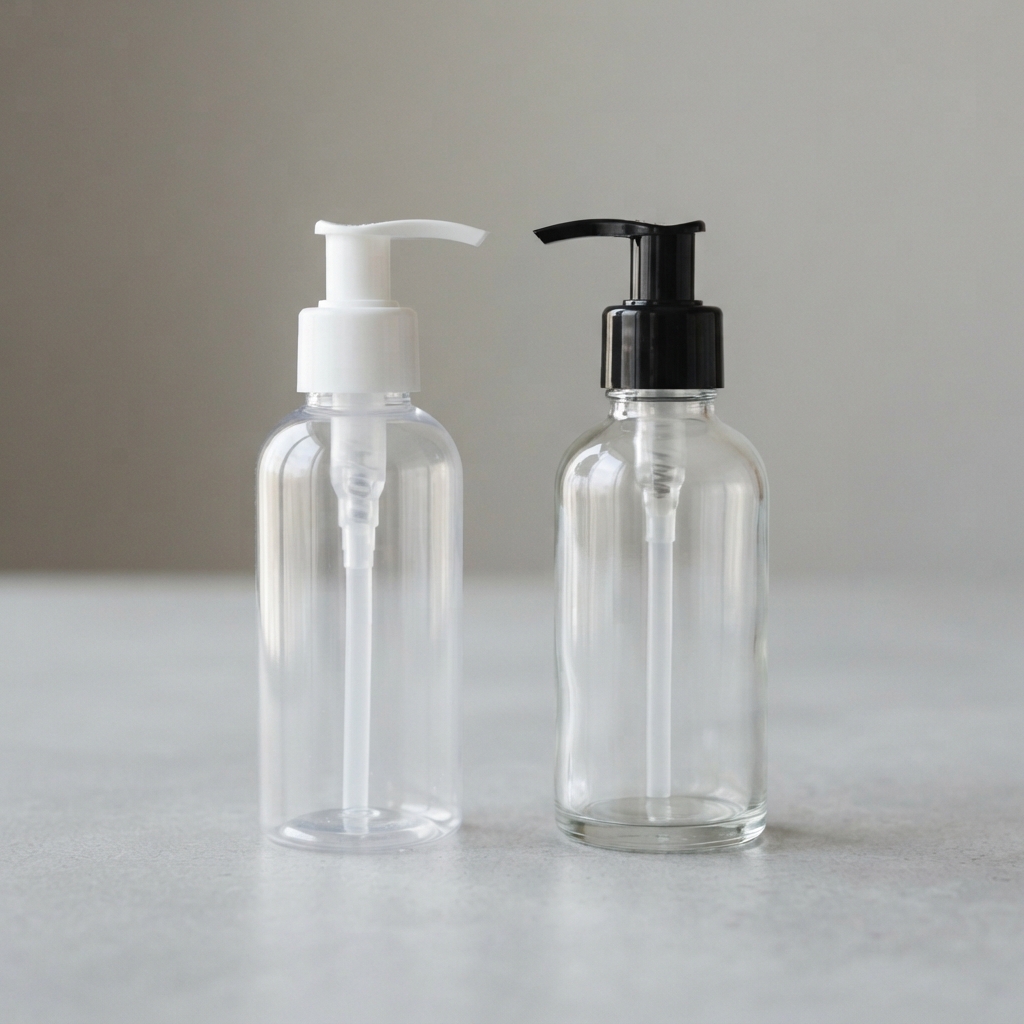
PET vs glass bottles is the first material decision in most skincare packaging projects, and it is usually argued with the wrong evidence. Glass blocks oxygen, shrugs off solvents and reads as premium on a shelf. PET is three to five times lighter, survives a parcel network, and starts at half the minimum order in most stock ranges. The honest answer for a full range is usually both materials, split by formula and by the route the pack takes to the customer.
We quote both every week, and the same two arguments come back. A founder wants glass because a reference brand uses it. A supply chain lead wants PET because the last container arrived with breakage. Each is right about their own constraint, and neither has priced the other option. This guide works through the comparison in the order that decides it: formula, barrier, packaging cost, freight, then shelf impression.
PET vs Glass Bottles: The Short Verdict
Choose glass when the formula is oxygen-sensitive, oil-based or alcoholic, or when weight and clarity are doing real selling work. Choose PET when the pack ships in single-unit parcels, travels by air, or has to hold a price point at volume. Everything else is a trade you can measure in a week of testing.
- Glass for: essential oils, fragrance, vitamin C and retinol serums, anything with a two-year shelf life and an oxygen-sensitive active.
- PET for: body lotion, cleanser, toner, travel sizes, subscription refills, anything that goes through automated parcel sorting.
- Either, after testing: cream jars, treatment pumps, shampoo, hotel amenities, where both materials can pass.
What we would not do is choose from a photograph. Both materials can be frosted, sprayed, printed and sleeved until they look expensive. The difference shows up on a freight invoice and in a stability chamber, not in a sample photo.
PET vs Glass Bottles Side by Side
The table below is the comparison we walk through before quoting a PET vs glass bottles brief. The minimum order and production rows reflect our own stock pattern rather than an industry rule, so treat them as an example of the shape of the difference.
| Criterion | PET bottle | Glass bottle |
|---|---|---|
| Weight | Typically 3–5 times lighter than glass | Heavy; drives freight, pallet height and handling |
| Barrier | Moderate and resin-dependent; excellent clarity | Airtight; best gas and moisture barrier |
| Chemical resistance | Good for water-based formulas, weak against concentrated oils and solvents | Inert with almost everything, including alcohol and citrus oils |
| Breakage | High impact resistance; dents rather than shatters | Fragile; a chipped finish ends the bottle |
| Recyclability | Depends on design, colour and local collection | Infinitely recyclable where collection exists |
| Recycled content | PCR PET widely available at several percentages | Cullet; availability varies sharply by region |
| Decoration | Labels, sleeves, print; surface scratches with handling | Coating, frosting, fired decoration, heavy-base moulds |
| Shelf signal | Practical, everyday, travel-friendly | Weight, sound and clarity read as quality |
| Typical stock MOQ | 5,000 units | 10,000 units |
| Typical production | 15–25 days | 25 days |
One row deserves a warning. Recyclability is not a property of the material alone. A PET bottle with a full-body shrink sleeve, a dark colour and a barrier layer can be harder to recycle than a clear one in the same resin, and the APR Design Guide for PET exists because those choices decide the outcome.
Packaging Cost: Where the Comparison Usually Goes Wrong
Most packaging cost comparisons stop at the bottle price ex-works. Glass comes in a little higher, PET looks like the saving, and the decision is made. That comparison is incomplete in three places, and all three sit downstream of the unit price.
The first is freight per 1,000 units to your actual destination. Carriers price weight and cube, and glass loses on both. The second is a breakage and returns allowance: a bottle that arrives cracked costs the container, the product inside, the return shipping and the customer service time. The third is working capital, because a 10,000 unit minimum ties up more cash than a 5,000 unit one at the same launch stage.
Put those three lines together and packaging cost per delivered unit can invert the ex-works ranking. A glass bottle that looks 20 percent dearer on the quotation can land 40 percent dearer once freight and breakage are loaded, while a PET bottle that looks cheap can lose its advantage if the tooling amortisation is spread over too few units.
There is a fourth line that rarely appears in a spreadsheet: the cost of changing your mind. Tooling for a custom glass mould is a large, slow commitment, while a stock PET bottle can be sampled, decorated and reordered inside a quarter. At concept stage, that flexibility is worth more than the unit price difference.
Barrier: What Each Material Does to the Formula
The PET vs glass bottles question changes once you look at the formula instead of the photo. Glass is airtight. It blocks oxygen, moisture and most gases outright, it does not absorb flavour, and it does not interact with the contents. That is why fragrance, essential oils and oxidation-sensitive actives still live in glass.
PET is a different proposition. It offers excellent clarity and a moderate barrier that varies with resin, wall thickness and bottle geometry. For a water-based lotion with a two-year shelf life, that is often sufficient. For a citrus oil or a high-alcohol mist, it usually is not, and no amount of decoration fixes a barrier problem.
Light is the second half of barrier, and it is where brands get caught. Clear glass passes ultraviolet light. Amber glass filters a useful part of the spectrum. Clear PET passes most of it as well, so a light-sensitive serum in a clear PET bottle needs a UV absorber in the resin, an opaque sleeve or a carton. That decision belongs in the brief, not in the decoration round.
Barrier is measurable, which is the good news. Fill both packs with the real formula, store them upright and inverted at ambient and at 40 C, and weigh a sample each week. A weight-loss curve over eight to twelve weeks tells you more about moisture transmission than any data sheet, and it costs a laboratory balance and a shelf.
Glass vs Plastic Packaging: What Shoppers Actually See
The glass vs plastic packaging debate is often about signal rather than performance. Glass feels substantial. It is cold to the touch, it makes a satisfying sound when tapped, and it shows the colour and texture of the product without distortion. Those cues are why premium skincare still defaults to glass even when the formula would survive in plastic.
Plastic signals practicality. That is not a weakness if the brand is selling convenience, value or travel. The problem starts when a brand uses PET to save cost and then spends the saving trying to make PET look like glass, with heavy sleeves, fake seams and thick walls that erase the weight advantage.
Recycled content changes the story on both sides. A PCR PET bottle gives a brand a specific, verifiable recycled-content figure to talk about, and shoppers increasingly ask for one. Glass has an equally strong recyclability story, but the recycled-content percentage available to you depends on regional cullet supply, which is why the claim is harder to keep consistent across markets.
Weight, Freight and the Landed Cost You Do Not See
Plastic is typically three to five times lighter than glass, and freight is charged by weight. A pallet of glass bottles can weigh around 1,500 lb where the same count in plastic comes in near 400 lb, and that ratio is what carriers price. On long routes and air freight, glass can triple or quadruple the shipping line.
That is the number most PET vs glass bottles spreadsheets leave out. They compare the bottle price, see glass at a modest premium, and stop. The freight line is where the gap opens, and it opens widest for direct-to-consumer brands shipping single units through automated sorting centres.
Breakage is the second hidden line. On a pallet, glass is fine. On a parcel network with chutes, belts and mixed loads, a percentage of every order arrives damaged, and each of those orders costs a replacement plus the original freight. Budget for it explicitly rather than discovering it in month three.
Volume economics move the same way. In our own stock, PET runs at a 5,000 unit minimum with a 15–25 day production time, while glass runs at 10,000 units and 25 days. At launch volumes, that difference often decides which material you can afford to test at all.
Recyclability and Recycled Content
Glass is endlessly recyclable without loss of quality, provided collection exists. The infrastructure, not the material, is the limit: the US EPA reports that 9.79 million tons of glass containers were generated in 2018 and 3.06 million tons recycled, a rate of 31.3 percent, with the rest landfilled or burned for energy. Where deposit systems operate, the same bottle is collected at a far higher rate.
PET is the most widely collected plastic in bottle form, and PCR PET gives a brand a recycled-content story that glass cannot always match in a given region. Design still decides whether the bottle actually gets recycled: caps, labels, adhesives, colour and barrier layers all affect the yield a reprocessor can recover.
Recycled content is also where claims get loose. PCR PET is sold at different percentages, and the evidence behind a percentage is a chain of documents rather than a logo on a website. Our PCR content verification guide sets out what a supplier should be able to show, from mass balance statements to processor audits.
When Glass Is the Right Call
Glass earns its freight in five situations, and they repeat across the brands we work with.
- The formula is oil-based, alcoholic or oxidation-sensitive, and a two-year shelf life is not negotiable.
- The product sells at a premium where weight, sound and clarity do real work on the shelf.
- The pack is refillable. Glass survives washing and refilling in a way most plastics do not.
- The fill is hot, or the product is acidic enough that a plasticiser conversation is not worth having.
- The destination market has good glass collection, so the sustainability story survives scrutiny.
Essential oil and fragrance formats sit at the top of that list. A 12 ml dropper bottle in borosilicate glass, such as the 12 ml essential oil bottle, is specified with a 28/400 neck precisely so a standard dropper assembly seals it without a compatibility argument.
When PET Is the Right Call
PET wins where the pack has to survive a journey and a price point at the same time.
- Direct-to-consumer shipping, especially single-unit parcels through automated hubs.
- Travel and sample sizes, where weight per unit matters most.
- Large-format body care: 300 ml, 500 ml, one litre.
- Subscription and refill models that ship the same pack repeatedly.
- Retail price points where a glass premium would break the margin.
Note what is absent from both lists: aesthetics. Once a pack is decorated, most shoppers cannot tell a well-finished PET bottle from glass at arm's length. The material choice is a supply chain and formulation decision, and the decoration budget is what makes either one look expensive.
Matching the Material to the Skincare Format
Format usually settles the PET vs glass bottles question before the brand does. This is the pattern across skincare ranges we quote, with the exceptions noted.
| Format | Usual choice | Why |
|---|---|---|
| Serum with dropper | Glass | Inert bore, visible dose, premium cue |
| Lotion or treatment pump | Either | PET for travel and e-commerce, glass for retail shelf |
| Cream jar | Glass or PP | Glass for premium, PP for volume and refill pods |
| Toner and mist | PET | Light, shatterproof, cheap to ship |
| Cleanser, 250–500 ml | PET | Weight and cost dominate at that size |
| Essential oil and fragrance | Glass | Barrier and solvent resistance |
| Samples and travel | PET or PP | Cost per unit and parcel weight |
Skincare packaging also has a closure consequence that material comparisons miss. A pump specified for a 28/400 glass neck may not seal a 28/410 PET neck, and the dip tube length has to suit a different bottle height. If you are choosing between a pipette and a screw cap on the same bottle, the dropper cap comparison covers the fit side in more detail.
Common Mistakes When Choosing Between PET and Glass
Six errors account for most of the rework we see on plastic vs glass bottles projects. None of them is technical, and all of them are cheap to avoid.
- Comparing unit price only. Add freight, breakage allowance and returns before you compare anything.
- Assuming glass is automatically greener. A heavy bottle shipped a long way can carry a higher footprint than a light PCR PET one. The answer depends on route and recycled content.
- Testing barrier with water. Water tells you almost nothing about how a real emulsion behaves in PET over 24 months.
- Forgetting the closure. Neck finish, dip tube length and torque window all change with the material, even at the same nominal diameter.
- Ordering glass at MOQ before testing. Ten thousand bottles is an expensive way to learn that the formula reacts with the liner.
- Ignoring the parcel network. A bottle that survives a pallet may not survive a sorting belt.
What We Stock in Both Materials
Our catalogue carries both, and the pattern below is typical: PET at 5,000 units and 15–25 days, glass at 10,000 units and 25 days.
| Pack | Material and size | Closure and MOQ |
|---|---|---|
| 30 g PET skincare bottle | 30 ml, clear body, 45 mm wide mouth, 60 mm diameter, 50 mm body height | White cap, 5,000 units, 15–25 days |
| PCR PET pump bottle | 300–500 ml, 24/410 or 28/410 neck, white body, 160–180 mm body height | Black pump, 5,000 units, 15–25 days |
| 110 ml white glass lotion bottle | 50 ml and 110 ml, 28/400 neck, 30–38 mm diameter, 130–170 mm with pump | Pump or cap, 10,000 units, 25 days |
| 10 g pink glass cream jar | 10 g, 20 g, 30 g, 28/400 neck, 30–40 mm diameter, 40–50 mm total height | Cap, 10,000 units, 25 days |
Both material families share the same closure logic, which is why the neck finish drawing matters as much as the resin. If you are still deciding between a jar and a bottle for a cream, the cream jar versus lotion bottle comparison is a better starting point than a material argument.
How to Test the Decision Before You Commit
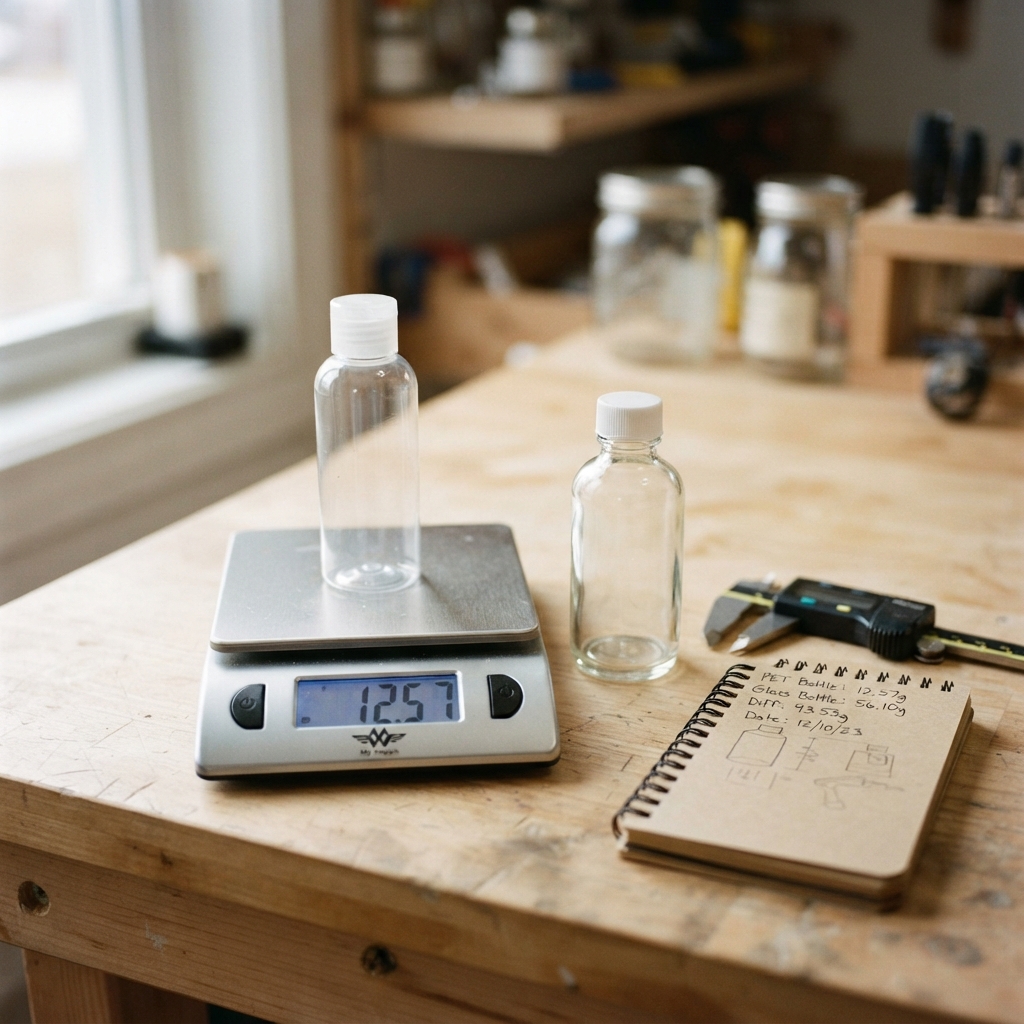
Run the PET vs glass bottles decision as a test, not a debate. Four steps settle it in about six weeks, and they cost less than one wrong production run.
- Fill both packs with the real formula, not water and not a placebo.
- Store upright and inverted at ambient and at elevated temperature, and weigh a sample each week to catch moisture loss.
- Drop filled units from parcel height and inspect the finish and the shoulder, not just the body.
- Get a freight quote per 1,000 units to your actual destination before comparing landed packaging cost.
Add a capping and torque check on your own line. A pump that seals on a sample may not seal at production speed, and that failure looks identical on both materials until you measure opening torque on ten units.
Frequently Asked Questions About PET vs Glass Bottles
Is PET better than glass for skincare?
For lightweight, shatter-resistant packs that ship to consumers, yes. For oxygen-sensitive oils and actives, no. The material should follow the formula first, then the route to the customer.
Is glass more sustainable than plastic?
Not automatically. Glass is infinitely recyclable and chemically inert, but it is heavy to ship. A light PCR PET bottle on a long route can carry a lower footprint than a heavy glass one. Both claims need a route and a recycled-content figure behind them.
Can the same pump fit a PET and a glass bottle?
Only if the neck finish matches. A 28/410 pump does not seal a 28/400 neck, and the dip tube length has to suit the bottle height. Specify the finish on both the bottle and the closure drawing.
Why is the glass minimum order higher?
Glass runs need a mould and a furnace campaign, and setup dominates small volumes. Our stock glass starts at 10,000 units while PET starts at 5,000. Custom glass is higher again.
Does PET change the smell of a product?
PET is generally low-odour, but some resins and some recycled grades carry a note a fragrance can pick up. Ask for an odour panel on the exact grade, especially with PCR content.
Can essential oils go in PET bottles?
Concentrated oils are hard on most plastics including PET, and glass is the safer default. Diluted products in a well-tested PET pack are a different question, and they need a compatibility test rather than a rule of thumb.
What is the freight difference in practice?
Expect plastic to be several times lighter per unit and glass freight to be materially higher per thousand units, sometimes triple or quadruple on long routes. Quote both to your own destination before deciding.
Conclusion
The PET vs glass bottles choice is a formula question first and a cost question second. Test the barrier, price the freight, then argue about the shelf. Brands that run it in that order rarely change material after launch, and the ones that skip straight to the sample photo usually do.
If you want the comparison run on your own formula, send us the product type, fill volume and destination market. We will quote a PCR PET option and a glass option against the same brief, with the neck finish, MOQ and lead time on one page, so the packaging cost comparison is like for like. Start with the contact page and tell us which market the pack ships to.