
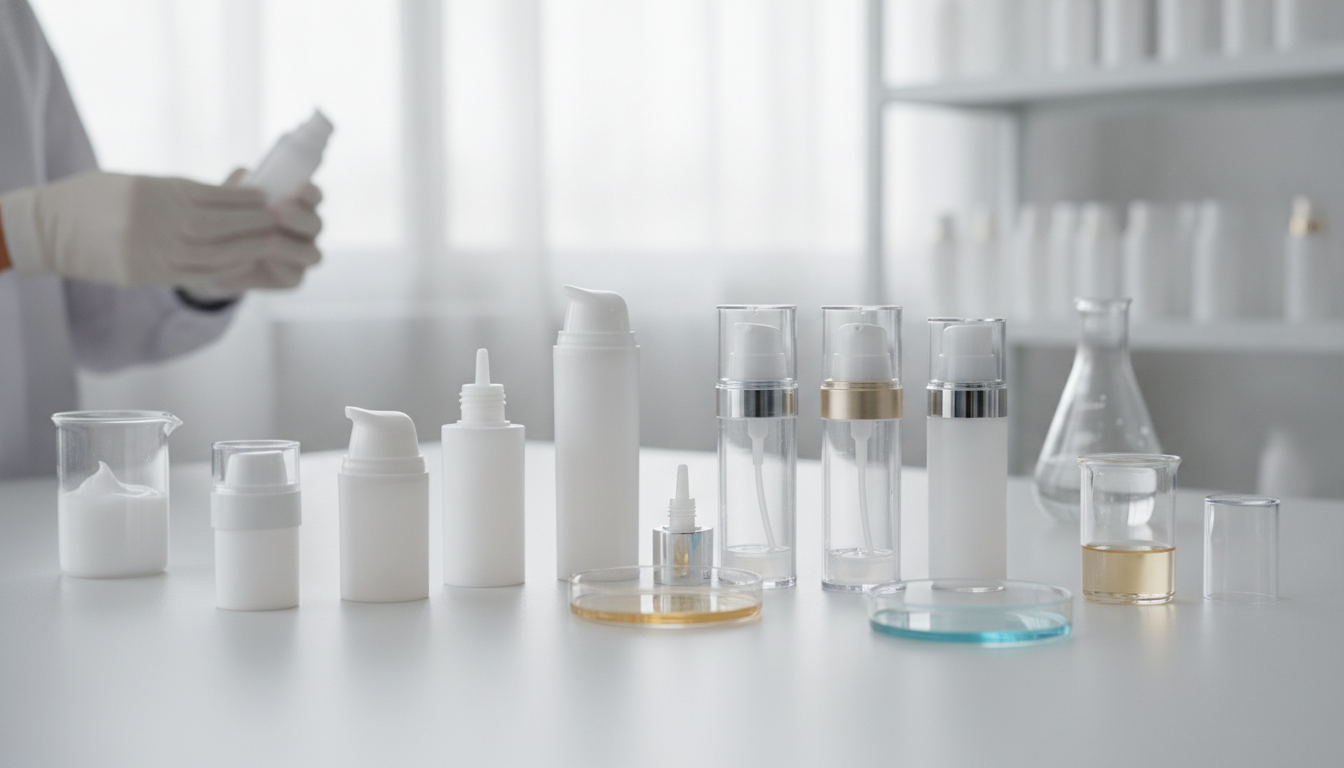
Airless pump bottles are sealed dispensers: serum sits in a cartridge, a piston rises behind it, and the pump pushes product out with no dip tube and no replacement air. For a serum, that means less oxidation and a more consistent dose.
This guide covers the three things that decide whether a launch runs clean: format, formula compatibility and supplier vetting. Buyers tend to get format right and vetting wrong — samples pulled from a different line than production is the classic mistake. We'll go through each in the order you'll face it.
PauPack, founded in Suzhou in 2013 and now running four factories for bottles, components and paper boxes, lists airless bottles and jars as a product family. Start with the custom airless bottles series for skincare. Then ask which components are stock and which are tooled to your brief; the answer decides how much of the pack is yours to change.
Source note: technical conclusions draw on PauPack's published neck-finish chart, airless pump priming guide and AQL sampling guide.
What Are Airless Pump Bottles and Why Use Them for Serums?
Sealed chamber, no dip tube, no air-return path. Airless pump bottles hold serum against a piston that rises from the base each time the actuator goes down, so the barrel wall wipes product toward the outlet instead of letting it slump back against air. Nothing goes back in.
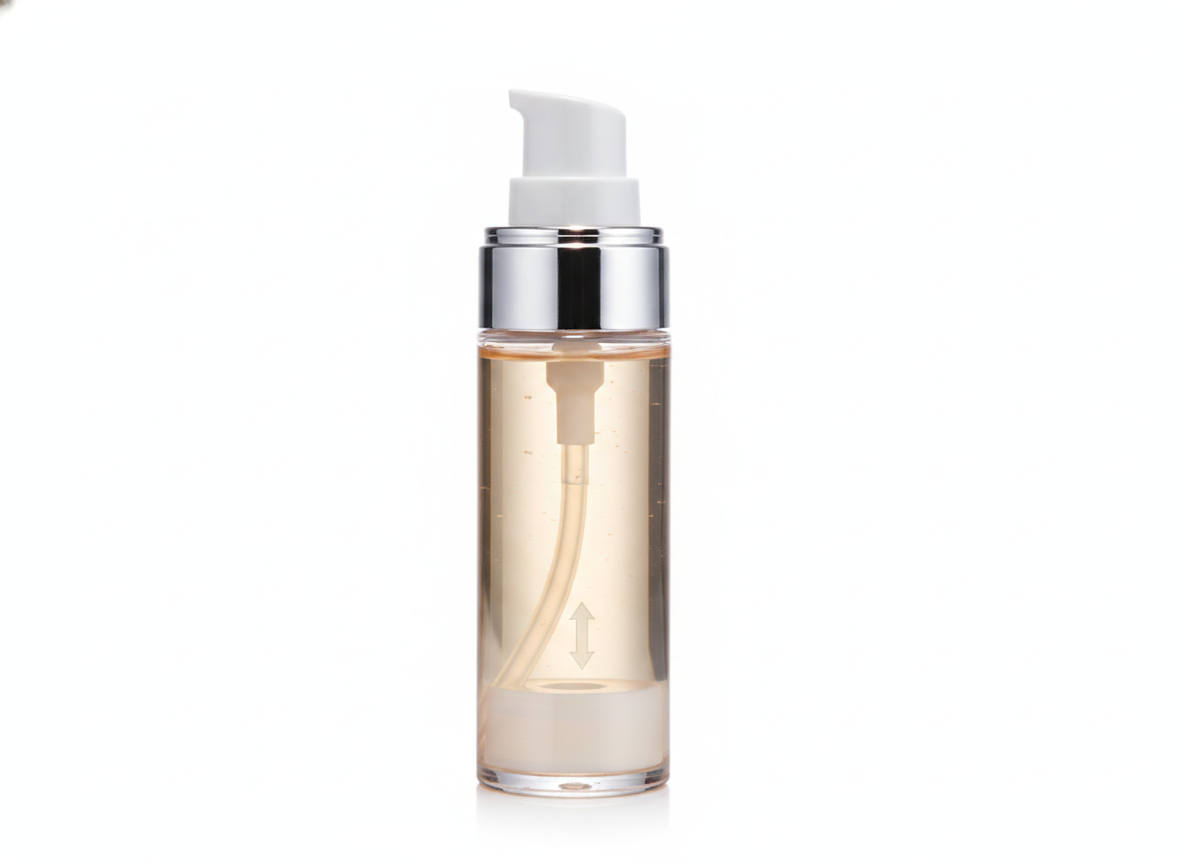
The mechanism is simple. That's exactly why it suits vitamin C, retinol and peptide blends, which oxidise fast once they meet air. Every millilitre left clinging to a dip tube is a millilitre your customer can't dose, and with a £60 serum that adds up over twelve weeks of use.
| Component | What it does | Why it matters for serum |
|---|---|---|
| Actuator (pump head) | Releases a metered dose per press | Controlled dose, no pouring, no over-application |
| Piston or wiper | Rises as product is drawn down | Keeps formula pressed to the outlet and away from air |
| Barrel (PP single or double wall) | Holds the fill | PP gives chemical resistance; double wall adds rigidity or houses an inner pouch |
| Collar and neck | Joins pump to bottle | Neck finish and closure are matched as one set, never mixed |
| Overcap | Shields the actuator in transit | Also the surface most decoration and branding sits on |
Treat that table as a spec sheet, because the pump, piston and barrel are matched as a set. Swap in a cheaper component and it usually surfaces later as leakage or a dead prime. PauPack's published guidance on priming the mechanism walks through the strokes and the checks, and it's worth ten minutes before you sign off a sample.
Which Serum Formulas Are Compatible with Airless Pump Bottles?
Not every serum belongs in an airless pack. Thin, oxygen-sensitive formulas are the natural fit. Thick gels and gum-heavy textures fight the piston, and no pump geometry fixes that.
Viscosity is your first screen. Water-thin serums move cleanly through the pump; anything that holds a peak in the bottle stalls the piston or spatters at the nozzle. Ask the supplier for the pump's working range instead of guessing from the millilitre figure on the quote.
Then the chemistry. PP, the usual body material for this format, resists most cosmetic actives, but high-pH systems and concentrated vitamin C still need a real fill test. Oils and silicones deserve suspicion too: they swell some pistons and make the actuator slip.
Preservative-free formulas are the classic case for the format, yet the pack doesn't sterilise anything. Water activity and pH range still carry that load. A formula that separates in glass will separate in here as well.
So test the formula in the pack you actually intend to buy. Fill samples, hold them at 40 °C, and read weight loss, pH drift, colour and actuation force at four weeks and again at twelve. PauPack publishes guidance on compatibility testing for buyers, and that evidence beats any brochure claim about serum actives.
What follows is a suggested protocol to adapt, not a set of PauPack test results. Agree the thresholds with your own quality team before the first fill.
| Check | Test condition | 4-week reading | 12-week reading | Judgement criteria |
|---|---|---|---|---|
| Weight loss | 40 ± 2 °C, 75 ± 5% RH, packs stored upright and inverted | Mass change, plus any seepage at the collar | Same, against the t=0 mass | 0.5% of fill mass or less by week 12, with no visible product on the valve or shoulder |
| pH drift | Same chambers; sample equilibrated to 25 °C before measuring | ΔpH against the retained t=0 sample | Same | ±0.3 units. A wider swing points to the formula attacking the wetted PP |
| Colour and appearance | Visual check against a retained reference, supported by L*a*b* readings | Photograph and ΔE | Same, plus a check for haze, sediment or phase split | ΔE of 2 or under, and no split, ring or sediment |
| Actuation force | Force gauge, strokes 5 to 20, at 25 °C | Mean force per stroke | Same, compared with the t=0 mean | Within ±20% of the starting mean and inside the ergonomic limit set at brief stage |
| Dose consistency | Ten consecutive strokes, weighed | Grams per stroke | Same | Shot weight inside the tolerance agreed at brief stage; creep at the top of the stroke usually means the piston is dragging |
Two public references frame the work. ICH Q1A(R2), issued by the International Council for Harmonisation in 2003, sets the accelerated condition at 40 °C ± 2 °C and 75% RH ± 5% RH with a long-term baseline of 25 °C / 60% RH, which is where the four- and twelve-week points come from. For the journey itself, the ISTA series covers it: 1A for a plain integrity check, 3A for parcel delivery, with the filled and decorated pack inspected for leakage and a working actuator afterwards.
Twelve weeks at 40 °C is a screening window, not a shelf-life claim. Keep the control packs at 25 °C so you can tell a real formula problem from ordinary heat ageing, and rerun the whole protocol after any change to the pump, the resin or the filler.
Airless Pump vs Dropper vs Lotion Pump: Which Format Fits Your Serum?
Three formats cover most serum launches, and they don't trade off in the same direction. Dosing precision, air exposure and unit cost move independently. The formula decides before the shelf appeal does.
| Format | Dose control | Air contact | Fits best | Skip it if |
|---|---|---|---|---|
| Airless pump | Fixed by actuator stroke; same shot every press | Only at the nozzle — the piston follows the fill | Vitamin C, retinol, preservative-light emulsions, 15–30ml | Your fill is a thick anhydrous oil that won't evacuate cleanly |
| Serum dropper | By the drop, in the user's hand | Headspace and product open to air at every use | Face oils, squalane blends, 10–30ml trial and travel sizes | The formula oxidises fast, or the brand wants no glass in the pack |
| Lotion pump | Higher output per stroke; a dip tube draws from the base | Through the dip tube and headspace | Viscous gels and milky essences too heavy for the airless format, 50ml and up | You need 0.2ml accuracy on a 15ml serum |
For an oxidising 30ml active, the airless pack earns its higher unit cost. A face oil or a sample run belongs in a dropper bottle. And when viscosity rules airless out, the lotion pump takes over — PauPack lists all three families, so the comparison happens on one quote sheet.
PP, PCR or Multi-Layer? Picking the Resin for Airless Packs
The resin decides more than the finish. It sets what the serum can hold, whether the format survives a courier, and whether a recycling line can do anything with it.
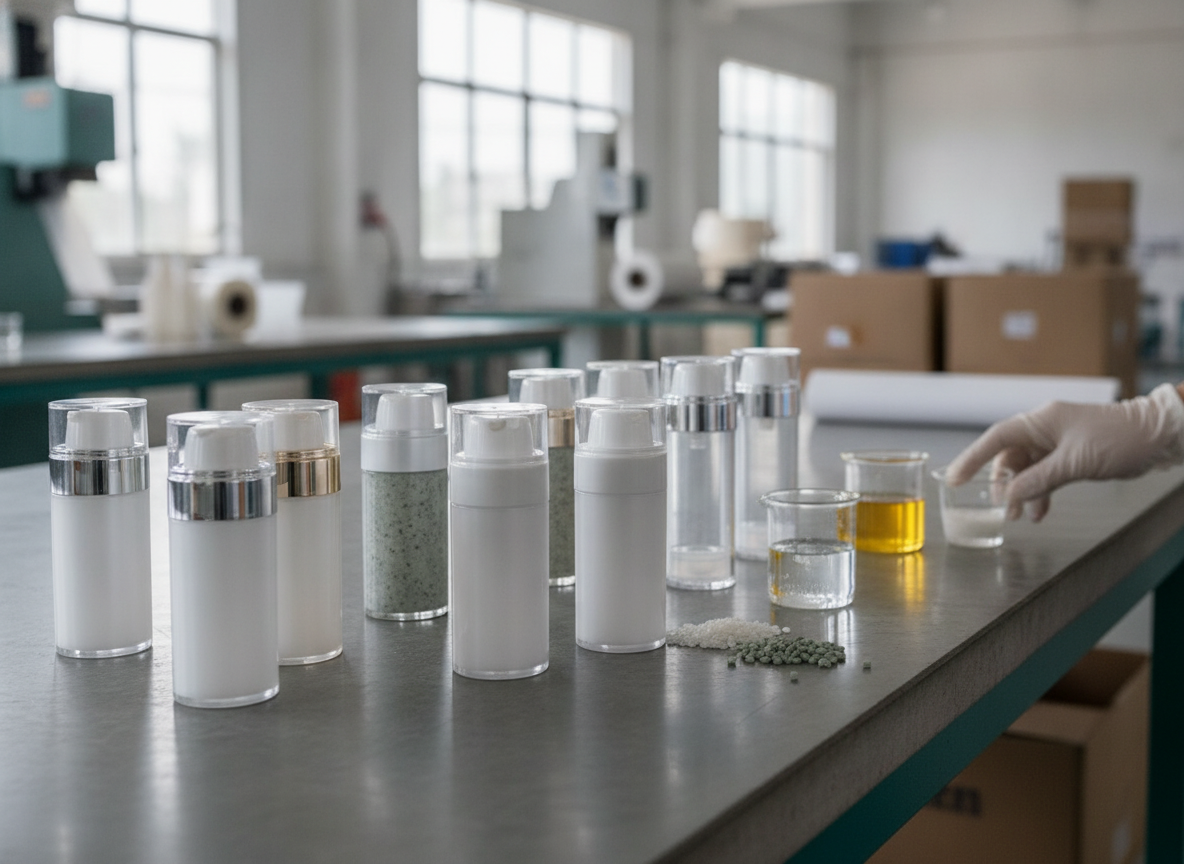
- PP: the default for good reason. It shrugs off acids, alcohol and most actives, and moulds thin enough for a piston to travel without flexing. PauPack runs it single and double wall.
- PCR: recycled content you can document. Ask for the percentage per component, not per pack — see this recycled-content bottle rangefor what the trail looks like.
- PET and PETG: clarity, glass-like, no breakage risk. Run the formula against the resin first; some solvents stress PETG over months.
- HDPE and PE: opacity plus squeeze. Light-sensitive actives stay safer behind a blocking wall.
- PLA and bio-based: plant-derived, and the wheat-straw PP bottles PauPack lists still behave like PP. Treat the filler as a small weight saving, not a new material.
- Single-material system: bottle, piston and pump in one resin. Skip it and your recyclable sticker is a stretch.
Ask for three things before you approve a PP sample: the resin grade sheet, a material declaration covering every component in the pack, and any regulatory statement the supplier holds for the resin. Buyers searching 'pp material airless pump bottles australia' should still ask for the PP grade sheet and the component declaration; the phrase is a search habit, not a shortcut. The documents identify the resin. They say nothing about whether your serum stays stable inside it.
How to Open an Airless Pump Bottle and Prime It
Your first production carton lands, and someone in the lab asks how to open airless pump bottle packs without wrecking the first unit. Fair question. On a sealed pack, you don't open anything; the actuator is the only way in.
Sealed airless packs arrive filled and closed at the factory. Priming means holding the bottle upright and pressing the actuator gently until serum appears. Don't pump hard or fast to speed it up. Forcing the actuator pushes the piston past its designed travel; the wiper can skip, product bypasses the seal, and the pack starts spitting or leaking. A few seconds of patience beats a scrapped unit.
A refillable airless bottle is a different animal. You keep the outer shell and pump engine, swap the inner cartridge or pouch, then re-prime with the same gentle presses. Check that the cartridge clicks home before you press anything.
Airless pack care is mostly restraint: store upright, wipe the actuator, don't unscrew the pump to top up, don't refill a sealed pack. PauPack's audit of seven common airless claimsis useful background on what the format can and can't do.
Do 1 oz Airless Pump Bottles Make Sense for Serum Samples?
Usually, yes. One ounce is about 30 ml, so the count falls straight out of the dose: 0.5 ml per use gives roughly 60 applications, 1 ml per use about 30. Daily use turns that into one to two months — long enough for a tester to judge texture and work out whether a new active suits their skin.
Where in that range you land depends on the pump output you choose and the dose the brand targets. It's arithmetic, not a lab result. PauPack lists "travel and sample formats" as a product family, and the PP all-plastic vacuum bottle it sells in the 30–50 ml range sits in that size class. Gift-with-purchase and hotel or gym-bag sizes come from the same thinking.
Pick the dose before you pick the bottle. A pump moves a fixed volume per stroke, and that volume shifts from one model to the next, so the same 30 ml reads as a one-month supply on a generous actuator and a two-month one on a stingy single shot. Match fill volume to your target dose, not the other way round.
Decoration gets tight at this scale. Silkscreen holds up on a narrow body; a full-wrap label crowds it. Sculpted and dual-chamber versions exist if the sample has to feel premium in the hand.
Viscosity decides as much as size does. A thin, watery serum moves through a pump chamber cleanly; a heavy gel can dose unevenly, so show your formulator the bottle before the formula is locked. Airless also keeps the product away from air, which matters for vitamin C and retinol-type actives that oxidise in a dropper.
Five numbers make a usable brief: fill volume, formula viscosity, target dose per use, decoration, and the date you need samples in hand. Compatibility testing still applies, because concentrating a formula into a small pack doesn't remove its risks.
Airless Pump Bottles Manufacturer China: Supplier Vetting Checklist
Ask one question early: does the plant mould both the bottle and the pump, or buy the engine in? Scope decides who fixes a leaking airless pack at 2am.
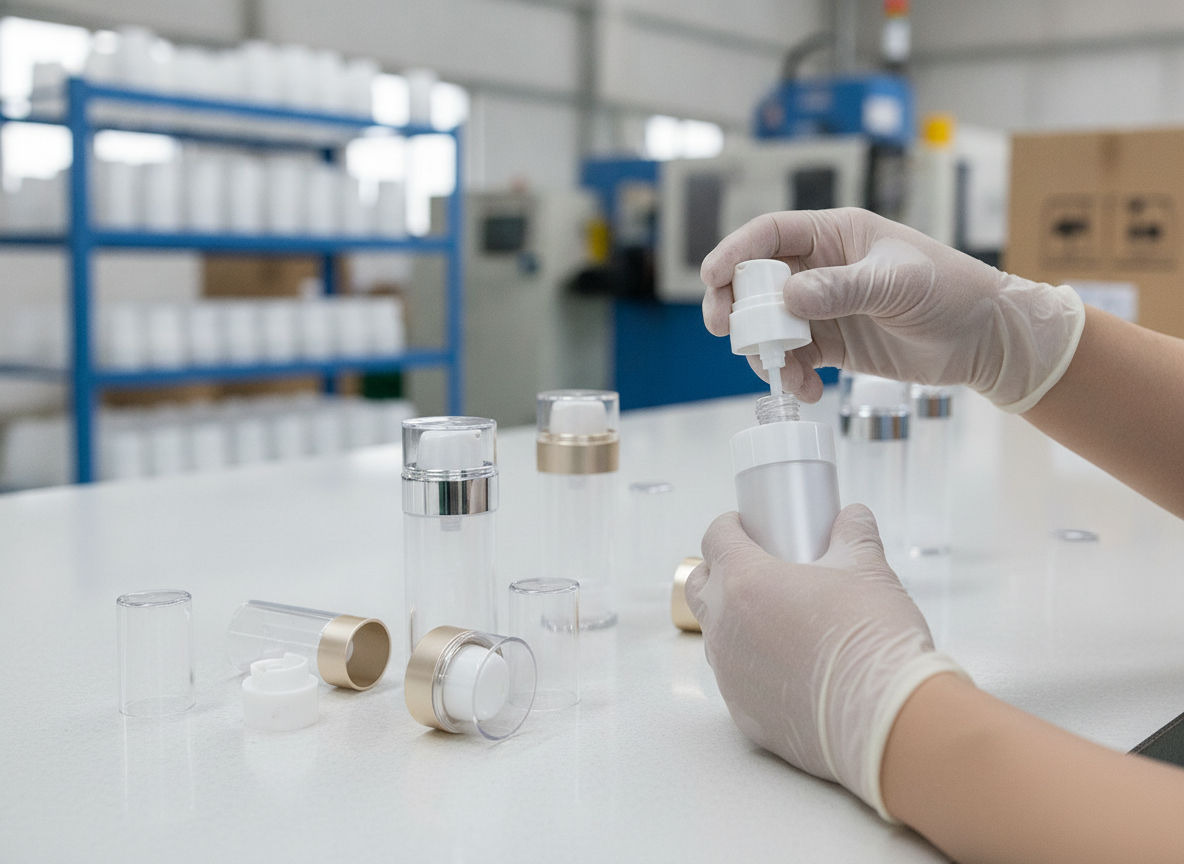
The failure point in an airless pack sits at the seal between pump and bottle neck, so component matching beats a glossy catalogue every time. A short list, with reasons:
- Factory scope. PauPack runs four plants covering bottles, components and paper boxes, so a mismatched neck finish gets corrected in-house instead of through three intermediaries.
- Certificates you can read. Ask what the ISO 9001 and ISO 14001 scopes cover, and request the SGS and TÜV NORD documents behind the logos PauPack's site lists. A logo alone tells you nothing.
- A named process. PauPack's nine steps run from brief and options through tooling, sample approval, production, assembly, checks and delivery. Sample approval is a gate you sign off, not a favour.
- Sample first. Dose the pump, watch the piston travel, load your serum for two weeks. Cheap here, expensive later.
Then test how they answer a technical email. Who replies, an engineer or a sales rep reading a script? Short, specific answers usually mean the factory floor is a short walk from the desk. Keep the evidence in one file (spec sheets, signed samples, certificate scans, email threads) so a dispute has a paper trail. For any airless pump bottles supplier in China, that folder outranks a low quote.
Quality, Certification and Compatibility Testing: What Evidence Should You See?
Ask for the paperwork before you ask for a price. A supplier that publishes neck finish charts and pump priming notes usually has the documents ready. One that answers "we are strict" has nothing.
Start with sampling. ISO 2859-1, the International Organization for Standardization's attribute sampling standard, sets the inspection level (general levels I, II or III) and the defect class you agree before production, not after a complaint. Ask which AQL you'll both sign against. Skip a written standard and disputes come down to whoever argues harder.
Sample approval is step five of PauPack's nine-step process, and I've stood through that sign-off often enough to know what a clean one looks like. Ten consecutive strokes on the same unit, at the fill the project will actually run. The sample passes when the dose stays even across all ten and the actuator returns to full rest every time.
It fails on a drip at the nozzle, a short or soft stroke, or an actuator still creeping back up at stroke seven. Would you sign off after one squirt? Nobody should. That is process experience, not a client case: no brand name and no measured result gets attached to it here, just the pass/fail line the sample room works to.
Then the drawings. Neck finish dimensions decide whether your pump seats without leaking, and the closure drawing should match the bottle drawing line for line. Pump priming instructions belong in the same pack. A piston forced dry can score the barrel.
Compatibility testing is the one buyers underestimate. Your serum goes into the actual airless pack, at the actual fill, and sits in a stability chamber under ICH Q1A(R2), the International Council on Harmonisation's stability guideline. A two-day bench test does not count. Packs are pulled at the 4-week check and again at 12 weeks, and both readings go into the file. Child-resistant packs need CR cap testing against the standard your market enforces; have the lab name the current reference before it goes into the spec.
Transport testing deserves its own line. Ask for ISTA series protocols from the International Safe Transit Association, matched to parcel, LTL or combined distribution, run on the packed, finished format. A pump that survives the bench but not a pallet drop is a return waiting to happen.
Certificates? PauPack states ISO 9001, ISO 14001, SGS and TÜV NORD. Read the scope. A logo alone proves little. For airless packs, that paper trail is the difference between a claim and a program.
PauPack publishes compatibility testing guidance for buyers, plus a blog post titled "Airless Pump Benefits: 7 Claims Audited" that takes seven common airless claims and checks them against the hardware. Read the audit first. If a supplier quotes a benefit that isn't in there, ask what test backs it.
MOQ, Tooling, Decoration and Scheduling: Planning the Packaging Program
MOQ on airless packs isn't one number. It moves with the bottle, the pump and the finish. A stock format with a frosted finish sits in different territory from a sculpted limited edition with a magnetic refillable closure, and the quote will tell you that before you fall in love with a mould.
Count components before you commit. A pump, a piston, a collar, a cap, an inner cartridge: each one carries its own minimum and its own tooling line. Order the set from one source. PauPack's four factories (injection and blow moulding since 2013, glass added in 2022) exist for that reason: matching a serum bottle to a closure that actually fits beats saving two cents across two suppliers.
Decoration drives MOQ and lead time together. Coatings, hot stamping and labels all need setup runs, so ask what the setup adds before you design a four-surface print.
Then walk the nine steps: brief, packaging options, quote and samples, design and tooling, sample approval, production, assembly, quality checks, delivery and follow-up. Put tooling on the calendar first. Everything downstream waits on sample approval, and sample approval waits on you.
First step: quote and samples. Email info@paupacking.comto request a quote and samples for your airless pump bottle format, decoration and finish. PauPack can match the pump, piston, collar and cap to the bottle, so the MOQ conversation covers the whole set.
Key Takeaways
Serum packaging leaves little room for error. These five decisions carry the most weight.
- Match format to formula before you shortlist. A water-thin serum and a thick gel need different pumps, so settle the formula first and choose the airless pack second.
- Specify bottle and components together. Neck finish, piston and actuator have to suit each other or the pack stalls before the fill line.
- Run the supplier checklist against evidence, not promises. ISO 9001, ISO 14001, SGS and TÜV NORD certificates count only when your model sits inside the scope.
- Plan MOQ and decoration early. MOQ varies by bottle, components and finish, and one late colour change can reset your quantity.
- Prime gently. Airless packs need a few strokes to clear air; forcing the actuator bends the piston.
Next step
Email info@paupacking.comand ask for a quote and samples in the same message. PauPack's nine-step process runs brief, packaging options, quote and samples, design and tooling, so the brief is what the whole pack gets built on. Vague briefs cost sample rounds.
Five lines do most of the work. Copy the list below into your email and answer each one in plain text:
- Fill volume: how many ml or oz the bottle must hold, plus any headspace you want above the fill
- Formula viscosity: water-thin, gel, emulsion or oil, and whether it contains actives that need a low-oxygen pack
- Target dose per use: how much one press should deliver, in mg or ml
- Decoration: label only, print, colour match to a Pantone reference, or none
- Sample-in-hand date: the day you need the physical sample, not the day it ships
Samples come before tooling for a good reason. A pump that handles a thick gel will fight a water-thin serum, and you'll only see the difference once the pack is filled and primed. Fill volume and dose per use are the two answers that decide which airless option gets shortlisted; get those wrong and the sample round restarts.
Send those five lines to info@paupacking.comand the first sample round gets built around your formula instead of a guess.
Frequently Asked Questions
How are airless pump bottles priced?
Price is built from parts: the body, the piston or wiper, the pump engine, the actuator, then decoration, labels and the box. A two-colour print run and a frosted finish can add more to the unit cost than the moulding does. Ask for a quote on the full pack, and keep the component list identical between quotes so the numbers compare.
What is the MOQ?
MOQ varies by bottle, components and finish. A standard cap and a custom-tooled actuator don't carry the same minimum. Fewer colours and one stock pump keep it low. If launch volume is small, ask which parts of the brief can come off the custom list.
What drives lead time?
Tooling is the slow part. New moulds, a custom actuator or multi-pass decoration push a schedule out further than filling does. Standard components and a simple label shorten it; repeat orders shorten it again. PauPack's nine-step process runs from brief to delivery, and each stage has its own slot.
How do you check quality?
Ask for the AQL sampling plan and inspection level in writing, then look at what gets measured: pump priming, dose consistency, leakage under storage, piston travel to the last gram. Certification scope matters too. PauPack states ISO 9001, ISO 14001, SGS and TÜV NORD certificates, and the scope lines tell you what was audited. Approve a golden sample and hold production against it.
Can airless pump bottles be customised?
Yes. Colour, soft-touch or matte finishing, silk screen, hot stamp, metallisation, plus the outer box and label all sit inside a normal project. Material is a design choice too: PP, PCR, PETG for clarity, or a single-material system if recyclability is the goal.
How do you open and prime the pack?
You don't open it. A sealed airless pack has no dip tube and no removable lid; the actuator is fitted and primed at filling. Prying or forcing it can unseat the piston.
Which certifications matter?
ISO 9001 for quality management and ISO 14001 for environmental management are the baseline most brands request. SGS and TÜV NORD reports support specific claims; read the scope, not the logo. Match the certificate to the claim you plan to print.
Which serums are compatible?
Water-based gels and lotions from roughly water-thin to a slow-flowing gel are the natural fit. Heavy oils, thick creams and formulas with large particles or high alcohol can separate, clog the pump or attack the piston. Run a compatibility test with your actual formula before tooling.