
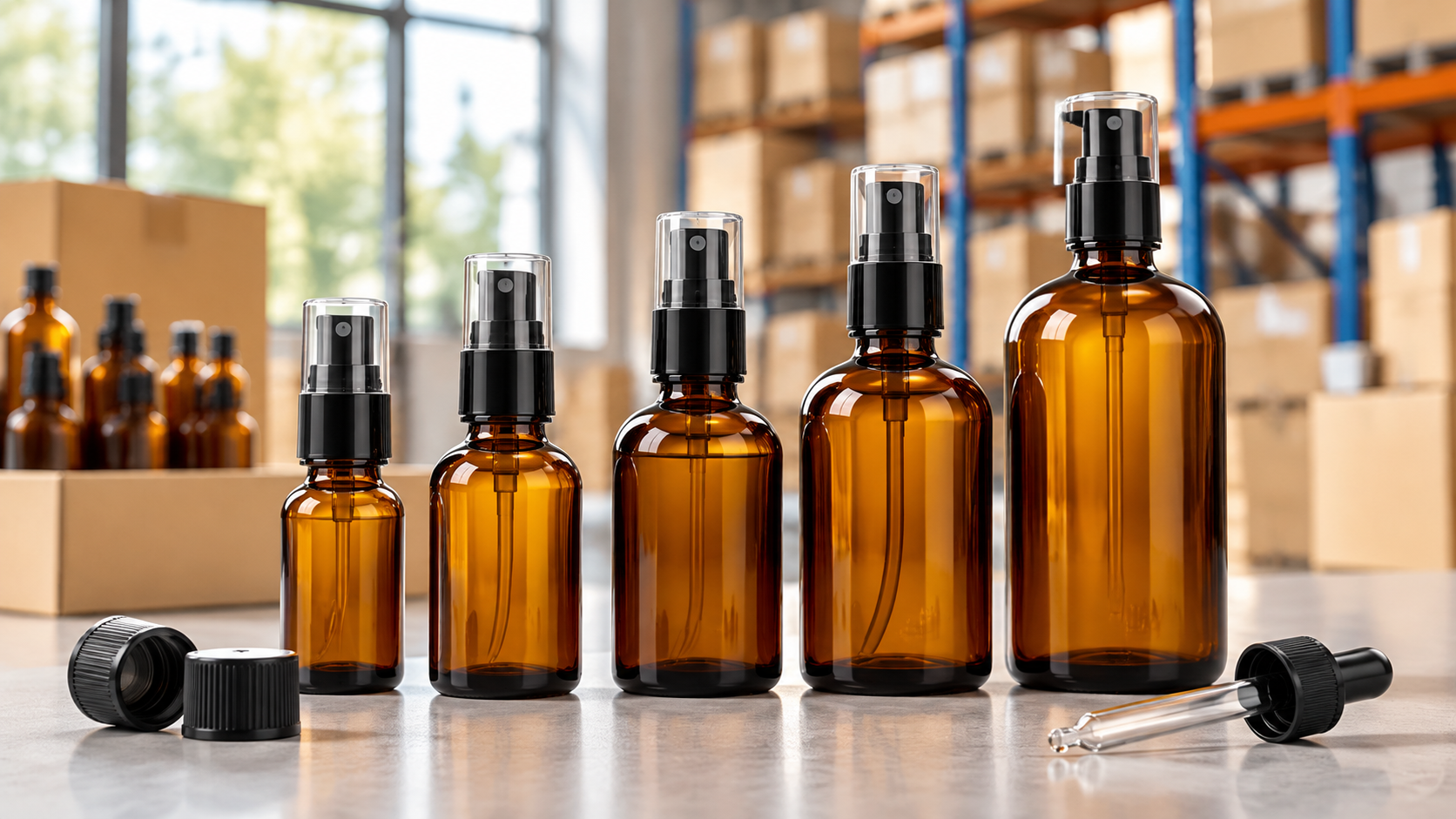
Amber glass absorbs short-wavelength UV and blue light, which is what keeps citrus oils, retinol and other light-sensitive formulas from going off. The color is in the melt, not a sprayed coating. But absorption alone won't protect a fill: an airtight closure and low headspace matter just as much. Those three requirements shape every amber glass bottles wholesale decision, from neck finish to case quantity.
Request a quote or a sample
PauPack lists 100ml Amber Glass Bottles in premium amber-colored glass among the 573 products on paupacking.com, a Suzhou-based one-stop glass packaging supplier. For your own batch, confirm the neck finish and closure before anything goes near tooling: thread size, liner material, and whether that closure actually seals against the fill you run. Ask the headspace question too. An inch of air above a citrus oil is an inch of oxygen working on it.
How Does Amber Glass Protect Skincare, Essential Oils and Pharmacy Formulas?
Amber works by absorption. Iron oxides melted into the glass batch soak up short-wavelength UV and much of the blue end of the visible spectrum, the band that drives most photo-oxidation — the light-catalysed breakdown that turns citrus oils bitter and browns a vitamin C serum.

If you formulate to a pharmacopoeial standard, two external documents define how glass containers get tested for light transmission. USP <660> Glass Containers is the monograph in the USP–NF that sets out the spectroscopic transmittance method for amber containers in the United States. Ph. Eur. 3.2.1, Glass containers for pharmaceutical use, does the same job in Europe; the text sits in the European Pharmacopoeia's 11th Edition, in force since 1 January 2023. The two are harmonised through the Pharmacopoeial Discussion Group, so a transmittance curve generated against one is broadly readable against the other. Neither is a PauPack certificate. They're public test methods. Hand the curve to a lab and you get numbers your customer's QA can actually check.
On the chemistry itself, the reference most formulators reach for is ICH Q1B, Stability Testing: Photostability Testing of New Drug Substances and Products(1996). It's the guideline behind the twin near-UV and visible-light exposures a drug product runs before anyone signs off on a pack. For the longer version, Tønnesen's Photostability of Drugs and Drug Formulations(2nd ed., CRC Press, 2004) walks through the degradation routes and makes the point that wavelength matters as much as dose.
Now the myth. Amber is not a blackout curtain. Long-wave UV and plenty of visible light still pass through, so a bottle parked in a sunlit window still fails — and that assumption, that amber means full UV block, is how a serum ends up brown at month six. Light isn't the only enemy either. Oxygen does as much damage as photons, which is why headspace and closure fit matter as much as colour.
So treat UV protection as one part of the barrier, not the whole story. Pair the glass with an airtight seal and a low fill headspace. The amber glass bottles for skincarerange shows the format logic; the frosted amber jars follow the same rule.
Which Amber Glass Bottle or Jar Format Fits Your Wholesale Program?
Format follows the fill, not the other way round. Choose the container your formula needs, then let the neck finish decide what screws onto it.
| Product | PauPack format | Closure | Best for |
|---|---|---|---|
| Essential oil, serum, spot treatment | 10ml Glass Roller Bottles | Roller ball and cap | Samples, travel sizes, tester sets |
| Facial mist, room spray | 30ml Amber Glass Spray Bottle | Sprayer | Small-format mists |
| Tincture, facial oil, apothecary blends | 100ml Amber Glass Bottles | Screw-top cap | UV-protected storage and DIY refills |
| Cream, balm, salve | 30g Frosted Glass Cream Jars | Screw lid | The frost hides fingerprints |
What the table really says: the closure is where orders go wrong. Buyers over-order glass and under-order caps, then find the sprayer they bought doesn't sit the way the render promised. Small cream launches start at the 30g cream jarsand grow outward from there. PauPack publishes neck finish charts for this exact reason. Check them before you commit to a container, not after the pallet lands.
My verdict on range building? Standardise. Four formats on two or three shared neck finishes cuts closure stock, lets caps move between SKUs and keeps your capping line sane. For distributors and private-label buyers running the same bottle under three brand names, that single choice protects margin better than any decoration upgrade.
Six Measurements That Set Your Amber Glass Bottle Specification
Your drawing is the contract. Fix these six numbers and the closures fit, the label sits straight, the fill line lands where you planned it. Miss one and you'll find out at the filler.
- Overflow capacity.Measured to the brim, never to your fill level. It's the only figure that tells you how much headspace a formula gets, and the one you check a fill claim against.
- Neck finish.Two letters carry it: T is the outside diameter across the threads, E is the diameter over the bead just below them. Those decide whether the cap's thread engages and where the liner seats. And the code after the slash isn't decoration — 18/415 and 18/400 both sit on an 18 mm opening, but the thread forms differ, so a cap moulded for one will not seal on the other. Work from the current neck-finish chart supplied for your project, not an older copy kept from a previous run.
- Body diameter and height.Together they set your amber glass bottle sizes against carton volume, pallet count, and whether the bottle clears an existing filler line.
- Weight and wall.Give weight a tolerance band, or shipment two will feel lighter than shipment one.
- Closure and liner.An airtight claim is a liner decision as much as a cap decision.
- Decoration zone.Print and label areas shrink once you allow for curvature and the mould seam.
Then write tolerances, not just nominal values. Moulded glass moves, and how far it moves belongs to the mould in front of you — a 200ml Boston body and a 30ml amber spray bottle don't come off the line to the same window. So before you sign the drawing, get the tolerance band from PauPack QC for that specific mould and put it on the sheet. AQL inspection then has something real to measure against.
Specifying a Small Amber Range: The Order the Decisions Actually Go In
Four SKUs, one amber family. This is an illustrative decision sequence, not a customer project — no client, no dates, just the order I'd lock things down in. That order matters more than most buyers expect.
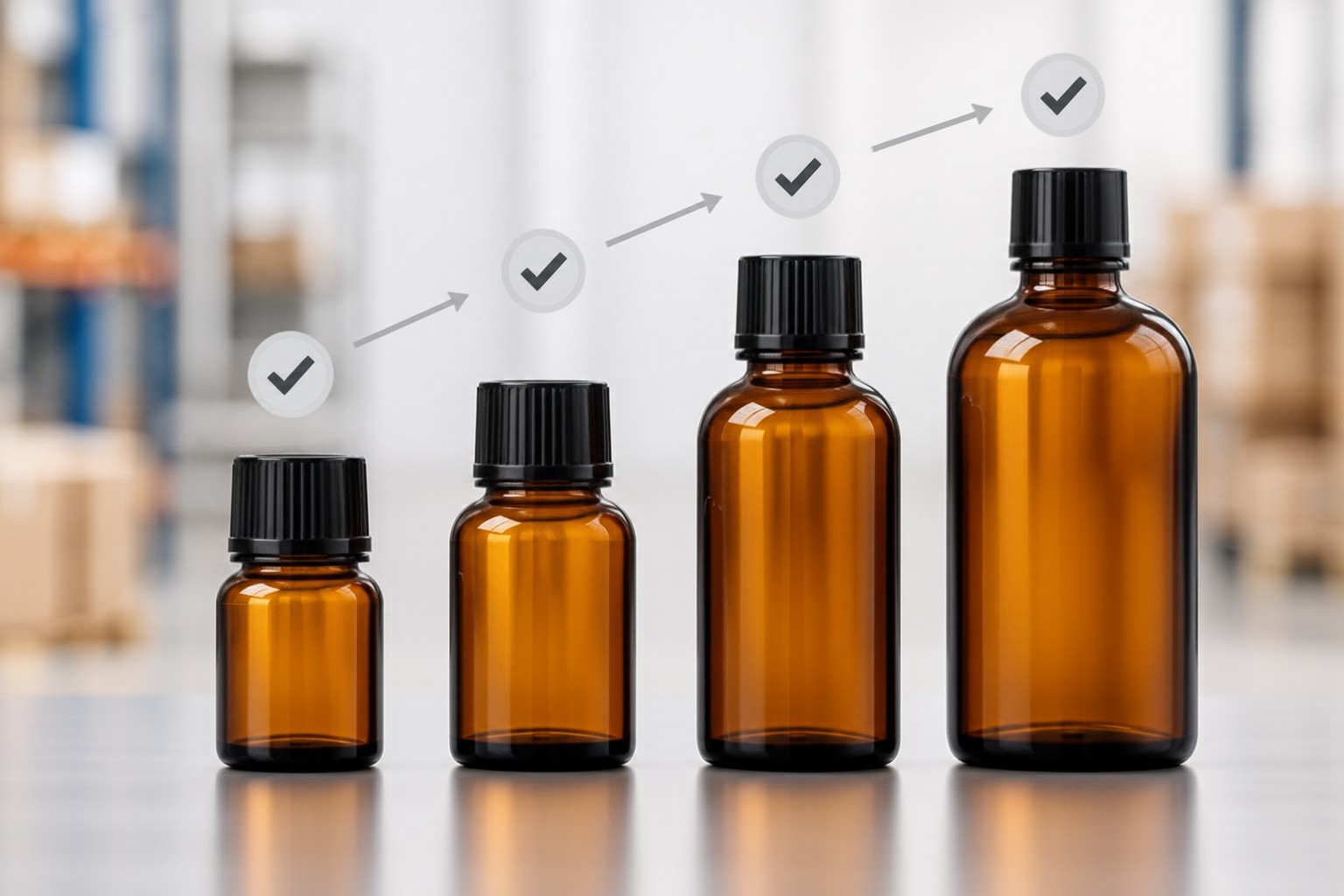
Start at the bottom of the range with a small roller or vial. It sets the neck thread for everything above it. Approve that thread first; get it wrong and every closure downstream rattles, weeps or sits proud of the shoulder. The 10 ml Glass Roller Bottlesthen copy it exactly — same neck, same cap, no new tooling.
Next the amber spray, 30 ml. Take the fine-mist versionand choose actuator and dip tube in the same breath as the bottle. A tube that bottoms out spits unevenly; one cut too short leaves the last few millilitres stranded. Most first-time buyers miss that entirely.
Last, 100 ml. Order the UV-protected amber bottle with a screw caponly once the small-format thread is locked, and treat the dropper assembly as its own approval — bulb fit, collar torque, how the pipette hangs inside the glass. Amber buys you UV protection by filtering the shorter wavelengths; how much protection depends on wall thickness and the glass itself, so don't assume two amber bottles behave alike.
One label width across all four sizes saves more than shaving glass weight ever will. And put an AQL sampling plan on the first production run rather than eyeballing a carton — PauPack publishes guidance on AQL sampling and neck finish charts if you want the vocabulary before the call.
Which Closure Should Go on an Amber Glass Bottle?
Start with how the product leaves the bottle. A screw cap suits the 100ml Amber Glass Bottles, and anything you pour. Droppers meter oils and serums. For mists, a sprayer, as on the 30ml Amber Glass Spray Bottle.
An airtight seal comes from contact, not torque. The liner (the disc inside the cap that presses against the neck rim) has to match the neck finish and the formula. Essential oils and alcohol attack some liner materials. And the cap must sit square, or you'll chase leaks forever. Check the published neck finish charts before you commit.
Transit leaks usually start with a closure backing off under vibration, or a liner too hard to compress. Test filled bottles upright and on their side before the pallet ships. Both, not one or the other.
- Screw cap:the low-cost default for the 100ml amber bottle; simple to fill and reclose.
- Dropper cap:choose it for dose control, then check pipette length against fill volume.
- Sprayer:use it for thin mists; orifice and priming decide the spray.
- Child-resistant (CR) cap:CR caps need a deliberate two-step motion to open, such as push-and-turn, and some pharmacy and high-strength oil products call for them. The common test reference is ISO 8317, the standard for reclosable child-resistant packaging; PauPack publishes CR cap testing guidance, and the mechanism still has to work after filling.
Private-label buyers, one more thing: standardise on a single closure family and one neck finish across your SKUs. One capping setup and one liner spec to qualify. Fewer spare parts to stock.
What Drives Amber Glass Bottles Wholesale Cost?
The glass itself is rarely the biggest line on an amber glass bottles wholesale price sheet. What you put on the bottle, and how the order is structured, decides more.
| Cost driver | What pushes it up | Lever you can pull |
|---|---|---|
| Glass weight and format | Thick walls and short, wide bodies use more glass and more furnace time per unit | Specify the lightest standard weight your filling line tolerates |
| Colour and frosting | Amber is a standard colour; frosting, coating and acid-etch add a second process pass | Keep frost to one zone, or use it on one hero SKU only |
| Decoration | Each print colour, coating and label is a separate pass with its own setup | Cut colours to two, reuse artwork across sizes, switch low-volume SKUs to labels |
| Closure assembly | Dropper, sprayer and pump components arrive as several parts and get hand-assembled | Standardise one closure family across the range |
| Order structure | Splitting volume across many sizes and colours spreads setup over fewer pieces | Consolidate onto one neck finish, then one colour |
| Freight | Glass is heavy and bulky; pallet and container fill decide a large share of landed cost | Fill containers, specify carton counts, keep bottle height down |
| QC level | Deeper AQL sampling and extra dimensional checks cost inspection hours | Agree the AQL level once, in writing, before the run |
Decoration cost is where most quotes surprise buyers: a heavy 100ml amber bottle with a plain screw cap is cheap next to the same bottle with two-colour print and a frost. Nail the decoration spec, then negotiate glass and freight.
Running a distribution or private-label line? The setups, not the glass, are what eat you alive. Every extra neck finish means a second closure catalogue, a second dropper or pump to stock, and a second minimum on liners. Every extra colour means another furnace run and another batch to hold. Twenty thousand pieces across four bottles costs more per unit than twenty thousand in one, because each mould change, each screen and each closure order pays its own setup. So consolidate to one neck finish (ideally the thread your closure supplier already stocks in volume) and let amber plus one frosted variant cover the range. Private-label customers will push for their own shape; give them a fixed menu of bottles and let the label, box or coating carry the difference. That single decision does more for your margin than any negotiation on unit price.
Before you ask for a number, send the spec. Tell us the sizes you need, the finish you want (amber as-is, frosted, coated), and the decoration: print colours, label, box, closure type. You'll get the quote split into glass, closure, decoration and freight, so you can see which line is eating the budget and where to cut. Request a quote at paupacking.com.
The MOQ Myth: Why One Number Never Covers a Whole Range
There is no single amber glass bottles MOQ. Ask "what's your MOQ?" and an honest supplier has to ask three or four things back: which body, which colour or frost, which closure, which decoration. The number moves with every one of them.
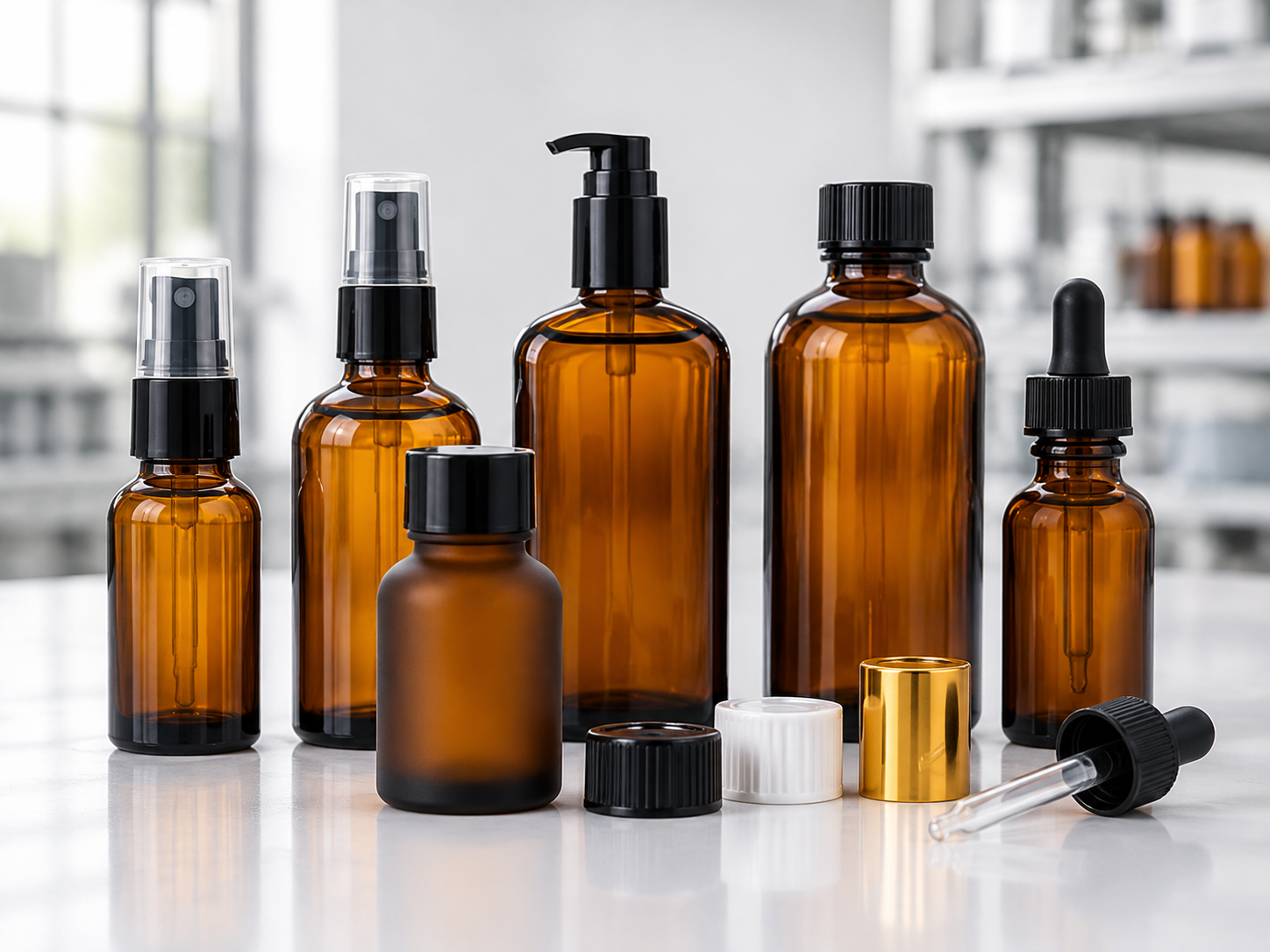
Published amber formats are specific, not endless: the 100ml Amber Glass Bottles, the 30ml Amber Glass Spray Bottle, and the two 100ml frosted amber jars — the golden-lid jar and the airtight pill jar. The stock-mould route is built around formats like those. You're buying time on existing tooling, picking a published body and neck, then choosing colour, closure and decoration around it. A custom mould is different work. New tooling, your own shoulder, your own neck thread, a sample-approval loop before production. That's a project, not a reorder.
Closures split the count again. A stock screw cap and a dropper with a specific pipette length are separate lines. Then decoration: a single-colour screen print and four-surface fragrance decoration will not share a break point. PauPack publishes MOQ discussion and RFQ sheets without fixed figures, which is sensible. Each line gets quoted on its own. Fix the size first, then the finish, then ask for the number. And if you're choosing between a manufacturer and a supplier, ask who controls the mould, who approves the sample, and who owns the decoration setup. Those answers tell you more than a headline MOQ.
Eight Checks Before Your Amber Glass Order Leaves the Line
Inspection isn't a formality bolted on at the end. It's your last cheap chance to catch a problem. After the pallet ships, everything gets expensive.
One term first, because it decides how many bottles you actually look at. AQL is the Acceptance Quality Limit: the worst process average, expressed as a percentage of nonconforming units, that you're willing to treat as acceptable. Lots at or below that level get accepted most of the time; lots above it get rejected most of the time. ISO 2859-1:2022 sets out the sampling schemes indexed by AQL for lot-by-lot inspection by attributes, and that's the document to name in your inspection plan. Put the agreed AQL level, the inspection level and the accept/reject numbers into the purchase order itself, not into an email thread. Sampling level and acceptance criteria agreed in writing before production starts is what makes the numbers mean something on the day the cartons are opened.
- Dimensional audit.Body diameter, height and neck finish, sampled across cavities rather than pulled from one mould. Half a millimetre of neck drift and your caps torque wrong or leak.
- Capacity.Weigh overflow capacity against your fill line. Short capacity turns into under-declared millilitres on the shelf.
- Visual defects.Bubbles, stones, seams, mould marks, chipped bore, colour banding. Sort them into critical, major and minor with the supplier before the run, because a "major" nobody defined is an argument carton by carton. PauPack publishes AQL sampling guidance for precisely this.
- Annealing.Residual stress in the shoulder cracks on your filling line, months after the warehouse signed off.
- Colour and frost match.Judge each lot against a signed master, under the same light, every time. Amber tone drifts, and a browner second batch reads as a different brand.
- Closure fit and leak test.Ask what application torque the factory holds and whether it inverts capped bottles over blotting paper before release; if nobody can show you a torque-and-inversion record, run it yourself. Cap three bottles to your filler's setting, invert them, wait and watch the liner edge for wicking. Most transit leaks come from liner and thread engagement, not the glass.
- Decoration adhesion.Tape-pull the coating or print. Anything that lifts in a wash-down feels cheap in the buyer's hand.
- Packing and transit trial.Drop one carton with closures assembled. Your quality control ends where the divider does.
AQL sampling is a statistical plan, not a certificate. It tells you whether to accept a lot; it says nothing about food-contact compliance, and no sampling record substitutes for the supplier's own documentation. Name the person who signs the inspection report in the same purchase order line as the AQL level.
OEM, Decoration and the Quote: Turning a Spec into an Order
Your spec is only real once it can be tooled. The path from drawing to steel runs in stages: form, mould, sample, fit, decorate, approve, cut tooling. Each gate closes off a mistake before it gets expensive, which is why PauPack runs that prototype-to-tooling sequence for custom bottles, jars, pumps and caps, then carries the same project through decoration, labels and boxes. The stages are standard. The calendar isn't.
Single source saves you the reconciliation work. Bottles, jars, droppers, sprayers, closures, decoration, labels and cartons come from one supplier, so a 30ml Amber Glass Spray Bottle arrives with the cap and box that fit it. Split the order across three vendors and you become the person chasing thread dimensions two weeks before launch. Not a fun job.
PCR, refillable and PLA options sit in the same range. Raise them at the prototype stage, not after tooling is cut: they're material and format decisions first, and how much one disturbs your mould depends on the build.
MOQ is negotiated per line in the RFQ, which is the honest way to do it. A 10ml roller and a 1 gallon pickle jar have nothing in common as a minimum run. Put sizes, closures, decoration and target volumes into the RFQ on paupacking.com, and the quote comes back against your actual mix rather than a catalogue average.
How to Choose an Amber Glass Bottle Wholesale Supplier for Private Label?
Eight things separate a supplier from a purchase order you'll regret. Work through them in order; the first two kill most bad matches.
- One-stop scope.Can they cover the bottle, the closure, the dropper or sprayer, the decoration, the label and the carton? PauPack lists 573 products across perfume, aroma, essential oil, dropper and roller bottles, cream and cosmetic jars, and food lines from juice to pickle, plus pumps, caps, droppers and sprayers. Every extra supplier is another set of tolerances to police.
- Neck and closure compatibility.Thread first, pretty bottle second. Ask for the neck finish chart and check the T and E dimensions against your pump, dropper or sprayer before you commit to a shape. A 100ml amber bottle with a screw-top cap is only useful if your cap torques down and seals. Buying bottles first and hunting a closure second is the classic private-label error.
- Decoration capability.Ask which surfaces they decorate, and when. PauPack's finishing range covers glass coating finishes, fragrance packaging decoration across four surfaces, and branded diffuser boxes and labels. Settle the sequence early, because decorating before filling means your decorator and your filler never touch the same carton.
- Quality documentation.Published guidance on AQL sampling, compatibility testing, CR cap testing and food packaging compliance tells you how to set an inspection level, and that's useful. The documents that actually travel with your lot are a separate agreement. Fix both at RFQ stage; don't discover what a failed AQL lot costs you on the first shipment.
- MOQ per line.One number for the whole catalogue is a red flag. A 30ml amber spray bottle, a 100ml frosted amber jar and a 500ml swing top each carry their own minimum, and decoration tends to set its own on top. Hand over your real mix and see what comes back.
- Samples.Get physical samples with your closure fitted, not studio renders. Check the frosted finish in daylight, the weight in hand, how the amber reads next to your label artwork, whether the pump primes without spitting. Photos hide plenty.
- Lead-time planning.Plan backwards from launch, not forwards from order date. Stock moulds and new tooling move on different clocks, and decoration adds its own queue. Ask for the current process and lead time in writing alongside your RFQ, then build slack around the answer. Any page that quotes one number for every SKU is guessing.
- Distributor and private-label support.PauPack works B2B and supplies cosmetics, skincare, fragrance, essential oil, candle, food and personal care brands along with wholesale buyers. Ask one question early: is your chosen shape a stock mould, or does it need a new one? That answer moves your launch date more than price does.
Request a quote and a sample through paupacking.com. Put the bottle size, closure type and decoration in the first message and you'll save a round of email.
Frequently Asked Questions
What actually drives the quote I get for amber glass bottles?
Weight and format set the floor. Decoration moves the number far more than the glass itself, and closure assembly, packing, freight and the QC level you ask for each take a slice. So ask for a quote that separates stock or mould cost, decoration and packing. Then you can pull one lever at a time instead of guessing at a total.
How few bottles can I order to start?
There's no single number, and anyone who quotes one over the phone is guessing. Minimums are set per size, per colour and finish, per closure and per decoration method, which is why a 10ml Glass Roller Bottle and a custom-moulded dropper won't share a threshold. Stock amber formats sit well below a custom mould. Send the sizes, finishes and quantities you'd want in a first run, and the RFQ comes back with a figure for each line.
How long does it take from order to delivery?
Stock amber items move fastest. Custom decoration and new tooling add stages; the site's "Custom Bottle Delivery: A Ten-Week Plan" walks through that sequence from spec to shipment as a planning outline, not a committed schedule. Allow your own buffer for ocean freight and customs clearance. That's usually where real timelines slip.
Does amber glass block all UV light?
No. Amber cuts short-wavelength UV and much of the blue end, but long-wave UV and visible light still get through. Oxygen damages essential oils about as fast as light does, so an airtight seal matters as much as the colour. Treat UV protection as risk reduction, not a shield.
Which closure suits my formula?
Screw caps for storage and apothecary work, droppers for serums and oils, sprayers for mists as on the 30ml Amber Glass Spray Bottle. An airtight seal comes from the liner meeting the neck land squarely, not from tightening harder. Transit leaks usually trace back to a mismatched neck finish, or a liner that swells against the oil. Check the neck finish chart before you approve a closure.
Can you match a colour, frost or decoration?
Yes. Coating finishes, fragrance decoration across four surfaces and branded boxes sit alongside labels in the range. Send a physical reference rather than a screen colour. Frost and coating read differently on glass than on paper, and thicker walls turn the same coating darker.
Do you offer recycled or refillable options?
PCR, refillable and PLA formats are offered next to standard glass. The 100ml Amber Glass Bottles are described as reusable and eco-conscious, which suits a brand building a refill story. Check the choice against your filling line first: recycled content can shift the tint from batch to batch, and PLA has limits of its own.
How is quality checked before shipment?
Dimensional audit, capacity, visual defects under AQL sampling, annealing, colour and frost match, closure fit and leakage, decoration adhesion, then a packing and transit trial. Compatibility testing with your actual formula is the step buyers skip and later regret. It costs a week and can save a container.
How do I get food-contact documentation for my market?
Request the paperwork your destination market requires, and say where the filled pack will be sold, because the EU, the US and China each ask for different declarations. PauPack's site covers food packaging compliance and compatibility testing as topics; the documents themselves travel with your quote request. Then test the filled pack, closure included. An empty bottle passing its checks tells you very little about a jar of chilli oil on a warm shelf.
How should I care for and reuse amber bottles?
Wash with mild detergent and warm water. Skip abrasive pads, which dull the frost and scuff the coating. Inspect the liner before every refill: glass tolerates repeated washing well, and the closure is what ages first.
Glossary: four terms worth knowing
- AQL(acceptable quality limit): the defect rate a sampling plan tolerates. An AQL of 2.5 on major defects lets a lot pass with up to that share of flawed units. It's a statistical filter, not a promise of zero defects.
- PCR: post-consumer recycled content, meaning glass cullet or resin recovered from used packaging and remelted into new bottles. Ask for the percentage, since the label alone says nothing about the ratio.
- PLA: polylactic acid, a plant-derived polymer used for some caps and inserts. It needs industrial composting to break down, so it isn't a drop-in answer for every market.
- 18/415 (T/E): a neck finish code. The 18 is the nominal diameter in millimetres and 415 the thread profile; T and E are the thread and neck diameters that decide whether a dropper or sprayer seats and seals.
Get a quote or a sample
Send the size, glass colour and finish, closure and liner, decoration method, first-run quantity and delivery country through the RFQ form. Add artwork or a reference sample if you have one. Ordering wholesale amber glass bottles and jars goes faster when the first message carries all of that. Want to fill and test before committing? Ask for a sample and run it on your own line first.