

A glass bottle neck finish is written as two numbers, and those two numbers decide which cap, dropper or pump will seal the bottle: 28/400, 20/410, 24/410. The first number is the thread diameter in millimetres; the second is the thread profile. A closure that matches only the first number will screw on and still leak.
Most glass bottle neck finish questions we answer begin the same way. A brand has a bottle it likes and a cap it likes, and neither photograph shows the part that matters. Then the samples arrive, the cap threads on halfway, and the launch date starts moving. What follows is the chart our team works from, the dimensions behind the code, and the checks that catch a mismatch before a mould is cut.
The Two Numbers in a Neck Finish Code
A neck finish is the section at the top of the bottle where the closure engages and seals. It includes the threads, the land area at the lip, the transfer bead below the thread, and the bore. When a supplier writes 28/400, they are describing that whole section in shorthand. Every glass bottle neck finish is also a compromise between the closure range you want and the mould you can afford.
The first number is the T dimension: the outside diameter across the threads, in millimetres. The second is the thread finish code, a three-digit profile number that describes thread shape, pitch and length. Both numbers belong to the specification. Neither one alone tells you whether a cap fits.
Those two numbers are shorthand for a full set of neck finish dimensions, and it is the drawing rather than the code that a mould shop works to. The T dimension is also the number buyers mean when they ask for a bottle neck size, which is why a bare “28 mm” answer needs the thread profile attached before anyone can quote a closure.
This is why two bottles that look identical on a shelf can take different closures. A 24/410 lotion bottle and a 24/400 lotion bottle have the same 24 mm thread diameter and different thread profiles. The pump that seals one may thread onto the other and weep at the shoulder.
T, E, I, S and H: The Dimensions Behind the Code
Five measurements sit behind every finish drawing. Only the first appears in the code, which is why a cap supplier will ask for the rest before quoting.
| Dimension | What it measures | Why it decides fit |
|---|---|---|
| T | Outside diameter across the threads | Sets which closure family can start on the bottle |
| E | Outside diameter of the neck below the thread | With T, sets thread depth: (T − E) ÷ 2 |
| I | Inner bore of the opening | Controls plugs, droppers, reducers and filling tubes |
| S | Top of the finish to the top edge of the first thread | Sets where the cap skirt sits and how the band breaks |
| H | Overall finish height, lip to transfer bead | Sets closure height, capping stroke and carton height |
The E and I dimensions are the ones buyers forget. A linerless cap with a plug seals on the bore, so an I dimension that runs small will hold pressure but refuse the plug. A dropper that reaches the base of a 100 ml bottle depends on H as much as on pipette length.
Glass Bottle Neck Finish Chart for Cosmetic Bottles
A glass bottle neck finish chart is a starting point for a brief, not a substitute for the bottle drawing: tolerances differ between moulds, and a glass finish is never exactly nominal. Six finishes cover most of the cosmetic glass we quote.
| Finish | Typical bottle | Closures seen on it | What to check |
|---|---|---|---|
| 18/400 | Small sample vials, mini perfume, 5–15 ml | Screw cap, reducer, roller assembly | Bore is narrow; filling needles and air displacement |
| 20/410 | Serum and essential oil bottles, 15–30 ml | Dropper, fine mist sprayer, screw cap | Plug diameter on linerless droppers |
| 24/410 | Lotion and mist bottles, 30–100 ml | Lotion pump, mist sprayer, disc-top cap | Dip tube length against bottle H |
| 28/400 | Perfume, oil and treatment bottles, 30–100 ml | Perfume sprayer, dropper, screw cap | Sprayer collar height and crimp or screw fixing |
| 28/410 | Lotion and cleanser bottles, 100–250 ml | Treatment pump, lotion pump | Pump output per stroke against the label dose |
| 45/400 | Reed diffusers and wide-mouth jars, 100–200 ml | Diffuser cap, screw cap, shaker insert | Reed bundle clearance and cap height |
A finish code describes the glass, not the closure. Two 28/400 sprayers from different suppliers can sit at different heights above the shoulder, which changes the total bottle height your carton was drawn around.
Published data sheets are the reference most suppliers work from. Cetie maintains finish data sheets for glass containers, and the Paramount Global guide to bottle neck finishes (2023) sets out the same T, E and I logic used here. Where a closure carries a safety function the definition gets tighter still: ISO 9057:1991 fixes the dimensions of the 28 mm tamper-evident finish for pressurised liquids down to a fraction of a millimetre.
Why a 24/410 Cap Is Not a 24/400 Cap
The diameter matches, so the cap starts. The thread does not, so the cap stops where the profile runs out of engagement. Two glass bottle neck finish codes can share a diameter and share nothing else. That is the failure mode we see most often, and it is a quiet one: the closure looks closed, the line passes it, and the leak shows up in a transit test or on a customer's shelf.
The practical rule is simple. Quote the closure against the bottle's finish code, not against its diameter. If a supplier offers to “make it work”, ask which thread profile their tool was cut to and put the answer in writing on the purchase order.
There is a second trap. Some 410 closures do thread onto 400 necks, and some 400 caps fit 410 bottles well enough to pass a hand check. Threading is not sealing. The land area and the plug do the sealing, and those can be a fraction of a millimetre apart while the thread still turns.
How to Measure a Neck Finish You Already Have
Measuring a glass bottle neck finish takes five minutes, three bottles from the same carton, and a pair of calipers.
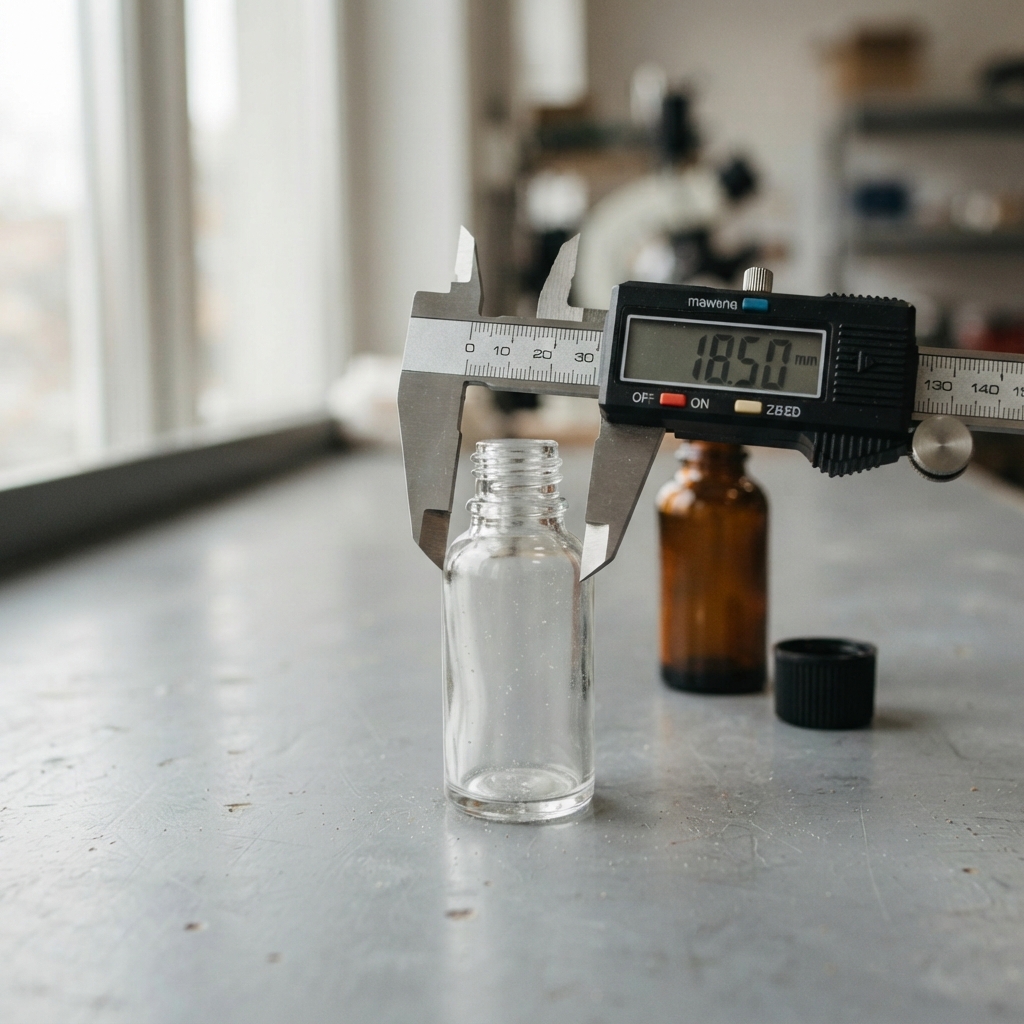
With calipers
- Measure across the threads at their widest point. That is T — 28.2 mm points to a 28 mm finish.
- Measure the smooth neck below the thread for E. If T minus E is around 1.2–1.6 mm, you are looking at a light cosmetic thread; a deeper figure suggests a heavier profile.
- Measure the bore for I, and the full finish height for H.
- Count the thread turns and note where the thread starts relative to the lip. That start point is what the S dimension controls.
- Repeat on all three bottles. A spread of more than about 0.3 mm on T across a carton is worth raising with the supplier before you order caps.
Without calipers
Press the opening onto a sheet of paper, trace the thread circle, and measure the trace with a rule. It is accurate enough to separate 24 mm from 28 mm, and it will not separate 400 from 410. For that you need the closure that came with the bottle, or a supplier who will measure a sample for you.
One more check costs nothing. Screw on a known cap and look at the gap between the cap skirt and the shoulder. A gap that is wider on one side means the finish is out of square or the thread has flash, and no liner will fix either. That single check tells you more about closure compatibility than any catalogue photograph.
Where Neck Finish Mistakes Come From
After enough projects, the same six errors keep turning up. None of them is exotic, and all of them are cheaper to prevent than to correct.
- Measuring the body, not the thread. Body diameter has nothing to do with cap fit. A 50 mm body can carry a 28 mm neck.
- Approving a cap before the bottle. The glass mould sets the finish; the cap must follow it. Reverse the order and you buy new tooling twice.
- Treating 400 and 410 as the same. Same diameter, different profile, different sealing geometry.
- Ignoring the I dimension. Plugs, reducers and droppers seal on the bore, and a 0.2 mm difference is enough to leak.
- Changing the finish after decoration approval. A coating or a fired decoration can add thickness at the land area, which changes the seal without changing the drawing.
- Forgetting the carton. A taller closure changes total height, and total height is what the box, the pallet and the freight quote are built on.
The fix is boring and it works: one finish drawing, signed by both sides, referenced on every purchase order for the bottle, the cap and the carton.
The Finish Is Not the Whole Pack
A glass bottle neck finish decision reaches further than the closure. On a filling line, the bore sets the nozzle size and the air displacement during a hot fill. On a capping head, S and H set the stroke and the torque window. On the shelf, the finish sets how tall the pack stands and how the cap sits against the shoulder.
Tamper-evident bands are the clearest example. The band needs somewhere to break, and that somewhere is a bead or a shoulder detail below the thread. Move the finish up by two millimetres and the band either bridges the gap or fouls the shoulder.
This is why we treat the bottle, the closure and the carton as one assembly rather than three purchases. The dropper cap comparison walks through the same logic from the closure side, and it is the article we send when a brand is choosing between a pipette and a screw cap on the same bottle.
Neck Finishes in Our Own Bottle Range
Our glass bottles are quoted with the finish written into the specification, so a closure can be matched before a sample is made. Three examples from the current range show how the code maps onto real packs.
| Bottle | Finish and size | Closure we quote with it |
|---|---|---|
| 100 ml glass perfume bottle | 28/400 neck, 50 mm body diameter, 150 mm body, 180 mm with sprayer | Perfume sprayer or screw cap; cap version stands 160 mm |
| 12 ml essential oil bottle | 28/400 neck, 28 mm body diameter, borosilicate glass, 65 mm body, 85 mm with dropper | Dropper assembly, clear or amber glass |
| 150 ml glass diffuser bottle | 45/400 neck, 6 inch body, 7 inch with diffuser cap | Diffuser cap, frosted or clear glass |
All three run at a 10,000 unit minimum with a 25 day production time, which is the pattern for our stock glass. A new finish, a new neck height or a new thread profile means new tooling, and that is a different conversation with a different timeline.
Testing a Bottle and Closure Pair
Once the finish matches on paper, four checks on filled samples settle it. We run them on the assembly as shipped, not on loose components.
| Check | Method | Pass condition |
|---|---|---|
| Leak | Fill, close to the specified torque, invert for 24 hours | No weeping at the thread or the land area |
| Torque | Measure opening and closing torque on ten units | Inside the closure supplier's window, consistently |
| Drop | Drop filled units from carton height onto a hard floor | Closure stays on; no chip at the finish |
| Compatibility | Store upright and inverted at elevated temperature | No swelling, clouding or liner deformation |
Add a thirty-cycle open-and-close test if the pack is reused, and a band-integrity check if it is tamper-evident. Two days of testing beats a container load of returns.
Frequently Asked Questions About Glass Bottle Neck Finishes
What does 20/410 mean on a glass bottle?
It means a 20 mm thread diameter with a 410 thread profile. The cap, dropper or sprayer must be specified as 20/410 as well. A 20 mm cap with a different profile will start on the thread and may not seal.
Is a 24/410 cap the same as a 24/400 cap?
No. Both are 24 mm, and the thread profile differs. Some pairs will thread together, which makes the mistake harder to catch. Test a filled sample rather than trusting the diameter alone.
How can I measure a neck finish without calipers?
Trace the thread circle on paper and measure the trace with a rule. That separates common diameters such as 24 mm and 28 mm. It will not tell you whether the profile is 400 or 410, so keep the original closure as a reference.
Can a neck finish be changed after the mould is made?
Not without new tooling. The finish is cut into the mould, and changing it means a new mould or a new insert. This is why the finish should be approved before any decoration or carton work starts.
Do all 28/400 bottles take the same dropper?
They take the same thread, not the same dropper. Pipette length has to reach the base of the bottle, and the collar height has to clear the shoulder. A 28/400 dropper built for a 100 ml bottle will close a 12 ml bottle and leave most of the oil out of reach.
What neck finish do perfume bottles use?
Perfume bottles commonly use 28/400 for screw sprayers and 15 mm or 13 mm crimp finishes for crimped pumps. The two systems are not interchangeable, and the choice usually follows the filling line rather than the design.
Does decoration change how the cap fits?
It can. Coating, spraying and fired decoration add material at the land area, and a thick coating can lift the cap or interfere with the seal. Approve decoration on the same drawing as the finish, or expect a surprise at the capping head.
Conclusion
A glass bottle neck finish is a specification, not a size. Read the two numbers, check T, E, I, S and H against the closure drawing, and test a filled sample before the order goes in. That sequence has kept more launches on schedule than any amount of sample swapping.
If you have a bottle and no finish drawing, or a cap that threads on and leaks, send us the bottle and the closure you want to use. Our team will measure the glass bottle neck finish and tell you which of our dropper bottle and closure combinations will seal it, or point you to a mould that will. Start with the contact page and include the bottle volume and the closure type you have in mind.