

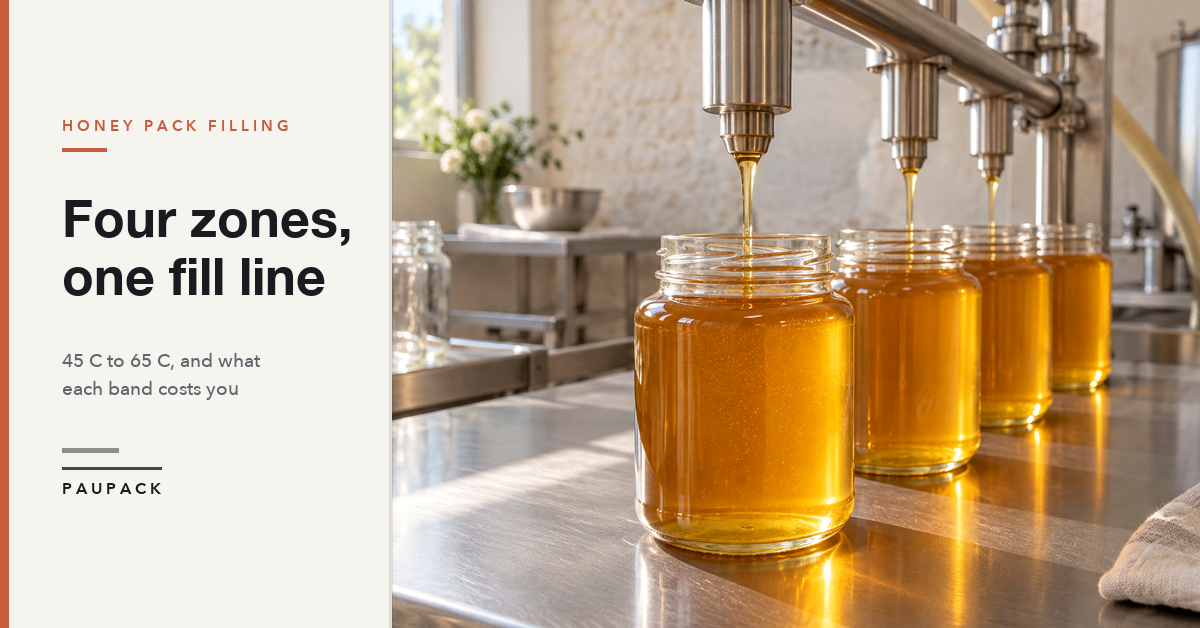
Honey jar filling temperature is the number that decides everything downstream: how the honey behaves at the nozzle, the headspace you actually ship, whether the lid releases for a customer, and how soon crystals show up in the jar.
Most brands settle on a figure early, usually by copying whatever a contract packer was already doing, and then spend months treating symptoms that all trace back to it. That is an expensive way to learn a simple lesson.
PauPack supplies honey jars and honey packaging to food brands across Europe, North America and the Middle East. Across those lines one pattern holds. Fill 8 C too warm and the complaints cost more than the time a fill 3 C too cool ever cost. Either way, a trial catches it and a launch does not.
What follows is the temperature ladder we use with brands: four zones, the numbers that move inside each one, and the trial that tells you where your product belongs.
Why Honey Jar Filling Temperature Decides the Pack
Honey is a supersaturated sugar solution, and two properties govern how it behaves: viscosity and dissolved air. Both answer directly to temperature.
Thick honey fills slowly. It traps air against the wall and leaves a domed surface that slumps into an ugly ring on cooling. Thin honey fills fast, and pays for it by releasing aroma, foaming readily, and finding its way past a gasket that was qualified on a heavier product.
There is a second effect, quieter but just as real. Temperature sets the vacuum in the sealed jar. A jar filled at 60 C physically holds more honey than the same jar filled at 45 C, and when it returns to room temperature, that extra volume disappears into the headspace.
The Four Temperature Zones, and What Each One Buys You
We describe the range as four zones rather than one target, because the right honey jar filling temperature depends on the honey, the jar and how fast the line has to run. Zone one protects the product. Zones two and three protect the line. Zone four is where quality problems start, even though it is the fastest and most tempting place to work.
Treat the boundaries as working figures from PauPack sample trials rather than legal limits. What matters is the shape of the curve, not the exact boundary. Viscosity falls quickly with heat, and the side effects climb just as quickly alongside it.
Zone One: 45 to 50 C, the Slow Fill That Keeps Aroma
At the bottom of the range, honey still moves. Slowly. A raw or lightly filtered product keeps more of its volatile aroma compounds down here, and the colour stays closer to the sample that was signed off.
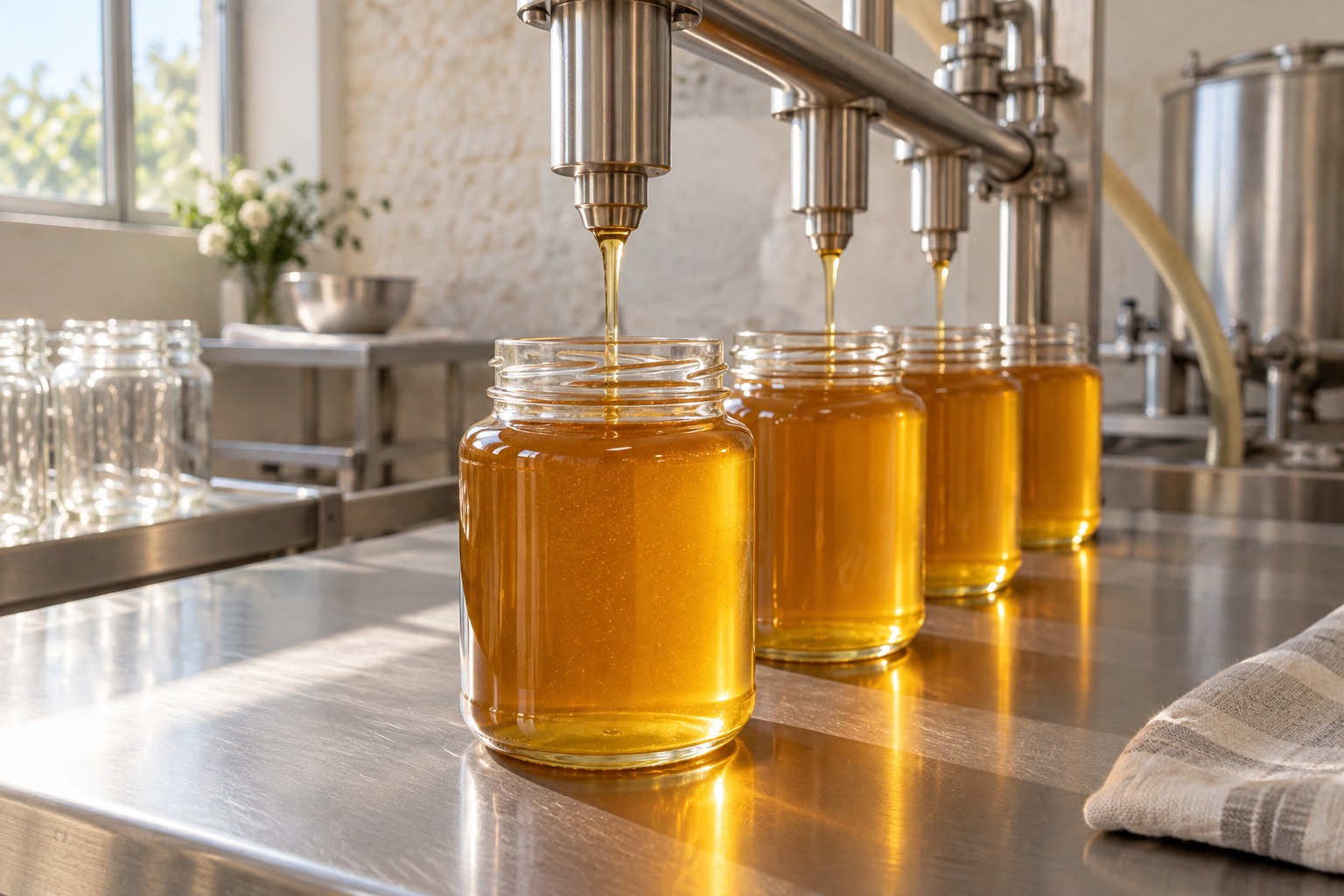
You pay in line time. A nozzle sized for 55 C honey fills a 340 g jar noticeably slower at 47 C, and a fixed-stroke piston pump turns any drift in product temperature straight into fill-weight variation. For those products the honey jar filling temperature is the whole quality argument, and the extra minutes are the price of the claim on the label. PauPack quotes the fill window for every mould, so the trial has a number to work towards rather than a feeling. Zone one suits short runs and premium products.
Zone Two: 50 to 55 C, the Working Band for Most Lines
This is the band where most PauPack honey projects land. It is the honey jar filling temperature that keeps viscosity low enough for a smooth fill and a level surface, while staying far from boiling off the aroma that makes the product worth buying in the first place.
It is also the easiest band to hold. A jacketed tank with a simple thermostat rides 50 to 55 C all shift. Try holding 47 C through a cold morning and you will need a chiller as well as a heater.
Zone Three: 55 to 60 C, Fast Fill and a Thinner Product
Above 55 C the honey jar filling temperature is high enough that the product pours almost like syrup. Fill weights become easy, foam collapses faster, and the last jar of a run matches the first. On a high-volume line with short cycles, that is genuinely worth having.
What you trade away is aroma and vacuum headroom. Loss is measurable at this end of the range, shrinkage on cooling is larger, so the gasket takes a harder pull. And if a sleeve or label goes on the line, a hotter surface can change how the adhesive behaves.
Zone Four: Above 60 C, When Warm Filling Backfires
Past 60 C the line runs fastest and the risks stack up. Volatile compounds carrying the floral and citrus notes leave the product, colour drifts darker in storage, and any crystal or pollen already in the batch is now fully dissolved and ready to re-form the moment the jar cools.
Heating honey has a legitimate purpose, and pasteurisation is a real step in some products. But that decision belongs to the product specification, not to the filling machine. Filling hot because it is convenient is how a jar ends up crystallising in eleven weeks instead of fourteen months.
Viscosity and Headspace: Two Numbers That Move Together
Viscosity decides how the jar fills. Headspace decides how it ships. Temperature links the two, so both belong on the same line of the trial sheet.
| Fill temperature | Approximate viscosity | Headspace to plan | Line behaviour |
|---|---|---|---|
| 45 C | 2,400 cP | 4% | Slow, high fill-weight variation, minimal aroma loss |
| 50 C | 1,500 cP | 5% | Steady, good surface levelling, low foam |
| 55 C | 900 cP | 5 to 6% | Fast, easy weight control, some aroma loss |
| 60 C | 600 cP | 6% | Very fast, harder vacuum on cooling, colour drift over time |
| 65 C | 400 cP | 7% | Fastest, but crystallisation and aroma risk both rise sharply |
Those figures describe a typical floral honey at 18 percent moisture. Creamed honey behaves on a different curve entirely, because its structure rather than its sugar content controls flow, and it is usually filled cool through a positive-displacement pump.
Why Honey Crystallises Faster in a Warm-Filled Jar
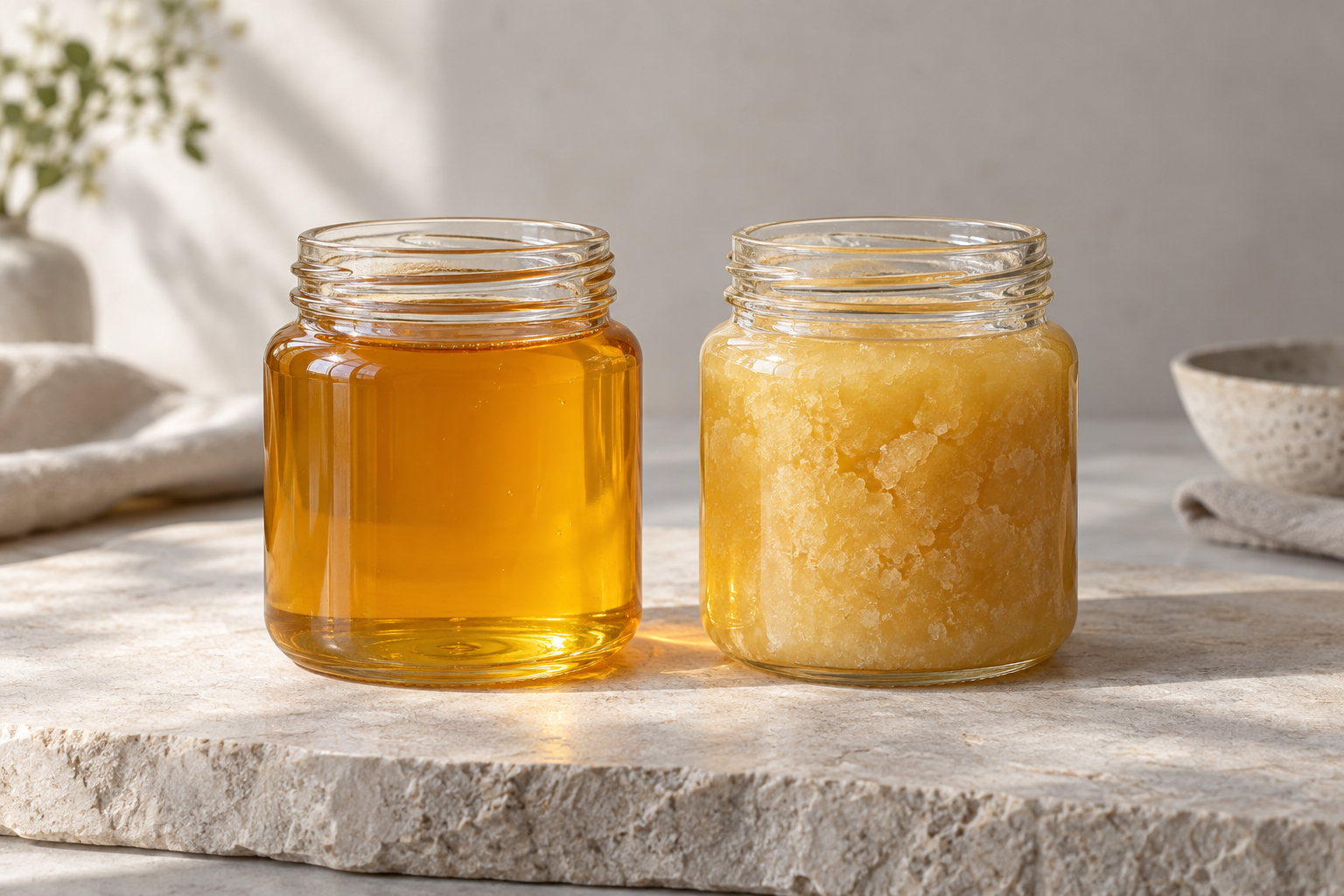
Crystallisation is a seeding process, and honey arrives carrying the seeds: pollen grains, tiny crystals, dust. Nothing short of a full melt removes them. The honey jar filling temperature decides how many survive the trip into the jar.
Warm filling does two things to that population. It dissolves the smallest seeds, which then re-form later as a far larger number of fine nuclei. And it lowers viscosity, so those nuclei spread evenly through the jar instead of sitting near the bottom.
What a customer sees is a jar going cloudy as one mass rather than from the base upward. Customers who want a long clear shelf life usually choose the other direction: filter finely, stay in zone two, accept a slightly slower line.
Cooling, Vacuum and the Lid That Will Not Release
Every sealed jar carries a small vacuum once it reaches room temperature, and that is not a fault. It is evidence of a sound seal. Trouble starts when the vacuum is stronger than the lid and gasket were built for.
| What the customer reports | What the trial sheet usually shows | First change to make |
|---|---|---|
| Lid cannot be turned by hand | Fill above 60 C with 7% headspace | Reduce fill temperature before changing the lid |
| Honey weeping around the thread | Torque set hot, then re-checked never | Set torque on cooled jars and re-check at 24 hours |
| Pale foam ring under the lid | Nozzle above the surface, fast final third | Submerge the nozzle and slow the end of the fill |
| Surface settling below the shoulder | Headspace planned for cold fill | Add 1 to 2 percent headspace allowance for hot product |
| Crystals in eleven weeks | Fill in zone four, light filtering | Move to zone two and tighten the filter |
Honey Jar Filling Temperature and the Nozzle You Need
Nozzle geometry follows the honey jar filling temperature, not the jar on its own. At 50 C a 12 mm nozzle with a gentle taper fills a 340 g jar cleanly. Drop to 45 C with the same nozzle and you get a rope of honey curling against the wall with air trapped underneath it.
PauPack sizes the fill path from trial data, and the rule of thumb is blunt: the colder the fill, the wider and shorter the path. Keep the tip below the surface for the whole stroke as well. Finish above the honey level and you leave a crater that the next jar inherits as a foam ring.
Moisture Pick-Up, Foam and the First Centimetre
Honey is hygroscopic. Leave it open and it pulls water out of the air, which collects at the surface, raises local moisture and invites fermentation. Seal it and the same process continues in the headspace, which is exactly why the gap above the product matters.
A large warm headspace holds more water vapour. As the jar cools, that vapour condenses on the underside of the lid, and over months it can drip back and leave a pale, thinner layer on the surface. PauPack holds headspace to 5 or 6 percent and treats the honey jar filling temperature as a fixed specification rather than a line preference, which keeps the effect too small to see.
A Fill Temperature Trial You Can Run in a Day
One batch, one jar format, four temperature points, and you have the answer for every future run.
- Draw a single homogenised batch and split it into four jacketed vessels at 47 C, 52 C, 57 C and 62 C.
- Fill twelve jars at each temperature through the production nozzle, with the tip kept below the surface.
- Record fill weight and headspace height for every jar, and photograph the surface within two minutes of filling.
- Apply caps at production torque, then re-measure torque on three jars per group after 24 hours at room temperature.
- Hold the remaining jars upright at 20 C and inspect at day 1, week 2 and week 6 for foam, condensation and crystal onset.
- Write the winning temperature, headspace percentage and torque pair into the specification, and attach the photographs to the batch file.
PauPack runs the trial with the brand's own honey rather than a laboratory simulant. Two floral honeys at identical moisture can differ more than two temperature zones do, and only the real product shows you which side of the curve you are on.
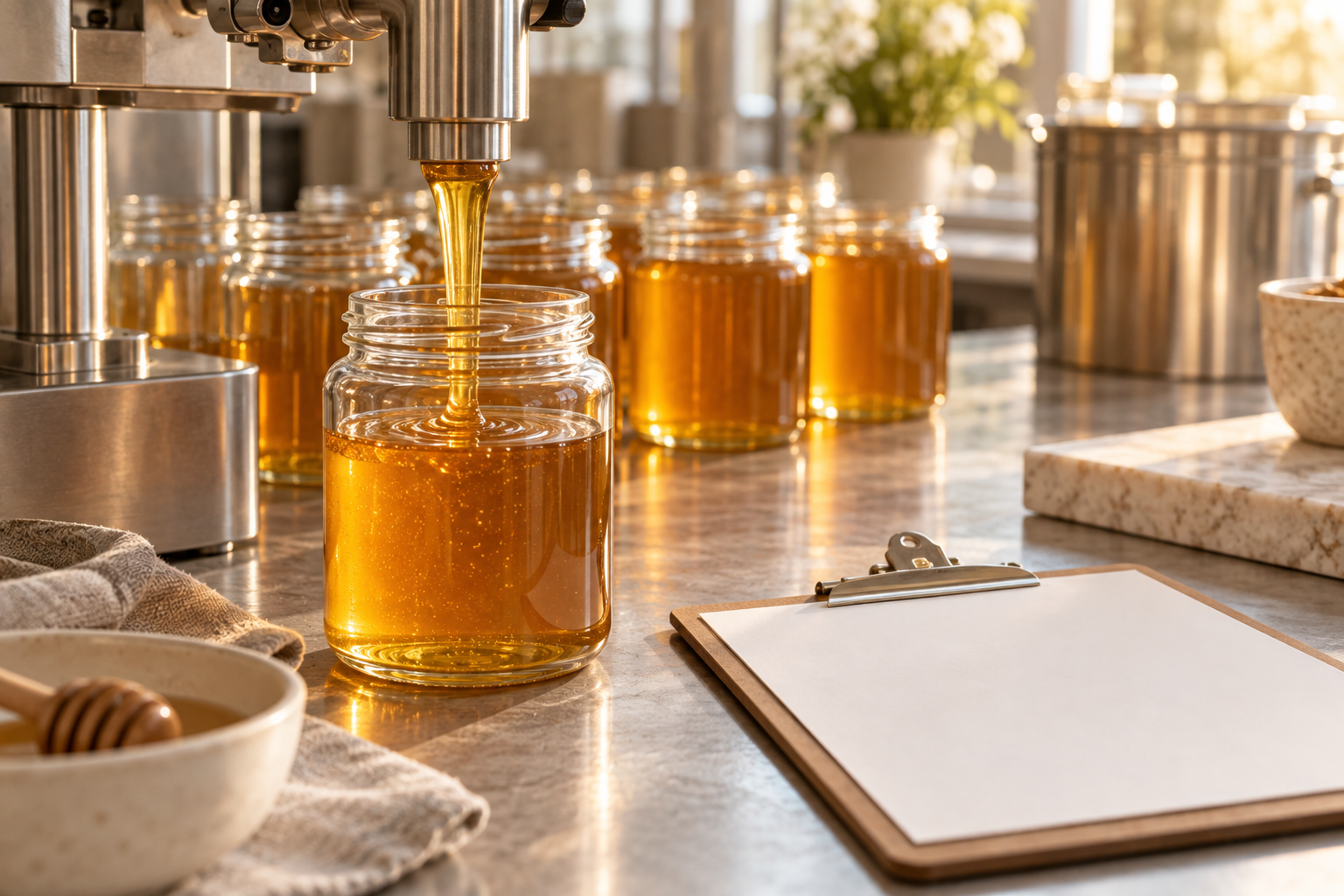
What a Temperature Failure Looks Like Six Weeks Later
The evidence arrives weeks later, and it usually comes from a retailer's quality team rather than from your own line.
PauPack keeps retained jars from the trial batch and compares them at six weeks against the photographic record. It costs almost nothing and it converts a vague argument about shelf appearance into a documented result. The same discipline runs through our packaging quality control checklist and the storage checks covered in glass jar headspace.
What PauPack Prepares Before a Honey Jar Run
A honey jar is not a generic food jar, and the differences show up at the filling head. The neck finish has to suit the lid actually being used. The bore has to be wide enough for the pump or nozzle at the planned viscosity. And the glass weight has to survive a vacuum without being heavier than the shelf positioning can justify.
PauPack prepares honey jars wholesale in whatever mould, finish and decoration combination the brand needs, and supplies reference jars from the trial so the temperature result can be reproduced on a different line. Brands comparing formats usually start from food grade glass bottles and glass yogurt jars, which share the same wide-bore filling logic. The preserve side of the family is covered under pickle jars and maple syrup bottles.
One more check belongs on the list if the jar ships into the United States alongside a household product, because the closure may fall under consumer packaging rules. The CPSC business education pages are a sensible place to start, and it is a far cheaper question to answer at sample stage than after the artwork is signed off.
Honey Jar Filling Temperature: The Questions Brands Ask Us
What is the best filling temperature for honey?
For runny honey in 250 to 500 g glass jars, aim at 50 to 55 C. That is warm enough to drop viscosity for a clean fill and a level surface, and cool enough that you are not chasing aroma loss or a punishing vacuum once the jar comes back to room temperature.
Does filling temperature change honey viscosity?
Far more than most people expect. Honey reading around 10,000 cP at 20 C can fall to roughly 1,500 cP at 50 C, and under 800 cP at 60 C. Same pump, same nozzle, completely different behaviour across a single shift.
Why does my honey jar lid feel sucked down after cooling?
Because it probably is. Warm honey takes up more space than cold honey, and when it contracts the headspace goes with it. That vacuum is normal, until the fill was too hot or the headspace too generous, and then it starts pulling a soft gasket into the thread.
Will warm filling make honey crystallise faster?
It can, and the mechanism is worth understanding. Seeds below roughly 60 C survive the fill, then re-form as a much larger number of fine nuclei as the jar cools. Hot filling also whips in more air, and every bubble is somewhere for a crystal to begin.
How much headspace should a honey jar have?
Plan on 4 to 6 percent of the jar volume when the honey goes in hot. The gap shrinks as the product cools, so a jar that looks slightly overfilled on the line usually settles exactly where you want it a day later.
Can honey be filled cold?
Absolutely, and for raw or unpasteurised product it is often the smarter choice. You keep enzymes, aroma and colour. What you pay for it is line speed, wider pump openings and a fill weight that wanders more than anyone would like.
Does filling temperature affect the lid torque setting?
It does, and this is where leakers are born. A cap applied to a warm jar is torqued against a warm gasket, and the seal relaxes as everything shrinks. PauPack sets torque on cooled jars, then re-checks at 24 hours instead of trusting the number taken on the line.
How do I stop honey foaming during filling?
Keep the nozzle under the surface, fill against the wall rather than straight down the middle, and ease off over the final third. Foam is only air, and air in a honey jar reappears later as a pale ring at the top and a crystallisation pattern nobody planned for.
Is there a food safety limit on fill temperature?
Honey is a low-moisture product, so bacterial growth is not the worry. Moisture migration and quality loss are. The USP packaging and storage requirements make the same general point for sensitive products: container, closure and fill condition get qualified as one system, not three separate decisions.
What should a fill temperature record include?
Product temperature at the nozzle, room temperature, fill weight, headspace height, cap torque measured hot and again after 24 hours, and the batch code. Six lines. With those six, PauPack can measure a second production run against the first without repeating the trial.