

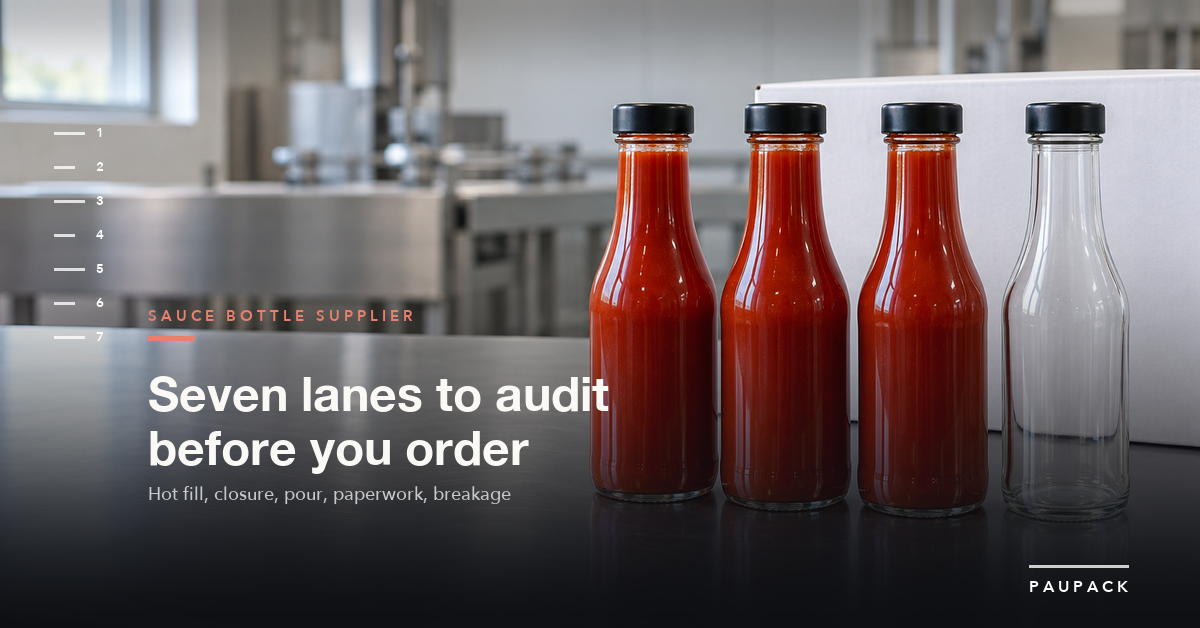
A sauce bottle supplier is not selling glass, it is selling shelf life, pour control and a breakage rate. Brands who buy on the bottle price alone usually meet the other three costs about six weeks later, on the filling line or in a returns report.
PauPack makes glass jars and bottles for food and beverage brands, including pickling, preserving, sauce and condiment lines. We qualify packs on seven lanes before quoting, and this page sets out those lanes in the order we work through them, so a brand can compare two suppliers on the same brief rather than on two different conversations.
What a Sauce Bottle Supplier Has to Solve
Start by deciding what a sauce bottle supplier is being asked to own: the bottle, the closure, the label advice, or all three.
A sauce is not a stable product from a packaging point of view. It is warm when it is filled, acidic in most recipes, sometimes thick enough to hold a bubble, chilled after opening and dropped on a kitchen floor at least once in its life.
Each of those facts lands somewhere on the pack. The point of qualifying a sauce bottle supplier is to find out whether the person quoting knows where, and a single question about fill temperature answers that. A supplier who asks about fill temperature and pH in the first reply is usually a supplier who has run sauce before.
The Product Chemistry Comes Before the Glass
Start with the recipe, not the shape. Acidity drives liner choice, sugar and salt drive the risk of corrosion on a metal closure, and viscosity decides the neck more than any design reference will.
This is also the step where the pack meets regulation. The FDA food ingredients and packaging pages set out how contact materials are treated in the United States, and the food contact substances section covers the notification route when a new material is introduced. A supplier's documentation should be able to sit next to those rules without translation.
Lane One: Hot Fill and Thermal Shock
Most sauces are filled warm, and warm filling is where bottles crack for reasons that have nothing to do with thickness. Thermal shock is a property of the glass and its annealing history, so it has to be asked about explicitly.
Give the supplier the fill temperature and the cooling method. A bottle that survives a bench fill at 60 degrees Celsius is not automatically suitable for a line that fills at 88, and the difference only appears during production, which is the worst possible time to find it.
Lane Two: Closure and Cap Compatibility
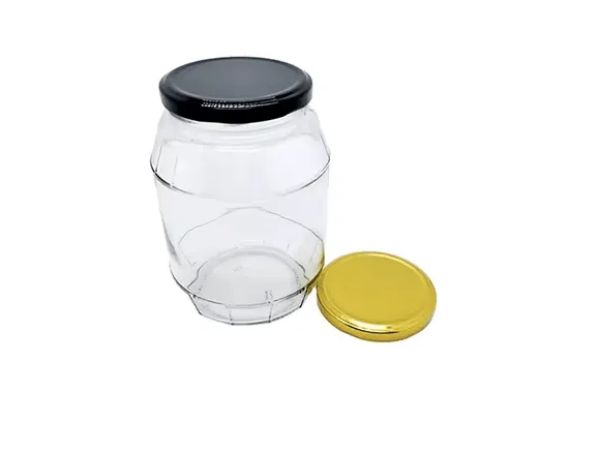
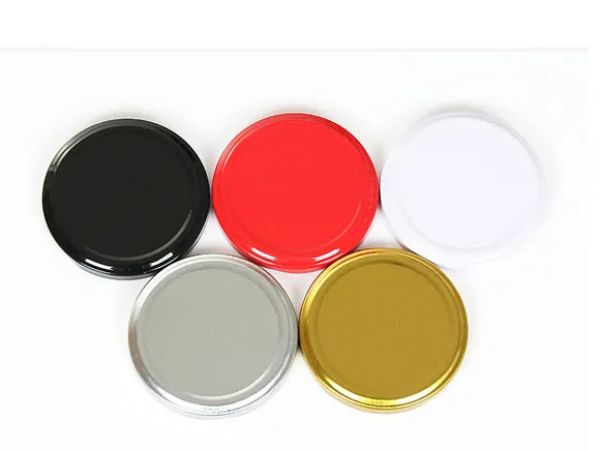
The closure is where a sauce pack earns or loses its shelf life. Twist-off metal caps with a plastisol liner dominate, and the liner grade has to match both the acidity of the product and the temperature of the fill.
PauPack quotes the neck finish and the closure together, with a torque window for the filling line. A supplier who quotes glass alone leaves the brand to discover that the cap it likes only comes in a diameter the bottle does not have. The accessories supply list is kept on the same sheet as the bottle for exactly this reason.
Lane Three: Viscosity and the Pour
Viscosity decides the orifice, and the orifice decides whether the customer complains. A thin vinegar-style sauce in a wide mouth leaves the bottle faster than the hand expects; a chunky product in a narrow neck blocks and has to be shaken.
The middle range is where restrictors and flow inserts earn their cost. PauPack tests a filled unit at fridge temperature as well as room temperature, because a sauce that pours well from a 20 degree bench can stop moving at 5 degrees.
| Product behaviour | Neck direction | Typical closure | What to test |
|---|---|---|---|
| Thin and pourable | Narrow with restrictor | Twist-off metal, small orifice | Pour rate from a chilled bottle |
| Medium, dressing style | Standard 43 mm to 63 mm | Twist-off metal or lug cap | Drip control after pouring |
| Thick or chunky | Wide mouth | Wide twist-off with a spoonable opening | Release from the jar, residue at the neck |
| Pressurised or carbonated | Narrow, pressure rated | Crown or swing top | Hold pressure over a warm week |
Lane Four: Food Contact Documentation
Documentation is the lane most often skipped by brands buying for the first time. Glass is generally accepted as a contact material, but the liner, the decoration that faces product and the gasket are not automatically covered.
A sauce bottle supplier should be able to send this as one pack. Ask for a declaration that names every part touching the product and the standard behind the claim. If the supplier answers with a certificate that covers the bottle but not the cap, the pack is not documented, only half of it is.
Lane Five: Decoration That Survives a Fridge
A sauce bottle lives in a cold, wet, handled environment that no other glass pack quite matches. Labels meet condensate, hands meet the label edge, and the bottle is wiped on a counter and returned to the door shelf.
Decoration has to be tested in that state. PauPack chills a decorated unit, wipes it, then checks adhesion and legibility, and asks the brand to use the same label stock in the production run rather than an equivalent. Substituting an adhesive after approval is the most common cause of a peeling label claim.
Lane Six: Volume, MOQ and Seasonality
Sauce has a season. Q4 gifting, summer barbecue and holiday preserving all move volume, and a supplier whose capacity is already booked will quote a longer lead time rather than a better price.
Ask for the lead time at the volume being ordered, not at a reference volume. A stock bottle with a stock closure moves quickly, while a decorated cap or a new mould adds weeks. The bulk pickling jar sourcing walkthrough shows how we sequence a seasonal food order around that calendar.
Lane Seven: Transit and Breakage Rate
Glass is heavy and sauce is heavy, so the shipping pack is doing double duty. A sauce bottle that survives a single drop but loses two percent on a pallet is an expensive choice regardless of its unit price.
Ask the supplier to state a breakage rate and to describe how it is measured. PauPack ships with dividers and a tested pallet pattern, and the quality management record keeps the transit result with the project so a repeat order can be checked against the same evidence.
Scoring Two Suppliers on the Same Brief
Bring both candidates to one sheet. The weighting below is the one we suggest to brands running a competitive round, because it prevents a low unit price from hiding a gap elsewhere.
| Lane | Weight | What a strong answer looks like |
|---|---|---|
| Hot fill and thermal shock | High | Asks for the fill temperature first |
| Closure and neck finish | High | Quotes the cap with the bottle, with a torque window |
| Viscosity and pour test | High | Offers a chilled pour test on a filled unit |
| Food contact documents | High | Names every part touching product |
| Decoration durability | Medium | Tests the label in the wet and cold state |
| Lead time and seasonality | Medium | Quotes lead time at the ordered volume |
| Breakage rate | Medium | States a number and how it is measured |
Two sauce bottle supplier quotations that answer all seven lanes are comparable. One that answers five perfectly and skips two is not cheaper, it is incomplete, and the missing lanes are where the launch date usually goes.
Red Flags in a Quotation
A sauce bottle supplier that answers all seven lanes is rare enough to keep. The warning signs are consistent across the market, and they appear in the paperwork long before they appear in a shipment.
| Signal | What it usually means | What to ask instead |
|---|---|---|
| Closure quoted separately with no neck finish | Fit was never checked | One line for bottle and closure together |
| No fill temperature question | No sauce experience on the file | Send a sample through the real fill condition |
| Food contact claim without a standard named | Documentation is a template | Ask which parts the declaration covers |
| Lead time quoted at a reference volume only | Capacity was not checked | Lead time at the ordered quantity, in writing |
| Breakage rate not mentioned | It has not been measured | A number, plus the packing method behind it |
What to Ask on the First Call
Five questions take ten minutes and shorten the project by weeks: what temperature will the product be filled at, how thick is it at room and fridge temperature, what is the pH, what volume does the range need in year one, and which market will it be sold in.
PauPack asks those five before suggesting a shape. With the answers, a sauce bottle supplier can narrow the bottle, the neck finish and the closure in a single pass, and the sample that follows is a comparison instead of a catalogue.
What PauPack Provides for Sauce Lines
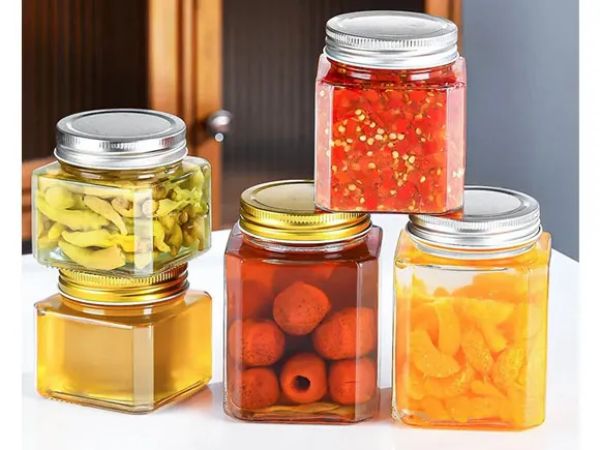
The glass pickle and pickling jar range covers the wide-mouth formats most sauce and preserve lines start from, and the food and beverage category lists the bottles, swing tops and closures that pair with them.
For hot sauce specifically, the hot sauce bottle flow path explains how the neck and the orifice are chosen, and the pickle jar wholesale notes cover the closure and lid selection that follows. When a range needs to start small, mention it on the first call: the stock route exists so a brand can test two sauces before committing to a mould.
Send PauPack the recipe characteristics, the fill temperature, the volume and the market through the inquiry form and PauPack will return a qualification sheet across all seven lanes rather than a price list.
Sauce Bottle Supplier: Ten Buyer Questions
What should I look for in a sauce bottle supplier?
Seven things, in this order: hot fill capability, closure compatibility, orifice matched to viscosity, food contact documentation, decoration that survives chilling, honest volume terms and a stated breakage rate. PauPack audits suppliers on those lanes because a cheap bottle that fails at any one of them costs more than the saving.
Does hot fill change the bottle specification?
It changes almost everything downstream. Filling above roughly 85 degrees Celsius puts the glass under thermal shock and the closure under pressure, so the bottle needs a documented annealing quality and the cap needs a liner rated for the temperature. Ask for the fill temperature before the bottle is quoted.
Which closure suits a sauce bottle?
It depends on the sauce. A thin vinegar-style product suits a small orifice or a flow restrictor; a chunky sauce needs a wide mouth and a spoonable lid. Twist-off metal and lug caps dominate, and PauPack quotes the closure with the neck finish as one line so the fit is not discovered at filling.
What food contact documents should a supplier provide?
A declaration covering the glass, the liner and any decoration that touches product, plus the test basis behind it. In the United States the material questions are framed by the FDA food contact rules, and the supplier should be able to name the regulation or standard its declaration rests on.
Will a sauce bottle label survive refrigeration?
It will if the adhesive and the surface were tested together in the cold and wet state. A label applied to a dry room-temperature jar and judged on a bench is not evidence for a fridge door. PauPack runs the chilled and wiped condition before approving a label stock.
How much breakage is normal in transit?
A well-packed glass sauce bottle should arrive with a breakage rate in the low fraction of a percent, and the number belongs in the contract. A supplier who cannot state a rate is a supplier who has not measured one, and that gap becomes your cost.
Can the same bottle serve several sauces?
Often yes, and it is the fastest way to build a range. One 250 ml body with a different closure and label carries a hot sauce, a marinade and a dressing, which keeps the print run large and the unit cost down. Change the closure, not the mould.
Is a wider neck always better for thick sauces?
Wider helps filling and spooning and hurts dosing. A wide mouth on a pourable sauce pours out faster than the customer expects and ends up on the plate. Match the neck to how the product leaves the bottle, not to how easily it enters.
What volume does a sauce line start at?
A stock bottle with a decorated closure and a printed label starts lower than a custom mould, because the tooling is already paid for. PauPack quotes the stock route and the custom route with the crossover volume so the brand can see what its range has to sell before a mould makes sense.
What should the first conversation cover?
Fill temperature, viscosity, pH, target volume and the market. Those five answers let a sauce bottle supplier narrow the bottle, the neck and the closure in one pass instead of sending a catalogue. Everything else in the pack follows from them.