

A kombucha bottle pressure test answers one question: at the warmest point in its journey, will this bottle and this closure still hold? Producers usually answer it from a supplier rating on a drawing, and that rating describes the glass rather than the filled pack.
PauPack supplies kombucha bottles and glass beverage packaging to brewers in North America, Europe and Australia, from 250 ml singles to 750 ml sharing formats. Most failures we investigate share one cause: the pressure figure was taken cold, the shipment spent a week warm, and the difference was never measured.
What follows is the pressure budget we build for every kombucha project, from carbonation volume to closure choice and the warm room hold that decides release.
What a Kombucha Bottle Pressure Test Has to Prove
Three things have to be true together. The glass has to carry the highest pressure the product will reach, the closure has to hold that pressure without creeping, and the fill level has to leave enough headspace that the gas has somewhere to go as the liquid expands.
A kombucha bottle pressure test that checks only the first of those is a burst test, not a pack qualification. The failures that reach consumers are rarely bursts; they are lifted caps, seeping gaskets and the occasional bottle that breaks in a case because a neighbouring bottle vented.
Carbonation Volume to Internal Pressure
Pressure follows dissolved CO2, and the conversion is the first number in the budget. The table below shows the internal pressure at 20 C for typical kombucha carbonation levels.
| CO2 volumes | Pressure at 20 C | Style | Bottle rating needed |
|---|---|---|---|
| 2.0 | 1.7 bar | Lightly sparkling, cold chain | 4 bar |
| 2.5 | 2.1 bar | Standard retail kombucha | 6 bar |
| 3.0 | 2.5 bar | Brisk, most common target | 8 bar |
| 3.5 | 3.0 bar | Highly carbonated, warm-market risk | 10 bar |
| 4.0 | 3.4 bar | Near beer carbonation, needs a rated bottle | 10 bar and a pressure closure |
PauPack asks producers for the carbonation target before the bottle is chosen, because the difference between 2.5 and 3.5 volumes is the difference between a decorative bottle and a pressure-rated one.
Temperature Is the Multiplier
The same bottle at the same carbonation carries very different pressure across a summer. Pressure rises with temperature roughly in line with the solubility curve, and glass strength falls slightly at the same time.
| Storage temperature | Pressure at 3.0 volumes | What it means for the pack |
|---|---|---|
| 4 C | 1.0 bar | Safe, and why cold chain hides design problems |
| 20 C | 2.5 bar | Reference condition for the test record |
| 30 C | 3.6 bar | Retail floor in a warm month |
| 40 C | 4.5 bar | Container interior and unshaded warehouse |
| 50 C | 5.8 bar | Beyond most closures, and where caps lift |
This is why the kombucha bottle pressure test is run at 40 C rather than at room temperature. A pack that only survives at 20 C is not a pack, it is a cold-chain assumption that nobody wrote down.
The Headspace Decision and Nucleation
Headspace is not wasted volume; it is a buffer. Fill too full and there is nowhere for expanding liquid to go, so the closure takes the strain. Fill too low and the bottle holds more gas volume, which raises pressure and gives the liquid a larger surface to degas into.
PauPack works to 4 or 5 percent of nominal volume on a still fill and checks it as a running measurement rather than a visual line. The fill height also decides nucleation behaviour: a rough fill that leaves foam clinging to the wall gives CO2 a place to come out of solution, and a bottle that foams on opening is usually a bottle that has been degassing for days.
Glass Strength Is a Distribution, Not a Number
Every glass container has a range of burst pressures, not a single value, and the range is set by surface flaws, mould seams, cord and how the base was formed. Two bottles from the same pallet can differ by thirty percent.
The practical consequence is that the kombucha bottle pressure test has to be run on a sample large enough to find the weak end of that distribution. PauPack burst tests twelve bottles from each batch and reports the lowest value rather than the average, because the lowest value is what the consumer holds.
Closure Choice: Crown, Swing Top and Screw
The closure decides whether a sound bottle stays sealed. A crown cap holds pressure well and fails by venting, which is usually a controlled, visible failure. A swing top reseals cleanly after opening and depends on a rubber gasket that hardens with age. A screw cap is the most convenient and the least stable if the torque is set warm.
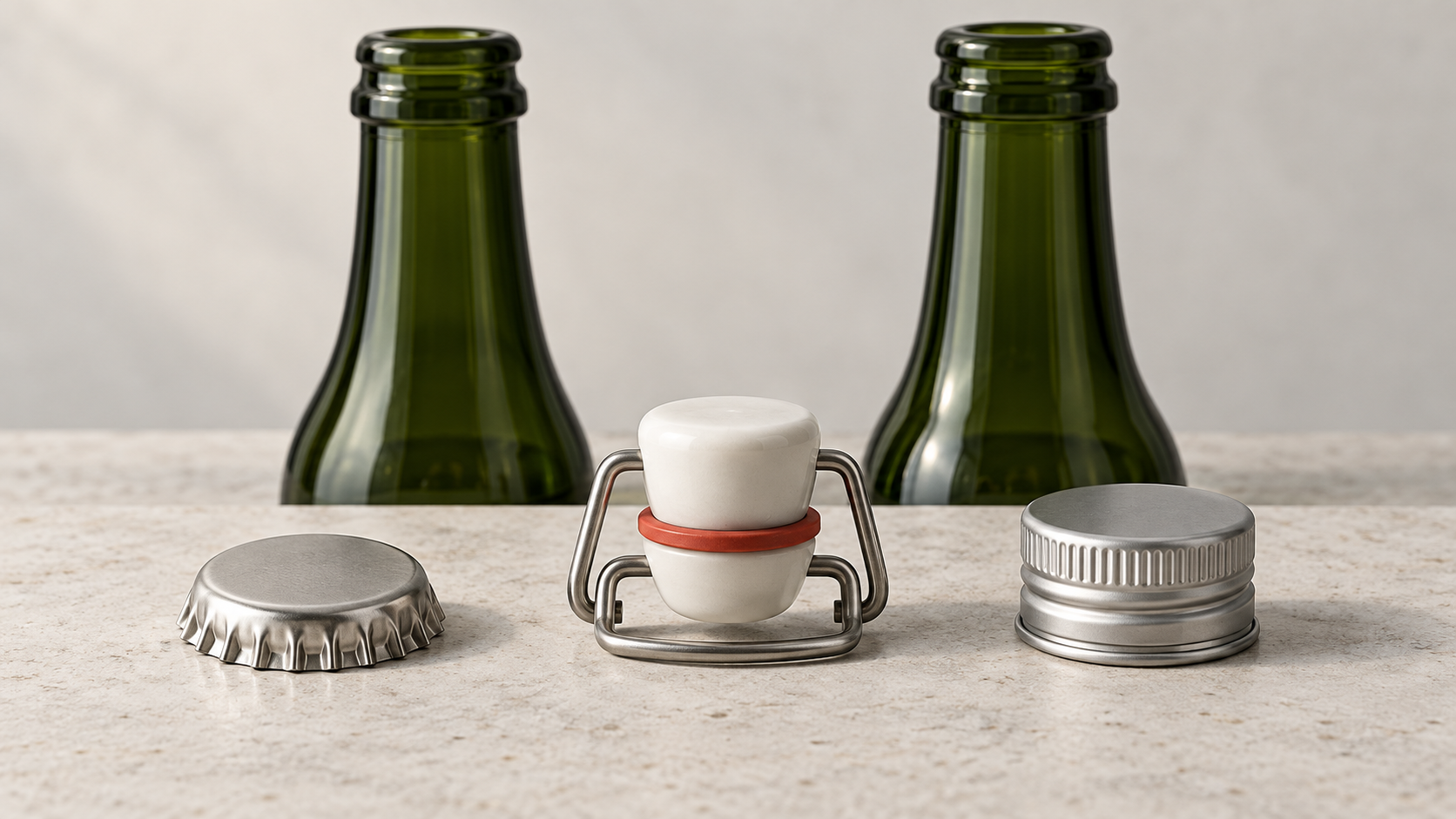
Whichever is chosen, the kombucha bottle pressure test should use it rather than a laboratory equivalent. PauPack also records closure torque at application and again after fourteen days, because torque lost during storage is what turns a sealed bottle into a leaking case.
Running the Warm Room Test
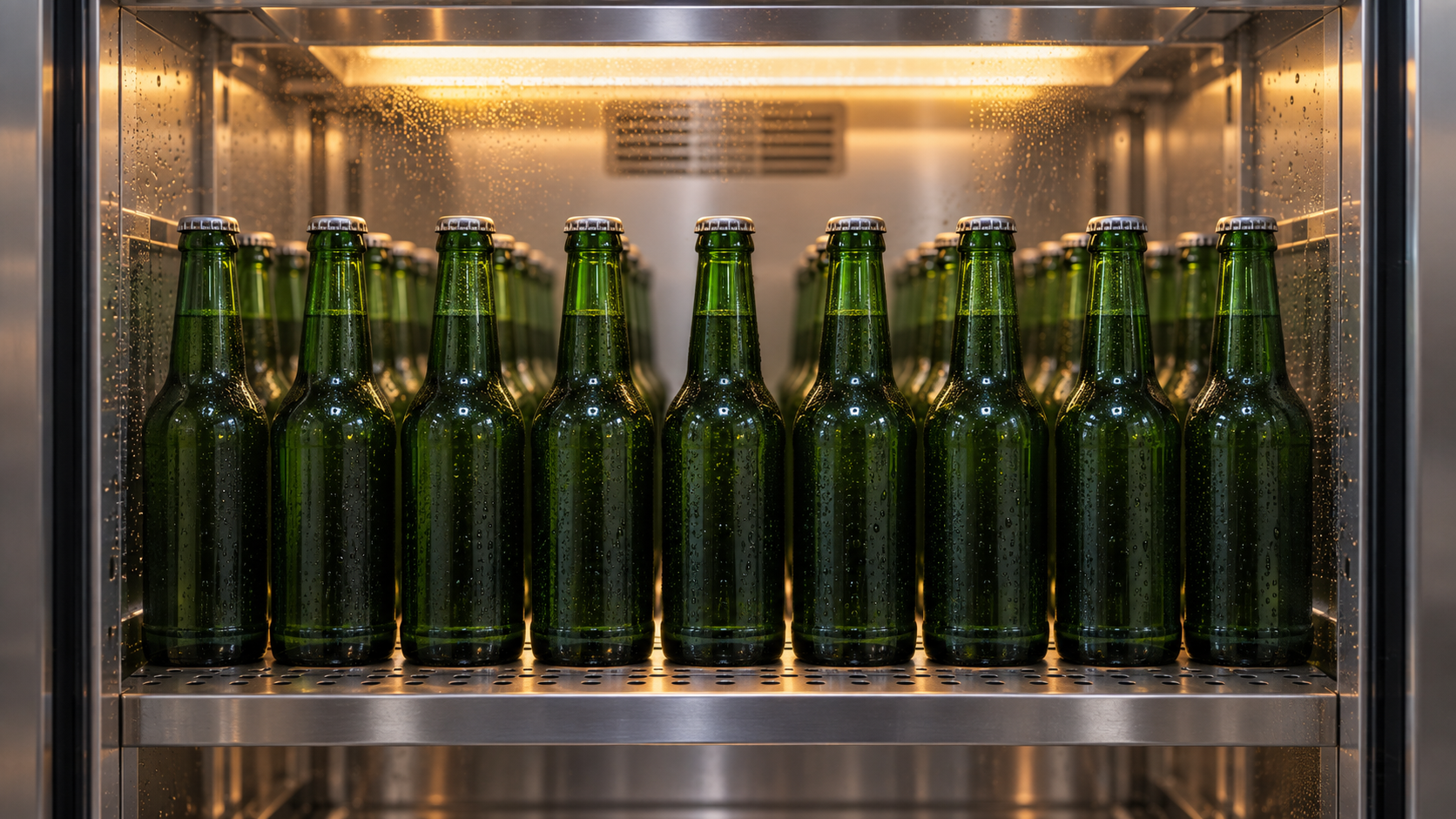
Fill twenty-four bottles from a single production batch to the target level, apply closures at production torque, and place twelve in a chamber at 40 C and twelve at 20 C. Inspect at one, three and six hours, then daily for three days, and record any lift, seep or foaming.
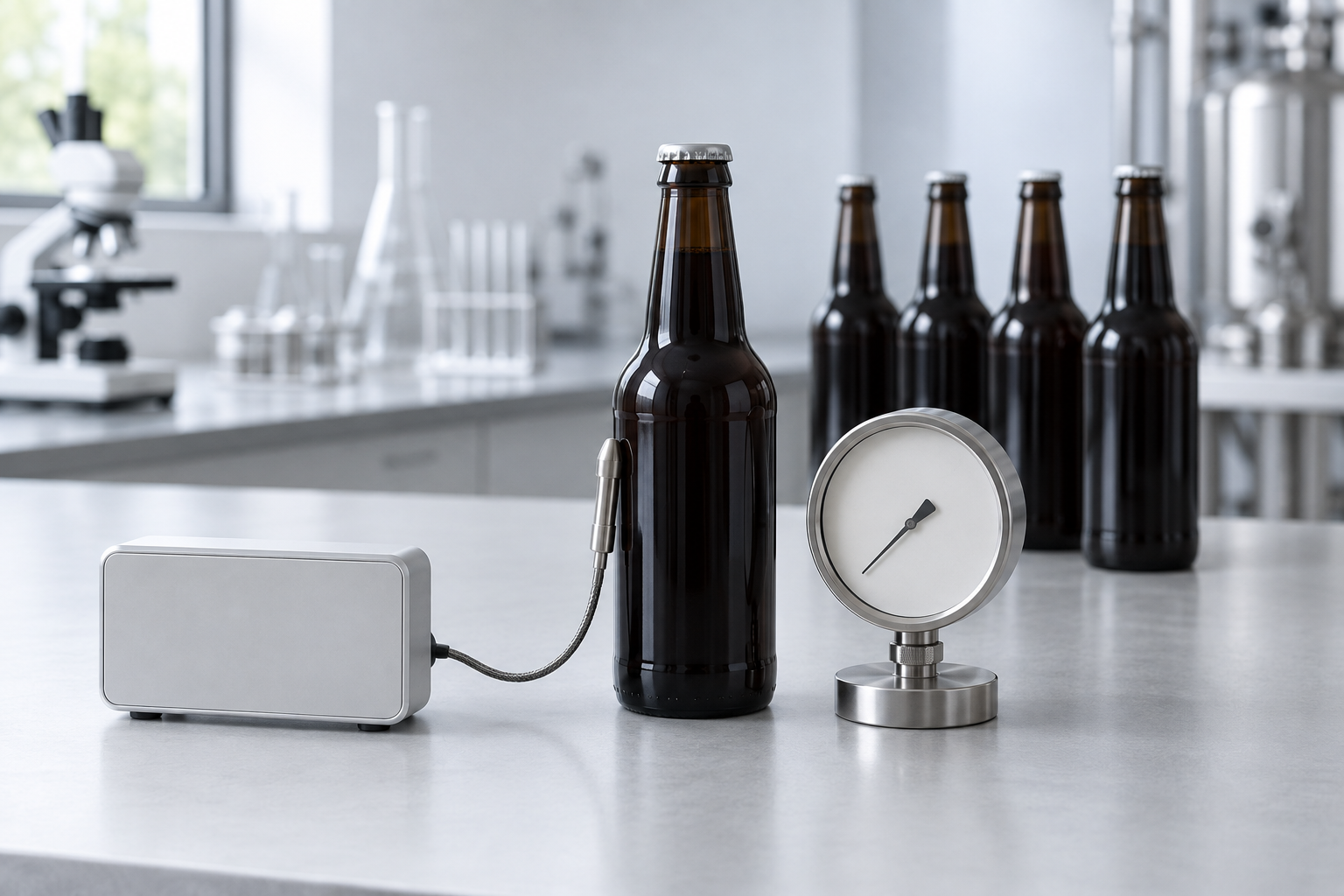
At the end of the hold, pierce two warm bottles with a pressure gauge and compare the result with the calculated figure. A measured pressure noticeably above the table value usually means secondary fermentation is still active, and the batch needs a longer hold rather than a different bottle.
Running the Cold Chain Scenario
A cold chain does not remove the need for the test. Run the same twelve bottles through a temperature cycle: three days at 4 C, two days at 30 C, then back to 4 C, and inspect after each change. Cycling stresses the closure more than a constant warm hold, because the gasket expands and contracts against the finish.
PauPack uses this cycle for export orders where the container crosses the equator, and the result is recorded alongside the warm room numbers. If the cycle produces a wet carton base, the closure specification rather than the bottle specification is the first thing to change.
What a Kombucha Bottle Pressure Test Misses
The test measures pressure and sealing; it does not measure taste, alcohol drift or the microbiology of a live product. A bottle can pass every pressure check and still be undrinkable after three weeks of fermentation in the warehouse.
Keeping the test honest means keeping the product real. PauPack runs trials with the brand's own kombucha rather than sweetened water, because residual sugar is the variable that keeps generating pressure after the bottle is sealed. Where a batch has to be withdrawn, the traceability discipline is the same one described in the CPSC recall pages, and it starts with knowing which mould, which batch and which closure were used.
Failure Patterns in the Field
Field failures are consistent enough to be read backwards from the symptom.
| Symptom | Usual cause | First change to make |
|---|---|---|
| Caps lifted in a warm pallet | Pressure above the closure rating at 40 C | Lower carbonation or move to a pressure closure |
| Wet cartons, intact bottles | Torque set warm and lost during storage | Re-set torque on cooled bottles and re-check at day 14 |
| Breakage in the base | Surface flaw in the distribution tail | Burst test twelve units and review mould condition |
| Foam on opening at three weeks | Secondary fermentation continuing | Extend the hold or adjust residual sugar |
| Bottles fine in the fridge, failing in transit | Container temperature never measured | Add a temperature logger to the next shipment |
Transport, Pallets and Secondary Fermentation
A pallet is a thermal mass, and the middle of a stack stays warm long after the air around it cools. PauPack asks for a temperature logger in the first export container of any new kombucha pack, placed in the centre of the stack rather than near the door, because that is where the peak pressure will occur.
The second transport variable is vibration. Glass bottles that rub against each other in a case lose surface strength over a long journey, and the damage shows up later as breakage under pressure. Case dividers and a snug fit are cheaper than a stronger bottle, and they are part of the specification we quote rather than an afterthought.
Records and the Release Decision
The release decision rests on eight recorded numbers: fill volume, headspace, carbonation volumes, measured pressure at 20 C, measured pressure at 40 C, closure type and application torque, day fourteen hold result, and the lowest burst pressure from the sampled bottles.
With those eight lines on file, a repeat order can be compared without repeating the burst test, and a field complaint can be traced to a batch rather than to a rumour. It is the same discipline we apply to packaging quality control across every product family.
What PauPack Supplies for a Pressure Trial
A pressure trial needs production bottles, production closures and the real product. PauPack supplies kombucha bottles in the finish and decoration the brand has chosen, and provides swing top bottles and crown finishes as matched sets so the closure and the neck are qualified together.
Brands building a wider beverage range usually start from glass beverage bottles and the pressure-compatible formats listed under glass juice bottles wholesale, then move to custom juice bottle moulds once the carbonation target and the closure are fixed.
Kombucha Bottle Pressure Test: Questions From Producers
What is a kombucha bottle pressure test?
It measures the internal pressure a filled bottle reaches at the highest temperature it will meet, and compares that with the rating of the glass and the closure. The test is run on production bottles filled with the real product, because dissolved CO2 and residual sugar both change the pressure after filling.
How much pressure does kombucha build in a bottle?
A kombucha carbonated to 3.0 volumes of CO2 reaches roughly 2.5 bar at 20 C and close to 4.5 bar at 40 C. A sweet, actively fermenting product can climb beyond that in the bottle, which is why a kombucha bottle pressure test is run on the finished product and not on carbonated water.
What pressure can a glass bottle safely hold?
Standard beer bottles are rated around 8 to 10 bar in production, while a light decorative bottle may be rated below 4 bar. The rating applies to the neck finish and the base as much as to the body, so the specification has to name the whole container rather than the wall thickness alone.
Why does my bottle break in the warehouse rather than in the fridge?
Because pressure scales with temperature. A bottle that sits at 2.5 bar in cold storage can reach 4.5 bar on a warehouse floor at 40 C, and glass strength falls as the temperature rises. Warm storage is the single most common cause of a field failure.
How much headspace should a kombucha bottle have?
Plan for 4 to 5 percent of the nominal volume on a still fill, and hold it consistently. Headspace controls the gas volume available above the liquid, and an inconsistent fill line means two bottles from the same pallet can see different pressure at the same temperature.
Is a swing top or a crown cap better for kombucha?
Both work, and they fail differently. A crown cap is the cheaper and more pressure-stable option, while a swing top seals better after re-closing but depends on a gasket that ages. The kombucha bottle pressure test should be run with the closure the brand will actually ship.
Can a kombucha bottle pressure test be run in a warm room?
It should be. Hold filled bottles at 40 C for seventy-two hours and inspect hourly for the first six hours, then daily. The warm room accelerates the chemical and biological part of pressure rise as well as the physical part, which is exactly what a summer shipment does.
What is secondary fermentation and how does it affect the test?
Residual sugar continues to ferment in the bottle, so pressure keeps rising after filling. PauPack holds trial bottles for fourteen days before release and weighs the caps to confirm the closure has not started to lift, because a bottle that passes at day one can fail at day ten.
How do you test a bottle without breaking it?
Measure the pressure with a piercing gauge on a sacrificial bottle, weigh the filled bottle over time to track gas loss, and use a dimensional check on the neck and base. Destructive pressure ramp testing then finds the burst point on a small subset, and the USP packaging and storage requirements are a useful reference for treating container and closure as one qualified system.
What should the record contain?
Fill volume and headspace, CO2 volumes, measured pressure at 20 C and 40 C, closure type and torque, the fourteen-day hold result and the burst pressure of the sampled bottles. Eight lines, and they let PauPack compare a second production run against the first without repeating the burst test.