

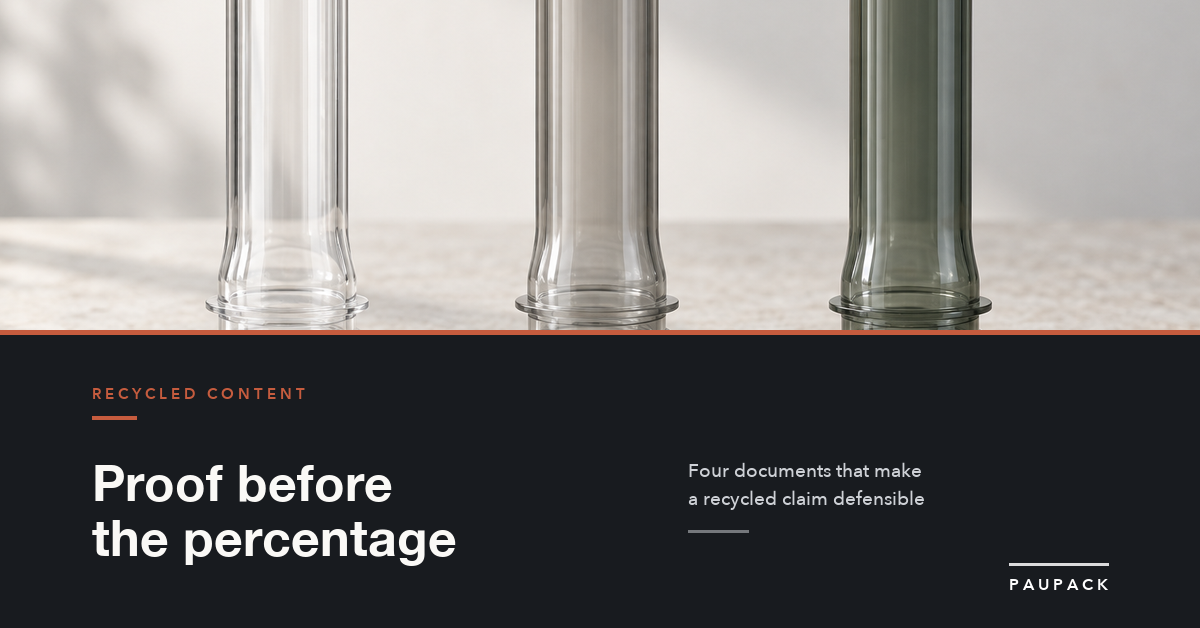
PCR content verification is the difference between a bottle that carries a recycled-content claim and a bottle that can prove one.
Writing a percentage into a specification takes a minute. Defending it takes a paper trail, and the gap between the two has ended more retail listings than any moulding defect we have seen.
PauPack moulds PCR and blended resin packs for brands across Europe and North America. The questions that arrive are almost never about polymer chemistry. They are about evidence: which certificate counts, what mass balance really means, how to word a claim, and what happens the day a retailer's sustainability team asks for the file.
Here is the chain we build for every recycled-content order, in the order an auditor will read it.
What PCR Content Verification Is Meant to Prove
A recycled-content claim makes three statements at once. It states how much material came from post-consumer waste. It states that the recyclate was tracked from collection through to moulding. And it states that somebody independent of both the brand and the converter checked that tracking.
Prove one without the other two and the claim comes apart. A processor can hold a purchase invoice for recyclate and still be unable to show that any of it reached a specific production run. A certificate can cover a company while telling you nothing about the product on your shelf. A PCR content verification exercise that stops at the invoice has verified a purchase, not a bottle.
Percentage of What? Mass Balance Versus Segregation
Two accounting methods, one certificate format, and very different bottles at the end of it.
Physical segregation keeps certified recyclate in its own stream through every step, so the number on the certificate matches what is physically in the pack. Mass balance allows certified and conventional feedstock to run through the same process, with the recycled volume allocated to a production run through bookkeeping.
Mass balance is widespread because it suits large continuous plastic production, and several certification schemes accept it. It only becomes a problem when a brand markets it as segregation. Name the method in the claim and the problem usually disappears, which is a strange thing to be able to say about a compliance question, but there it is.
The Four Documents Behind Every Claim
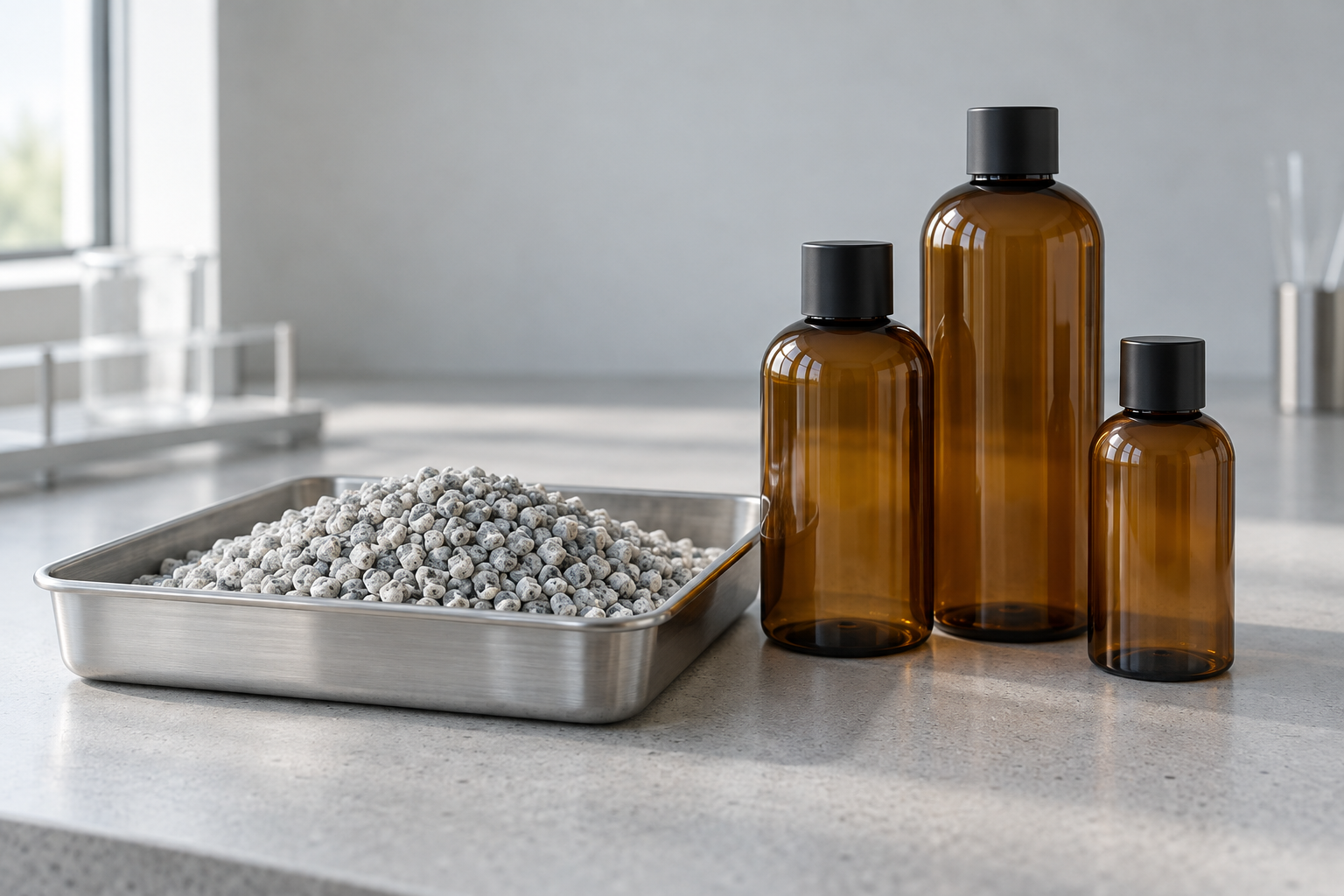
An auditable PCR order produces four documents, and all four should name the same production period, the same site and the same material grade.
| Document | What it proves | What it does not prove |
|---|---|---|
| Certificate of recycled content | Audited percentage for a defined period and site | That your specific order used it |
| Chain-of-custody statement | Feedstock movement from collector to processor | That no conventional resin was blended |
| Feedstock declaration | Origin and grade of the recyclate | Food-contact suitability |
| Moulding charge record | The percentage actually charged on your run | Anything about the previous run |
PauPack issues the moulding record against the batch code, so a retailer holding your bottle can match it to the run that produced it. Without that link, the other three documents describe a facility. Useful, but not the same thing.
Reading a Recycled Content Certificate
Certificates are short, and three fields decide how much they are worth to you. The scope says which sites and processes are covered. The period says which window was audited, and a certificate from two years ago does nothing for a claim about a run from last month. The validity statement tells you whether this is full certification or a self-declaration somebody verified on the side.
The most common mistake is accepting a certificate issued to a resin supplier as evidence for a converter's bottle. The percentage travels with the material, but only if the transaction record between the two companies forms part of the chain. PauPack asks for both documents plus the transfer note, because the transfer note is the step auditors probe first.
Certification Bodies and What Each One Audits
Schemes differ by feedstock, region and how strictly material is traced. A brand selling into two markets may end up needing two of them.
| Scheme | Typical feedstock | Common use |
|---|---|---|
| ISCC PLUS | Mixed plastic waste, bio-based and circular feedstock | Mass-balance claims across large supply chains |
| EuCertPlast | Post-consumer plastic recyclate in Europe | Recycler certification feeding EU claims |
| SCS Recycled Content | Post-consumer and pre-consumer material | North American brand claims |
| Control Union | Multiple streams including ocean-bound material | Region-specific and collection-scheme claims |
How to Audit a Supplier's Claim in One Afternoon
Four questions separate a documented claim from a hopeful one. Which scheme covers the material? What period does the certificate run to? Where is the transfer note between resin supplier and converter? And what percentage was actually charged on your batch?
Miss any one of the four and the claim is not yet verified. PauPack keeps that four-part file with the order rather than in a marketing folder, because the request usually lands two weeks before a listing goes live. Being able to answer it in an afternoon is the entire point of running a PCR content verification check at order stage instead of at launch.

What PCR Changes in the Bottle Itself
Recyclate carries a longer heat history than virgin resin, and polymer chains break each time material passes through an extruder. At the machine, that shows up as slightly lower melt viscosity, a narrower processing window and a small loss of impact strength.
None of that is a reason to walk away from PCR. It is a reason for PauPack to adjust the parison, the wall thickness and the cooling time, then re-run the drop test rather than inheriting a result from the virgin version of the same bottle. Our PCR bottle work starts from the drawing rather than from a stock mould for exactly this reason.
Colour, Odour and the Cosmetic Limits of PCR
The visible difference is what brands notice first. Light recyclate arrives greyer and warmer in tone, and at higher percentages a fine speckle appears that no masterbatch entirely hides.

Odour follows a similar curve. A faint smell from residual material is normal and usually gone within a week of aeration, but it turns into a genuine problem for a delicately scented product. PauPack recommends a closed-jar sensory check at day one and day seven, with the result written on the trial sheet instead of remembered.
PCR Content Verification for Regulated Markets
Food contact and pharmaceutical packaging add a feedstock question to the usual evidence chain. Recyclate has to come from a stream permitted for the intended use, and the converter needs documentation to show that the material qualifies.
Rules differ by region and by product, so the honest answer is to settle intended use before the resin is ordered. Where the container is glass, PauPack works to the same standards described under food grade glass bottles. Where the pack is PCR plastic, we hand the certificates to the brand's own regulatory contact rather than summarising them, because a summary is exactly what an auditor will ask you to replace.
Claim Wording That Survives a Legal Review
Claim wording is where good documentation meets bad marketing, and it is the last step in any PCR content verification file.
A defensible claim names the percentage, the scope and the accounting method. It also dodges two traps. Do not imply a whole-pack figure when only one component is recycled, and do not let recycled content sound like recyclability. Those are different properties and regulators treat them separately.
PauPack's default wording on a specification is deliberately plain: percentage by weight, accounting method, certification scheme, period. The consumer-facing sentence is left to the brand's own legal team. Where a pack carries a safety or compliance component, the CPSC voluntary standards programme is a useful model for how a claim becomes checkable through a written standard rather than through an adjective.
Cost, Lead Time and the Volume Question
Recyclate costs more than virgin resin in most markets, and the premium tracks collection volumes rather than oil price. Freight and colour sorting add to it. A dark recyclate stream is cheaper than a light one, simply because fewer sorting steps are needed to reach it.
Lead time moves too. A dedicated PCR run needs resin booked ahead, and a first trial usually adds three to five weeks to the schedule. Brands planning a launch around a recycled-content claim should treat that window as fixed, and start the certification conversation alongside the moulding conversation. The certificate period and the production period have to overlap, and that overlap is what closes a PCR content verification file.
Where PCR Content Verification Fails
The same five failures show up in almost every audit we support, and each one breaks the same link in the chain. That is why they are listed together rather than as separate problems.
| Failure | What it looks like | Prevention |
|---|---|---|
| Certificate without scope | Percentage claimed for a site that is not covered | Check the scope field against the actual plant |
| Expired period | Certificate predates the production run | Confirm the period overlaps the batch |
| Missing transfer note | Gap between resin supplier and converter | File the note with the order |
| Method not stated | Mass balance presented as segregation | Name the accounting method in the claim |
| No moulding charge record | Bottle cannot be linked to a run | Issue the record with the batch code |
What PauPack Provides With a PCR Order
A PCR order from PauPack ships with the certificate reference, the chain-of-custody statement, the feedstock declaration, the moulding charge record tied to the batch code, and trial photographs at the agreed percentage. Where food contact applies, the material documentation travels in the same pack rather than arriving separately.
Brands weighing up recycled options usually start from eco friendly packaging and glass vs plastic packaging to decide whether PCR plastic suits the product at all. From there the logic often moves to PLA bottles or to sustainable glass packaging, depending on where the material argument actually lands.
PCR Content Verification: Questions From Packaging Buyers
What is PCR content verification?
It is the evidence behind a recycled-content number: where the recyclate came from, how it moved through processing, how much of it ended up in your moulding run, and which independent body checked any of that. Skip the chain and the percentage on the drawing is a marketing figure with no file behind it.
Is mass balance the same as recycled content?
No, and the difference matters commercially. Mass balance lets certified recyclate be allocated to a run by bookkeeping instead of being physically kept apart, so a bottle can carry less recyclate than the label suggests. Some markets accept it. Others do not. The claim wording has to say which method was used.
Who certifies recycled content in plastic packaging?
The names that turn up most often in packaging supply chains are ISCC PLUS, EuCertPlast, SCS and Control Union, depending on region and feedstock. They audit chain of custody in different ways, so read what the certificate actually covers before you repeat the percentage anywhere.
How much does PCR change the appearance of a bottle?
Expect a warmer, greyer tone than virgin resin, a light speckle once you push past 50 percent, and a faint smell that fades after a few days of aeration. Under 30 percent most people cannot see the shift in a matte finish. Above 70 percent, brands usually stop fighting the colour and design a dark or opaque pack instead.
Can PCR resin be used for food contact packaging?
In several markets, yes, provided the recyclate comes from an approved food-grade stream and the process holds a letter of no objection or an equivalent assessment. The sticking point is nearly always feedstock origin rather than the percentage, and it is far easier to settle before the moulding trial than after.
Does PCR weaken a bottle?
Repeated heat history shortens polymer chains, so impact strength and stress-crack resistance do drop at high percentages. PauPack compensates through wall thickness, a revised parison profile and a fresh drop test on the finished pack, and records those changes in the drawing revision rather than leaving them to memory.
What documents should a supplier send with a PCR order?
A certificate covering the production period, a chain-of-custody statement, the feedstock source declaration, food-contact documentation where it applies, and the moulding record showing what was actually charged. Five documents, all naming the same batch. If one is missing, the claim has a hole in it.
How long does a PCR trial take?
Budget three to five weeks for resin sourcing and the moulding trial, plus whatever time the certification body needs for a period certificate. PauPack runs the trial on the production machine rather than a laboratory press, because colour and cycle differences only show up at line speed.
How should a PCR claim be worded on packaging?
Name the percentage, the scope and the accounting method. Something like: 50 percent post-consumer recycled content by mass balance, certified for the 2026 production year. Vague phrases such as eco bottle or green plastic invite a question you cannot answer with a certificate.
Can recycled content be verified on a finished bottle?
Not by looking at one. Verification runs through paperwork and audit trail rather than a test on the shelf, though laboratory methods can sometimes separate recycled from virgin polymer in a sample. It is why the USP packaging and storage requirements treat documentation as part of the packaging system rather than an optional extra.