

Custom bottle delivery runs on a calendar that starts at drawing approval, not at the purchase order, and that single distinction explains most missed launch dates. Brands count from the day they send a file; factories count from the day the tooling is booked.
PauPack builds custom moulds and supplies decorated glass and plastic bottles to brands in Europe, North America and Asia, and we publish our schedule as milestones rather than as one delivery date. The reason is practical: a single date tells a brand nothing until it is already too late to act.
What follows is the ten-week path we quote for a new mould, where it slips, what each freight mode costs in weeks, and how to shorten the schedule without buying risk.
What Custom Bottle Delivery Actually Measures
Delivery is not one event. It is a chain of approvals, tooling steps, production runs and transport legs, and each link has an owner. When a brand asks "how long", what it usually needs to know is which of those links it controls.
Three of the seven milestones sit with the buyer: drawing sign-off, sample approval and artwork release. Four sit with us: tooling, production, inspection and freight booking. A schedule that does not name the owner of each milestone cannot be managed, only awaited.
The Standard Calendar, Week by Week
For a new mould delivered by sea, PauPack plans ten to twelve weeks. Reorders on an existing mould usually land in five to six weeks, because tooling and sample rounds disappear from the path entirely.
| Stage | Weeks | Owner | Output |
|---|---|---|---|
| Drawing and deposit | Week 0 to 1 | Brand and PauPack | Signed drawing, tooling payment |
| Mould and samples | Week 2 to 4 | PauPack | First-off samples, dimensional report |
| Approval and artwork | Week 4 to 5 | Brand | Approved sample, released print file |
| Production | Week 5 to 8 | PauPack | Finished, decorated goods |
| Inspection and packing | Week 8 to 9 | PauPack | Inspection report, export cartons |
| Freight and customs | Week 9 to 12 | Forwarder | Arrival and clearance |
Week 0 to 1: Drawing, Deposit and Slot Booking
Nothing moves until the drawing is signed and the tooling payment clears. The drawing fixes the neck finish, the wall thickness, the base radius and the mould split line, and every one of those decides something downstream.
This week is cheap and it is where the money is saved. A brand that spends four days arguing about a shoulder radius before cutting steel will not spend four weeks arguing about it after. PauPack sends a marked-up drawing with the fill line, the decoration area and the neck dimensions shown together, so the conversation happens once.
Our own note on bottle mould development walks through the same week from the tooling side, and the cost mechanics behind the tooling payment are set out in custom bottle mould cost.
Week 2 to 4: Mould Cutting and First Samples
Steel takes about two to three weeks for a straightforward cosmetic or beverage bottle, longer where the mould carries fine texture or an unusual base. The factory sends first-off samples with a dimensional report rather than photographs alone.
Read that report against the drawing before approving anything. Capacity, neck finish, wall thickness and weight are the four numbers that matter, and a sample that looks right while missing a weight target will cause trouble on the filling line rather than on the shelf.
Where the first-off sample misses by more than the drawing's tolerance, the mould is adjusted before any decorated units are produced. PauPack reports the adjustment and the new reading rather than sending a second sample box without comment.
Week 4 to 5: Sample Approval and Artwork Release in Parallel
Most brands lose a week here, and it is entirely avoidable. The sample round and the print proof are independent tasks, yet they are usually run one after the other.
PauPack schedules them together. While the brand measures the sample, the artwork can be going through the printer's proof cycle, so decoration is ready when the mould is. Send comments as one consolidated list within three working days; a trickle of single remarks restarts the round each time it arrives.
Week 5 to 8: Mass Production
Production runs in batches, and the batch size decides how long the line stays set up. A 30,000-unit run on one mould is a different animal from four colour variants of 5,000 each, where every changeover costs a shift.
Decoration is the usual hidden extension. Spraying, frosting, silk screen printing and hot stamping each add a separate pass, and printed bottles have to cure before packing. Add three to seven working days per decoration step rather than treating decoration as part of the moulding week.
Week 8: Inspection, Packing and Release
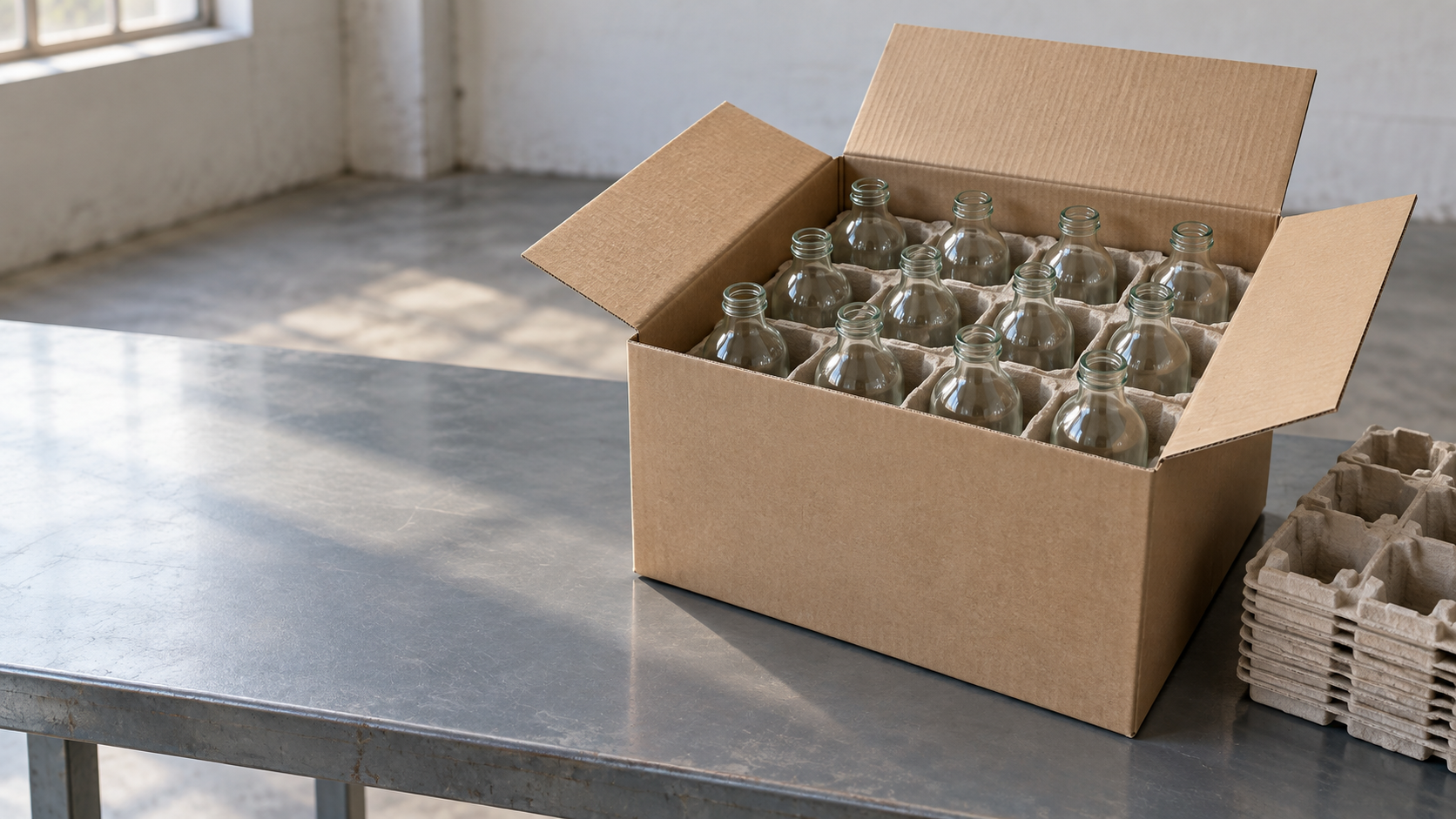
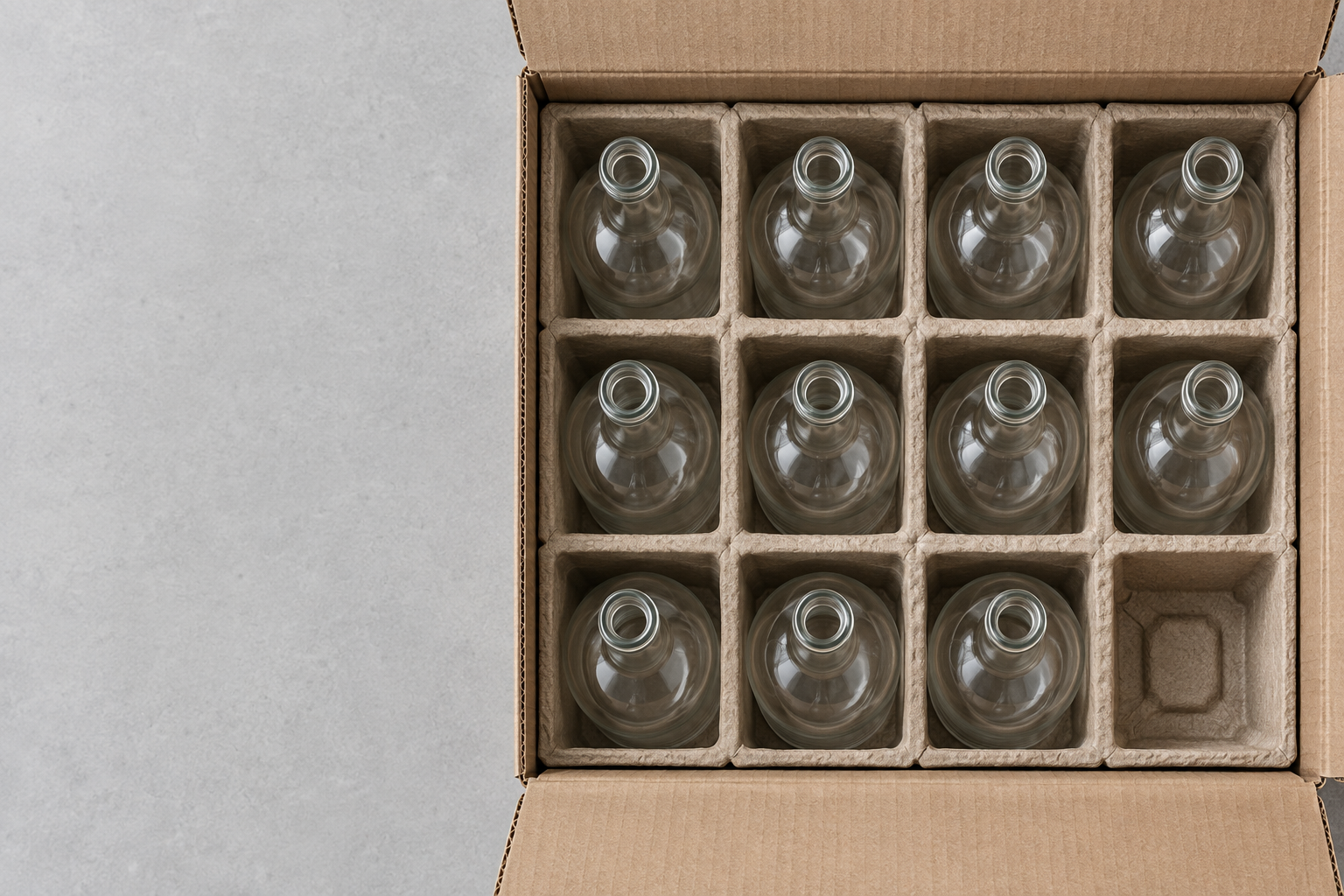
Inspection is a scheduled stage, not a final glance. PauPack inspects against the approved sample as the reference, records the sampling plan, and photographs the packing method for fragile glass before the cartons are sealed.
Packing decisions made in this week follow the goods to the customer. A double-wall carton with a full-height divider looks expensive until it is compared with a replacement shipment. The release board we use is described in the quality control release board note.
Week 9 to 12: Freight, Customs and Final Delivery
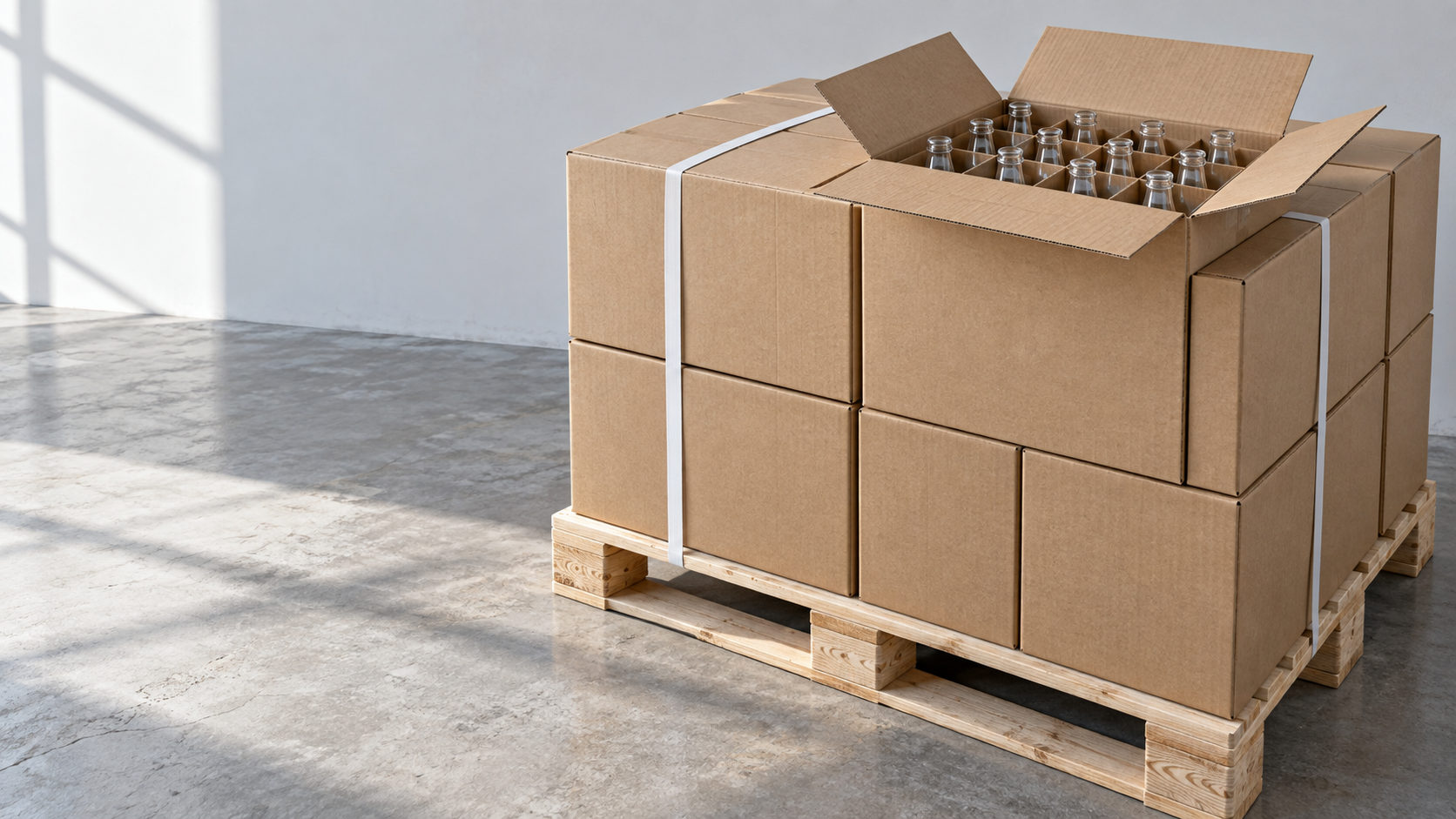
Ocean freight from Asia to Europe or the United States is commonly two to three weeks of sailing, plus one to four days of customs and a few days of local delivery. That tail decides custom bottle delivery more often than any other stage, and it is where most "we were promised ten weeks" conversations start.
Two practical rules shorten it. Book the vessel before production ends rather than after inspection passes, and send the commercial invoice and packing list to the broker as soon as they exist, not with the container. Documentation prepared in advance is the difference between a cleared container and a stored one.
Sea, Rail and Air Compared for a Bottle Programme
Freight choice is a trade of weeks against money, and for glass the weight dominates the calculation.
| Mode | Transit to Europe | Cost position | Suits |
|---|---|---|---|
| Ocean, full container | 21 to 30 days | Lowest per unit | Full production runs |
| Ocean, less than container | 28 to 40 days | Moderate | Partial runs and mixed SKUs |
| Rail to Europe | 18 to 25 days | Between sea and air | Inland destinations |
| Air freight | 5 to 8 days | Highest per unit | Launch quantities only |
Where a programme mixes glass and plastic, the two are often split across modes: plastic travels by air for a launch, glass travels by sea. PauPack quotes both legs separately so the comparison is a decision rather than an assumption.
Where the Calendar Usually Slips
Across the orders we have run, delays cluster in a small number of places. Naming them in advance is more useful than promising a shorter lead time.
- Artwork released after the mould is ready, so production waits for a print file.
- Sample comments arriving in five separate messages over two weeks.
- A tooling payment that clears a week later than the brand believes it did.
- Decoration quoted as one line but executed as three separate passes.
- A forwarder booked after inspection rather than during production.
- A specification change after first-off samples, which restarts tooling.
Every item on that list is a scheduling decision rather than a manufacturing one, which is why custom bottle delivery is often improved by planning rather than by paying for speed.
Documents and Approvals That Travel With the Goods
Compliance paperwork runs alongside the container, and on regulated packs it is part of the product rather than an administrative extra.
Where the bottle will hold a drug product or an oral liquid, the container closure system is qualified as a unit, and a change of mould or closure material reopens that qualification. The USP container closure chapter describes that expectation. Where the closure carries a child-resistance claim, the finished pack has to satisfy the test the Poison Prevention Packaging Act sets out, and the certificate should travel with the shipment rather than be requested afterwards.
On the sustainability side, recycled content claims need evidence that survives an audit. Our sustainability material lists what we can document for PCR and mono-material packs.
How to Compress the Schedule Without Adding Risk
There is about two weeks of genuine slack in the standard calendar, and it is found in approvals rather than in manufacturing. Faster custom bottle delivery comes from parallel work, not from pressure applied to the production line.
- Approve the drawing within 72 hours, with all comments in one reply.
- Run the sample round and the print proof at the same time.
- Approve decoration on a proof rather than on a sprayed sample where the colour is standard.
- Pre-book the vessel while production is still running.
- Send export documents to the broker the day they are issued.
What should not be compressed is the inspection stage or the sample round. Those two exist to catch faults while a mould can still be adjusted cheaply, and cutting them moves the cost from the factory to the customer.
What PauPack Confirms Before the Clock Starts
Before a custom bottle delivery is quoted as a date, we confirm the drawing, the material, the decoration route, the packing method, the freight mode and the incoterm in one document. That document becomes the schedule, and each milestone is confirmed in writing as it completes.
The mould programme as a whole sits inside our bottle manufacturing service, and the critical path behind the milestones is described in bottle manufacturing lead time.
Seven Lines for a Delivery Agreement
A delivery clause is only useful if it names what has to happen and who has to do it. These seven lines cover almost every dispute we have seen.
- Drawing approval date and who signs it.
- Tooling payment date and the point at which the production slot is booked.
- Sample round turnaround and the comment window in working days.
- Production quantity, batch structure and decoration passes included.
- Inspection standard, sampling plan and release criteria.
- Freight mode, incoterm and the last date for booking.
- Milestone reporting frequency and the named contact on each side.
PauPack puts those lines on the quotation, which turns a promotional lead time into a schedule with owners. When everything is agreed in week zero, the ten-week plan usually holds.
Custom Bottle Delivery: Questions We Hear Before Every Order
How long does custom bottle delivery take from order to arrival?
Ten to twelve weeks is a fair planning figure for a new mould delivered by sea: about one week to close the drawing, three weeks for tooling and first samples, three weeks of production, one week of inspection and packing, and two to three weeks of ocean freight plus customs. Reorders on an existing mould usually land in five to six weeks.
What is the most common reason a custom bottle delivery slips?
Late artwork. The mould runs on the drawing, but the decoration line runs on the approved artwork file, and a brand that signs the mould drawing and then revises the carton adds a week to custom bottle delivery without realising it. The second most common cause is a payment that clears on a Friday after the factory has closed the production slot.
Can the schedule be compressed without paying for air freight?
Yes, by about two weeks. Approve the drawing in 72 hours instead of a fortnight, run the sample approval and the print proof in parallel rather than in sequence, and pre-book the vessel before production ends. PauPack builds that parallel path into the quotation when a brand asks for it at the start rather than after the delay.
Does the mould have to be paid for before production starts?
Almost always, and it is usually split into a tooling payment and a production balance. The tooling payment books the slot; without it, the work sits in a queue. Treat that payment date as the start of your calendar rather than the purchase order date.
What documents travel with a bottle shipment?
A commercial invoice, packing list, bill of lading or waybill, certificate of origin where a tariff preference applies, and any material declarations the buyer's market requires. Packs intended for regulated contents travel with the closure qualification record as well, because the container closure system is qualified as a unit.
How much buffer should be added to a first order?
Plan for two weeks of buffer on a first order and one week on a reorder. First orders carry sample rounds, artwork proofs and a freight lane that nobody has tested yet. Reorders run on a known mould, a known carton and a known forwarder, so the uncertainty is genuinely smaller.
Is air freight worth it for glass bottles?
Rarely for a full order, because glass is heavy and air freight is priced on weight. It can be worth it for a small launch quantity where missing a retail window costs more than the freight difference. PauPack quotes both options so the comparison is explicit rather than assumed.
What happens if the first samples are not approved?
The mould goes back for adjustment and the clock pauses. That pause is why we ask for comments in one consolidated list within three working days, rather than a series of single remarks that each restart the sample round.
Does decoration add time to custom bottle delivery?
It does, and it is easy to forget. Spraying, frosting, silk screen printing and hot stamping each add a pass through a separate line, usually three to seven working days, and a printed bottle cannot be packed until the ink has cured. Plan decoration as a stage rather than as an afternoon.
How does PauPack keep a delivery date honest?
We publish the milestones rather than one end date: drawing approval, tooling complete, samples shipped, production start, production end, inspection passed and vessel booked. Each milestone is confirmed in writing on the day it happens, so a slip is visible in week three instead of week nine.