
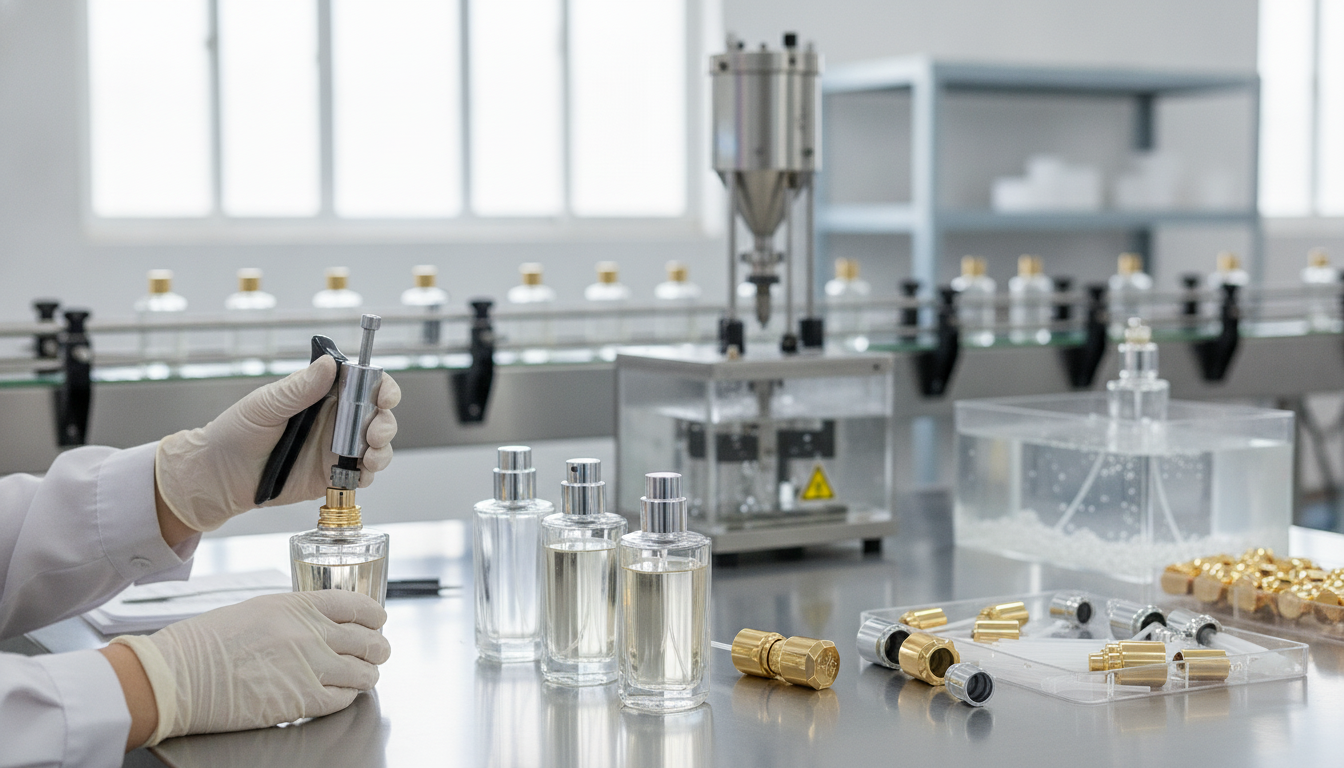
A perfume bottle crimp pump is held on by a metal collar that gets rolled permanently under the glass neck bead. No threads anywhere in the joint. So the seal comes down to three things: how consistent the glass neck is, whether crimp depth lands inside its working window, and a leak test that actually proves both.
A crimp neck perfume bottle is simply a bottle whose finish is made for that collar instead of a screw thread. Start with the anatomy (ferrule, body, dip tube, gasket), then the four neck features, the crimp depth window, the leak checks, and how to set the filling line for a perfume bottle crimp pump.
What a Perfume Bottle Crimp Pump Does, Part by Part
Pick up a pump and you're holding six parts. Only one of them gets deformed on the filling line.
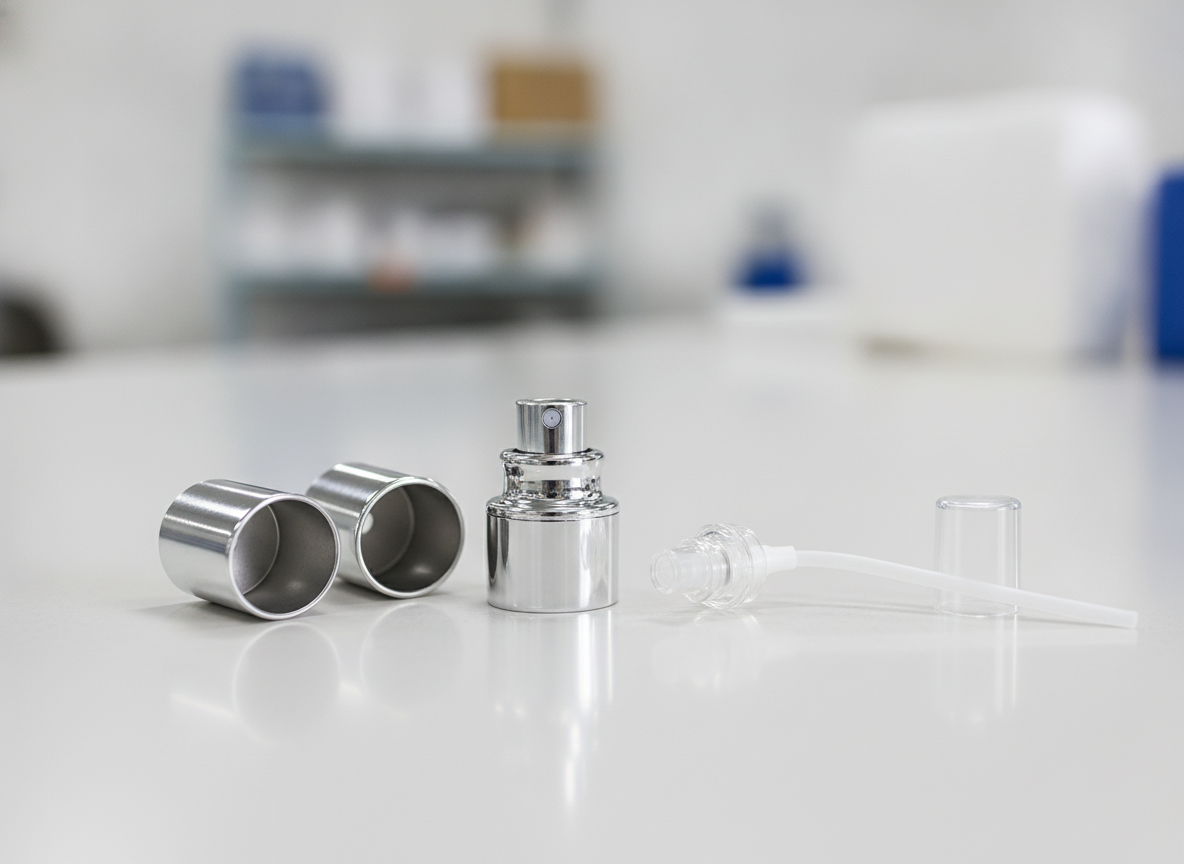
- The fine mist actuator sits on top and sets spray pattern and droplet size through its nozzle orifice. A coarse, spitting spray usually points at the actuator, not the pump.
- Pump body and housing form the metering chamber. If the housing doesn't land square on the neck, the stack tilts and the collar can't roll evenly under the bead.
- The dip tube must reach the bottle base without touching it. Too long and it curls against the glass; too short and the last few millilitres of a costly juice stay in the bottle.
- Gasket and spring live inside the chamber, in permanent contact with alcohol. Elastomer choice decides whether the gasket swells or the spring seizes after a few months on the shelf.
- The aluminium ferrule is the collar. It rolls inward under the glass bead and holds the whole assembly down.
- The overcap protects the actuator in transit and does nothing for the seal.
Everything above the ferrule stays as moulded when the crimp head descends. Glass and ferrule are the two surfaces that meet, so those are the dimensions worth checking first. PauPack lists a luxury glass perfume spray bottle (Luxury Glass Perfume Spray Bottle); take its neck section, not its silhouette, and lay it against your pump ferrule drawing.
Crimp Neck Perfume Bottle: Four Neck Features That Decide the Seal
Leaks usually trace back to the glass, not the pump. Four features on a crimp neck perfume bottle carry the whole seal:
- The glass bead.The aluminium collar rolls under this ring, so its underside needs to be full, smooth and square. Chipped or thin bead? The ferrule rides up, and the finished collar spins by hand.
- Bore and opening diameter. The pump housing should enter snug and straight. Oversize, and the body sits at a tilt — spray drifts off-centre and fragrance weeps past the gasket.
- Neck height plus the straight wall below the bead. The ferrule needs clean collar length to grip. Too short and the crimp has little to bite, so the pump pulls out when someone lifts the bottle by the actuator.
- Roundness and concentricity, which come down to how the neck finish was formed and annealed. An oval or unrelieved neck crimps unevenly: one side bites, the other stays loose and shows up in the inverted hold.
None of this is inspectable on a spec sheet alone, so put each feature on a bench check with a record behind it. The table below is the one we keep next to the crimp head.
| Neck / crimp parameter | What it controls | How to check it on the bench | Record on |
|---|---|---|---|
| Glass bead underside | Whether the aluminium collar has a full, square shoulder to roll under; a thin or chipped underside lets the ferrule ride up | Visual and comparator against the approved reference sample; run a fingernail around the underside to feel for chips and flat spots | Incoming glass inspection sheet, per cavity (cavity number is moulded into the base) |
| Bore / opening diameter | How snug and straight the pump housing sits; an oversize bore tilts the body and the spray goes off-centre | Go/no-go with the pump housing from the same lot that will run on the line | Pump-to-bottle fit record, filed with the bottle and pump drawings |
| Neck height + straight collar wall | Collar length the ferrule can bite; too short and the pump lifts out with the actuator | Comparator against the approved reference sample, then ferrule spin by hand on a trial crimp | Neck finish chart copy clipped to the RFQ drawing set |
| Roundness / concentricity | Even bite all the way round; an oval neck crimps tight on one side and loose on the other | Sectioned bottle from a retained sample, plus ferrule spin and the inverted-hold check | Crimp trial log, one line per mould cavity |
| Crimp depth | Where the collar seats on the bead and how much of the pump housing it captures | Sectioned bottle on a retained sample, compared with the approved reference; finish with a hand spin of the ferrule | Crimp room test record, kept with the crimp test report |
PauPack publishes neck finish charts as buyer guidance, and those charts matter more than any product photo. Pair them with the Glass Packaging Institute's neck-finish terminology and standard finish drawings at gpi.org: GPI names the bead, collar and bore the same way your pump supplier does, so both drawings end up describing one neck. Send your pump drawing with the bottle drawing. For an 80ml reference, look at this 80ml fragrance bottle from PauPackand compare its neck section, not its silhouette.
Crimp Depth and Crimping Height Tolerance: Why Tighter Is Not Safer
Two more turns of the adjusting screw feels safer. It isn't. A harder crimp is a crimp outside the window, and glass has no forgiveness.
Crimp depth is how far the rolls push the aluminium collar inward under the glass bead. That is the only thing the head controls, and it has a floor and a ceiling. Too shallow and the collar rides up the bead, spins on the neck, and leaks once the bottle pressurises in a warm shipment.
Too deep and the neck chips or cracks at the bead, the collar wrinkles into a skirt, the gasket crushes past recovery, and the pump body takes the load instead. Both sides reach the customer as the same complaint: wet cartons.
Crimping height tolerance is the band of collar position and neck height in which the seal still holds across a whole batch. One bottle proves nothing. Glass from the same mould varies, and decoration or annealing shifts the bead slightly, so pull bottles from several positions on the lehr and crimp each one. PauPack writes up the crimp room sequence in Crimp Room 7: How PauPack Runs a Perfume Crimp Test.
Set the head to the middle of the window and leave it there. Every perfume bottle crimp pump leaks for a reason you can measure.
Crimp Pump Anatomy: What the Ferrule, Body, Dip Tube and Gasket Tolerate
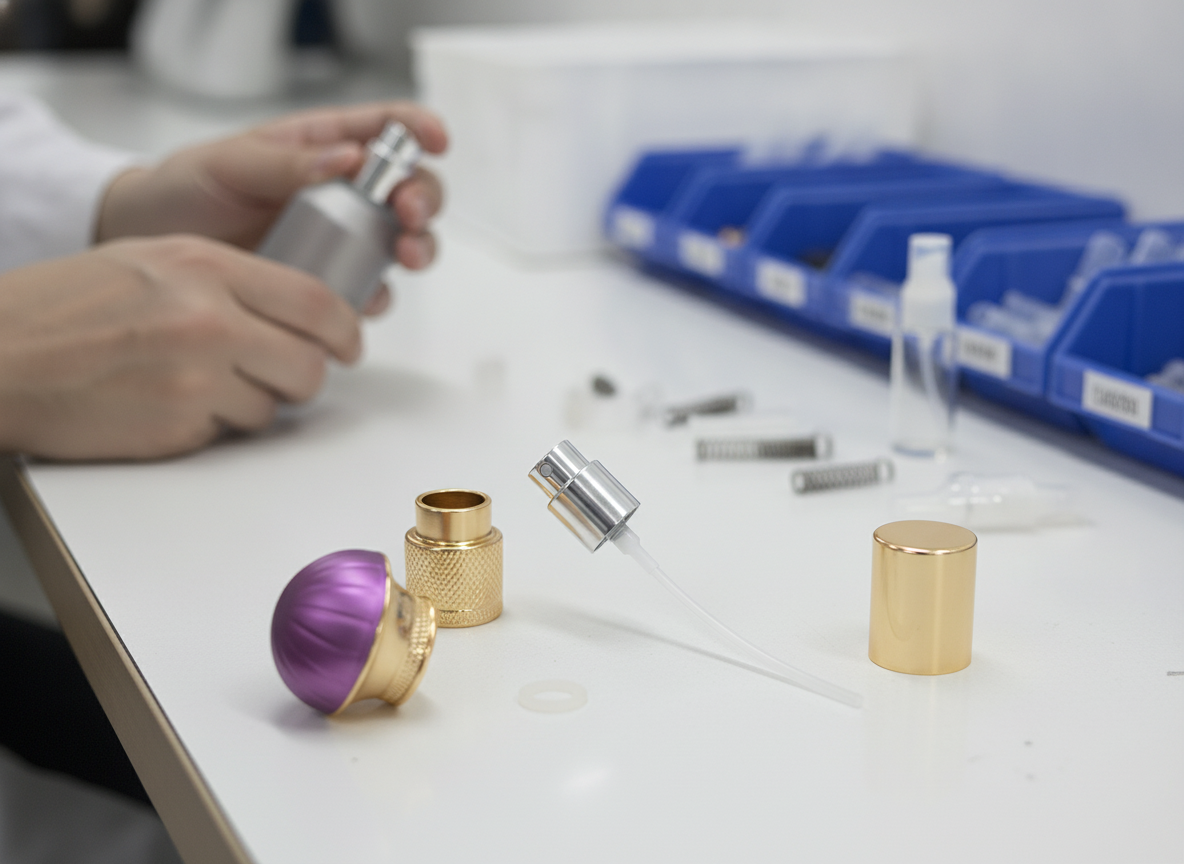
Hold a pump at the bench and you can grade it in about a minute. The parts that touch fragrance and the parts that only take a crimp are made from different materials for different reasons, and in an ethanol-based concentrate most failures start in the elastomer or the tube rather than the collar.
| Part | Typical material | What it must resist | Failure you'd see |
|---|---|---|---|
| Ferrule (collar) | Anodised aluminium | Rolling into the neck bead without cracking the coating; alcohol vapour at the joint | Darkened, chalky collar; coating rubbed off at the crimp rolls |
| Pump body and housing | Polypropylene | Ethanol and essential oils without hazing or stress cracks | Hazy body, cracks along the housing seam |
| Dip tube | LDPE (HDPE for a stiffer tube) | Curling to the base without kinking, then staying straight in storage | Tube curling up off the base, drawing air, spitting |
| Gasket | EPDM; PTFE for aggressive formulas | Swelling in fragrance concentrate over months | Swollen gasket, seep at the ferrule, lost prime |
| Spring | Stainless steel | Corrosion from high-oil or acidic bases | Seized or sticky actuator, brown marks in the liquid |
| Overcap | PP | Staying seated through transit and handling | Loose fit, scuffed or split cap |
A gasket that seals one concentrate will weep on another. Sorted by application, the usual closure-side options trade off like this (general industry choices, not a PauPack stock list):
| Option | Best for | Limitation | What to verify before ordering |
|---|---|---|---|
| EPDM gasket | Ethanol-heavy fragrance, eau de toilette and most alcohol-based concentrates; the default in standard crimp pumps | Swells and softens in hydrocarbon solvents, heavy citrus terpenes and some carrier oils, and compression set climbs as it swells | Cure system (peroxide versus sulphur) and hardness grade; a soak in your own concentrate, measuring swell and hardness shift |
| PTFE-faced gasket | Aggressive formulas, high terpene loads, or a concentrate you expect to reformulate | Takes more compression to seal, creeps under constant load, costs more, and comes in fewer standard shapes | Solid PTFE or a thin facing over an elastomer core; the sealing land on your pump body; compression available at your crimp |
| LDPE dip tube | Standard alcohol fragrances and shaped bottles where the tube has to curve toward a corner | Softer, so it curls in deep or narrow bottles, and it takes up more solvent than HDPE | Tube length against bottle depth, resin grade, and whether the tube still hangs straight after a week standing |
| HDPE dip tube | Tall bottles, higher alcohol content, pumps where the tube drops straight to the base | Stiff. Harder to route in asymmetric bottles, and it loads the tube socket more | Fit in the pump's tube socket, cut length, and that the tip doesn't press hard against the base |
| Anodised aluminium ferrule | Standard crimp necks, colour matching to cap or label, mainstream perfume assembly | Coating can craze or flake at the crimp rolls, dye fades where alcohol vapour sits, and it won't survive a formula that attacks the joint | Anodising class and dye fastness, plus how the collar rolls over your specific neck bead |
| Plastic-collar alternative (PP collar over an inner cup) | Refill and inner-cup designs, cost-down projects, and closures that need a snap or twist feature instead of metal | Reads less premium, creeps under crimp load, scratches more easily than anodised aluminium | Whether the plastic carries the seal or only decorates it; how it holds torque and retention after assembly |
For buyers, the gasket and ferrule carry the most specification weight: they sit at the two points where fragrance escapes, and a cheap polypropylene body usually outlasts a wrong EPDM gasket. PauPack publishes compatibility testing guidance if you want to soak-test the gasket against your own concentrate before committing a lot.
For an outside reference, ASTM D471, Standard Test Method for Rubber Property—Effect of Liquids(ASTM International, 2016, astm.org), sets out how to measure swell, mass change and hardness shift after immersion. Run it with your concentrate at the strength you actually ship. Treat it as a starting point for your own soak test, not a pass mark.
Perfume Bottle Leak Test: Six Checks Before a Batch Leaves the Crimp Room
Pull ten bottles off the outfeed of a 100ml run and stand them on the bench. Same six checks, same order, every batch, before the pallet gets its stretch wrap.
- Collar spin and seat.Grip the ferrule and twist. Any movement means the roll sat high on the bead, and that bottle will weep somewhere between the crimp room and the retailer.
- Actuator stroke and return.Two full presses, released slowly. A sticky return points at the spring or chamber, or a dip tube coiled against the base.
- Spray pattern and dribble.Fire at a paper towel from 20cm. A spitting cone, or a bead of liquid hanging at the nozzle, is a fill or orifice problem worth catching now.
- Weigh-loss on a retained sample.Log a sealed control bottle's weight, then reweigh it weeks later. Do this as a proper perfume bottle leak test by weigh-lossand you'll catch slow evaporation that no squeeze test finds.
- Inverted hold.Stand the bottle upside down for the interval defined in your approved test specification, and record that interval on the batch record. A leak that appears only in this position lives at the collar seat; the pump chamber is usually fine.
- Transit trial.Pack a shipper, drop and vibrate it, then open it. This proves the crimp survives the journey, not just the bench.
PauPack also writes up its own crimp test approach in "Crimp Room 7"; use the six checks above as the floor, not the ceiling.
Batch record header:Batch number ________ Bottle / pump lot ________ Crimp head setting ________
| Check item | Method | Result (pass / hold / fail) | Initials and date |
|---|---|---|---|
| Collar spin and seat | Twist the ferrule by hand; watch for rotation or lift at the seat | ||
| Actuator stroke and return | Two full presses, release slowly; note return speed and stickiness | ||
| Spray pattern and dribble | Fire at a paper towel from 20cm; check cone shape and nozzle drip | ||
| Weigh-loss on retained sample | Record sealed control weight, store upright, reweigh on the set interval | ||
| Inverted hold | Stand upside down for the interval defined in the approved test specification; record the interval | ||
| Transit trial | Pack a shipper, run drop and vibration, open and re-check items 1 to 5 |
Fragrance Bottle Filling Line Crimping: Eight Stages From Infeed to Release
Watch a crimp line for ten minutes and you'll see where the money goes. Two spots, every time: dip tubes that arrive bent, and heads set past the crimp window. Everything else is patience.
Here's the sequence a bottle actually travels, and why each stage exists:
- Infeed and orientation.Bottles arrive upright and evenly spaced. Skip the spacing and you get a jam that breaks glass.
- Dip tube straightening and length check.The tube must reach the base without touching it. Too long and it curls, so the spray starves and spits; too short and the last 10ml is unreachable.
- Pump presentation and pre-alignment.The pump is centred over the bore before anything descends. A cocked pump crimped down stays cocked — the collar seats off-axis and leaks at the shoulder.
- Seating before the head descends.The ferrule rests fully on the neck bead, square. Misalignment here is where the crack starts.
- The crimp stroke.Rolls push the aluminium collar under the bead. Depth lands inside the working window — shallow rides up, deep cracks the neck.
- Collar verification at outfeed.Spin and seat check, ideally every hour on a retained sample.
- Overcapping.Caps go on after the crimp, never before, or you'll crush the actuator.
- Batch hold for release.Quarantine the lot until leak and spray checks pass. Retailers don't accept "it looked fine".
Fix alignment before you touch the crimp setting. Always.
How Do You Keep Crimp Quality Stable Across Reorders?
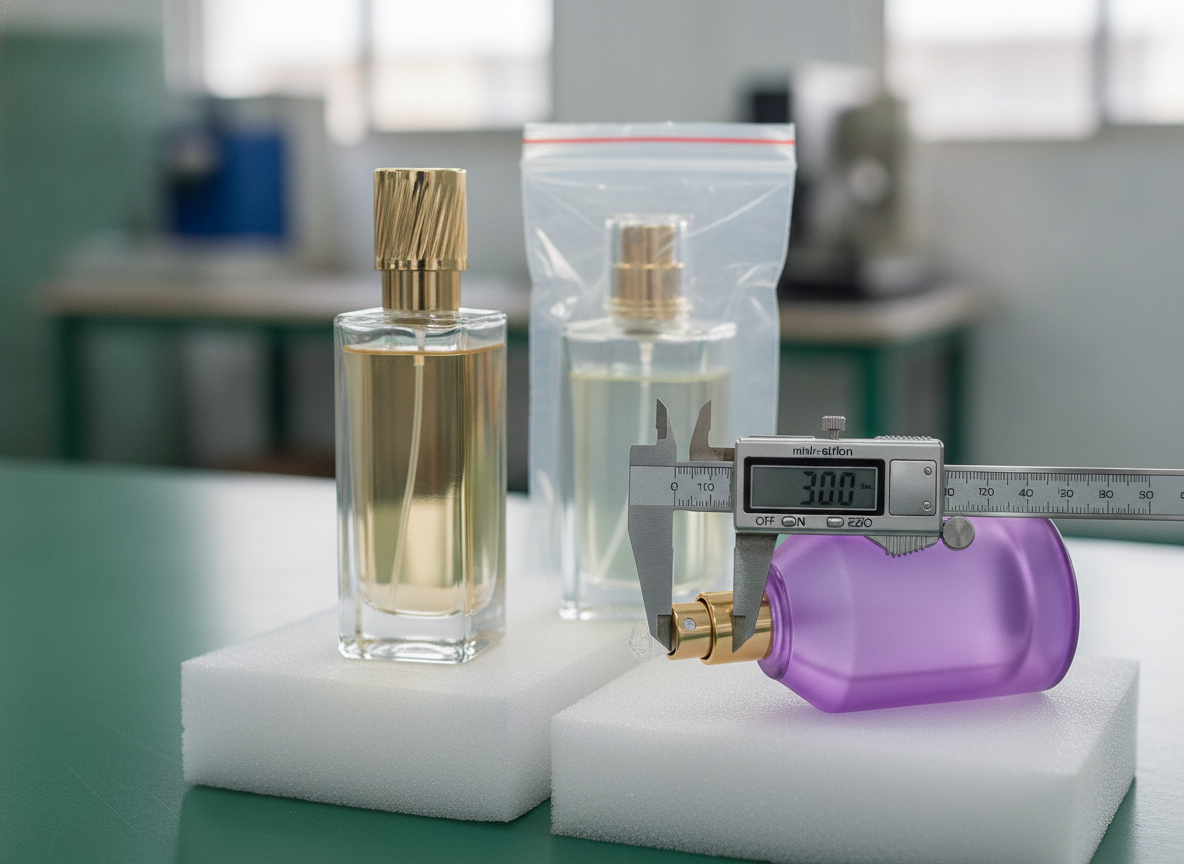
Freeze the job. A sealed reference sample — approved bottle, approved pump, crimped — is the cheapest tool in the crimp room. Every reorder gets checked against it, so drift in crimping height tolerance shows up before the line does.
Then hold the other variables:
- Stay on one bottle mould. A second mould brings a different bead and bore, so the same head setting no longer seats the collar in the same place.
- Keep decoration and coating off the neck. Lacquer on the sealing surface changes the crimp seat; the ferrule grips paint, not glass.
- Store ferrules dry and undented. A dented collar can't roll evenly, and a damp one traps a film that hazes.
- Re-check dip tube length whenever bottle height changes. Short tubes leave fragrance stranded below the intake; long ones curl against the base.
- Re-qualify at every pump lot change. Ferrule wall thickness shifts between lots, and last year's setting can slide out of the window.
Sourcing the crimp neck perfume bottle and its pump from one supplier keeps that chain short. PauPack supplies both. Whichever route you take, confirm in writing that decoration stays off the sealing surface.
Why Do Cheap Crimp Pumps Cost More? Cost and Risk on a Fragrance Line
A cheap perfume bottle crimp pump saves cents on the invoice and takes them back at the crimp head. Rejects come first. A ferrule that won't roll evenly means pulled pumps, dumped juice, bottles washed out and refilled by hand. Then the line stops while somebody chases the setting, and an hour of stoppage costs more than most pump lots cost in total.
Over-crimping breaks glass. A neck crack found after filling is a total write-off. Find it after decoration and the coating, the print and the box go with it, so the bottle turns out to have been the cheapest thing you scrapped.
Freight cuts the other way. Pumps and caps shipped loose pack denser than assembled units, so they cost less to move — but you pay someone to fit them, and you still keep spare pumps and caps on the shelf for after-sales complaints. Do the arithmetic per 10,000 units and the gap widens. Seven lines that qualify a fragrance bottle supplierwill sort the quotations faster than a price column will.
Custom Perfume Bottle Crimp Pump Programmes: OEM and ODM at PauPack
A one-stop programme means the bottle, the perfume bottle crimp pump, the overcap, the coating, the label and the box leave one factory against one spec sheet. PauPack, legally Suzhou PauPack Packaging Products Co., Ltd., keeps decoration and custom mould in-house, so a new neck geometry or four-surface fragrance decoration doesn't stall between three suppliers arguing over who owns the tolerance.
Their published Packaging Prototype Process: 7 Gates to Toolingis the route from sketch to mould. Ask which gate you're standing at before you pay for tooling. That single question saves most OEM projects a month.
Finishing covers glass coating finishes and fragrance decoration across four surfaces. Sustainable routes are PCR, refillable and PLA. Published sizes run from 1ml roller bottles and 2ml mini perfume bottles up to 1500ml teapots and 1 gallon pickle jars, so small fragrance bottles for sampling and travelsit in the same catalogue as your launch bottle.
Pumps, sprayers and closures ship as their own line, which puts the crimp pump spec in the same RFQ as the glass. Custom mould and in-house decoration are the capability; the seven gates are how a new shape gets from prototype to tooling.
Tell us which gate you're at and request a quote for the bottle, pump and decoration as one assembly against your neck drawing and RFQ sheet.
Key Takeaways
- The glass neck decides the seal, not the pump. A perfect ferrule cannot close a bead that runs oval or sits too low.
- Crimp depth has a working window, and both edges fail. Shallow means the collar spins and weeps; deep cracks the neck.
- Crimping height tolerance is a bottle-to-bottle property. Measure 30 necks across the lot — one good bottle proves nothing.
- Test inverted and by weight. Your eye will never catch a slow weep that shows up as 0.2g of loss.
- Fix dip tube alignment before you touch the crimp setting. Most "bad crimps" are bent tubes.
- Keep one approved, sealed reference sample from the signed-off lot. Reorders drift; that bottle doesn't.
Get a Perfume Bottle Crimp Pump Quote Against Your Bottle Neck
Send the neck drawing, or drop one glass bottle in a courier bag and mail it. PauPack quotes the perfume bottle crimp pump, the ferrule and the dip tube length against that neck finish, so every number on the paper belongs to your bottle instead of a catalogue average.
Fill in the published RFQ sheet with four things: target volume, fragrance base, fill volume and decoration. Add the alcohol load. That figure decides which ferrule and liner you end up with, which is why the quote is worth nothing without it. Once those lines are filled, request the quote against the neck finish you sent.
Want to evaluate before you commit? Crimp the approved trial units on your own head and test them against your own leak specification. Your filling line, your torque, your capping sequence — that's where a closure proves itself. PauPack's write-up on how it runs a crimp test (Crimp Room 7) shows the checks it applies in-house, and the weigh-loss methodcovers what happens to the fill over time. Neither replaces your own test on your own equipment.
Frequently Asked Questions
Will a crimp pump fit any perfume bottle?
No. It needs a crimp neck perfume bottle with a proper bead for the aluminium ferrule to roll under, plus enough straight neck height for the collar to grip. A screw-thread bottle gives the rolls nothing to hold, and the pump will spin or pull off. Send the neck drawing before ordering.
Why do bottles leak in transit when they passed the crimp room?
Most transit leaks on a perfume bottle crimp pump trace back to a shallow crimp, a cracked neck or a ferrule that was never fully seated under the bead. Vibration in a truck finds any gap the eye misses. Run an inverted hold and a packed-shipper trial before the batch ships.
Is the fragrance formula compatible with the pump materials?
It depends on the concentrate. Alcohol-heavy fragrances stress the gasket and the spring, and a wrong elastomer swells, hazes or seizes. PauPack publishes compatibility testing guidance you can run against your own base before you commit to a pump lot.
How much does a crimp pump cost?
The pump unit price is one line. The ferrule, overcap, dip tube, decoration, assembly and crimping labour, freight and storage of loose versus assembled units, and a scrap or rework allowance for rejects are the rest. Ask for the assembled-unit price and the loose-pump price side by side, so freight, storage and reject costs stay visible in the comparison.
What is the MOQ?
PauPack publishes an MOQ discussion and an RFQ sheet rather than a single figure, because the number moves with the bottle mould, the pump type and the decoration. Fill in the sheet with your target volume and the reply comes back specific to your project.
What lead time should I plan for?
PauPack lays out delivery planning in "Custom Bottle Delivery: A Ten-Week Plan" and states no committed lead time. Tooling for a new mould and decoration passes add their own weeks on top. Build the schedule backwards from your launch date.
Can you decorate the bottle and still crimp it?
Yes, and the order matters. Coating finishes and fragrance decoration across four surfaces belong before crimping, but keep every finish off the sealing surface under the bead. Coating inside the crimp zone changes the grip and causes spin.
How should I store and handle crimp pumps and ferrules?
For any perfume bottle crimp pump, keep the ferrules dry and undented, in the original cartons, away from anything that can crush the collars. A dented ferrule crimps crooked no matter how well the head is set. Hold one sealed reference sample from each approved lot.
How do I evaluate a crimp pump before ordering?
Start with the RFQ. Four items belong in it: the bottle drawing or a physical reference of the neck, the fragrance base (alcohol load, oils, any harsh note), the target fill volume, and the leak-test acceptance criteria you'll judge against. Those four set the pump, the ferrule and the dip tube length. Leave one out and the reply is a guess.
Then do the trial on your own bench. Trial units go onto your own crimp head, filled with your own concentrate. Water tells you nothing about a fragrance. It doesn't swell the gasket, doesn't wet the dip tube the same way, and it won't show the haze an alcohol-heavy base pulls out of the wrong elastomer. Check the sealed units against the criteria you wrote down, hold them inverted for the period you consider representative of shipping, and keep one sealed reference from every lot you accept.