
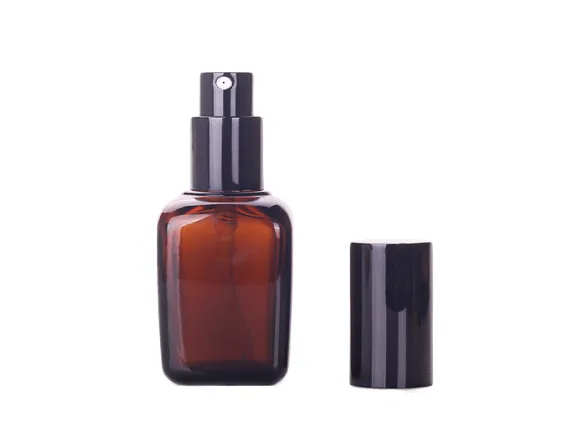
A fine mist sprayer fits a bottle when three numbers agree: spray rate, dip tube length and closure fit. The pump meters a dose per stroke, the actuator orifice breaks it into droplets, and the tube has to reach the base without curling. Get one wrong and the pack sputters, leaks or won't prime. Specify all three against the bottle drawing. Then sample.
Based on PauPack's sampling and inspection process and published test methods.
Where do spray packs actually fail at sample stage? Fit, usually. Neck finish, tube length, headspace. A pump that sputters, dribbles or refuses to prime is often just a dip tube bottoming out on the bottle base, or stopping 5mm short of the last of the liquid.
Settle those three numbers on the drawing, then choose pump and bottle together. Buying the bottle first and hunting a closure afterwards is how projects lose a month.
What does a fine mist sprayer actually do for a fragrance or skincare formula?
Your finger pushes the actuator, the pump chamber compresses, and a ball valve shuts so liquid can't drain back down the dip tube. The dose is forced through a small swirl chamber and out the orifice, where it breaks into droplets. Orifice size and swirl geometry set droplet size, and labs measure it by laser diffraction to ISO 13320:2020, Particle size analysis — Laser diffraction methods. Those two dimensions decide whether you get a scent cloud or a wet splatter.
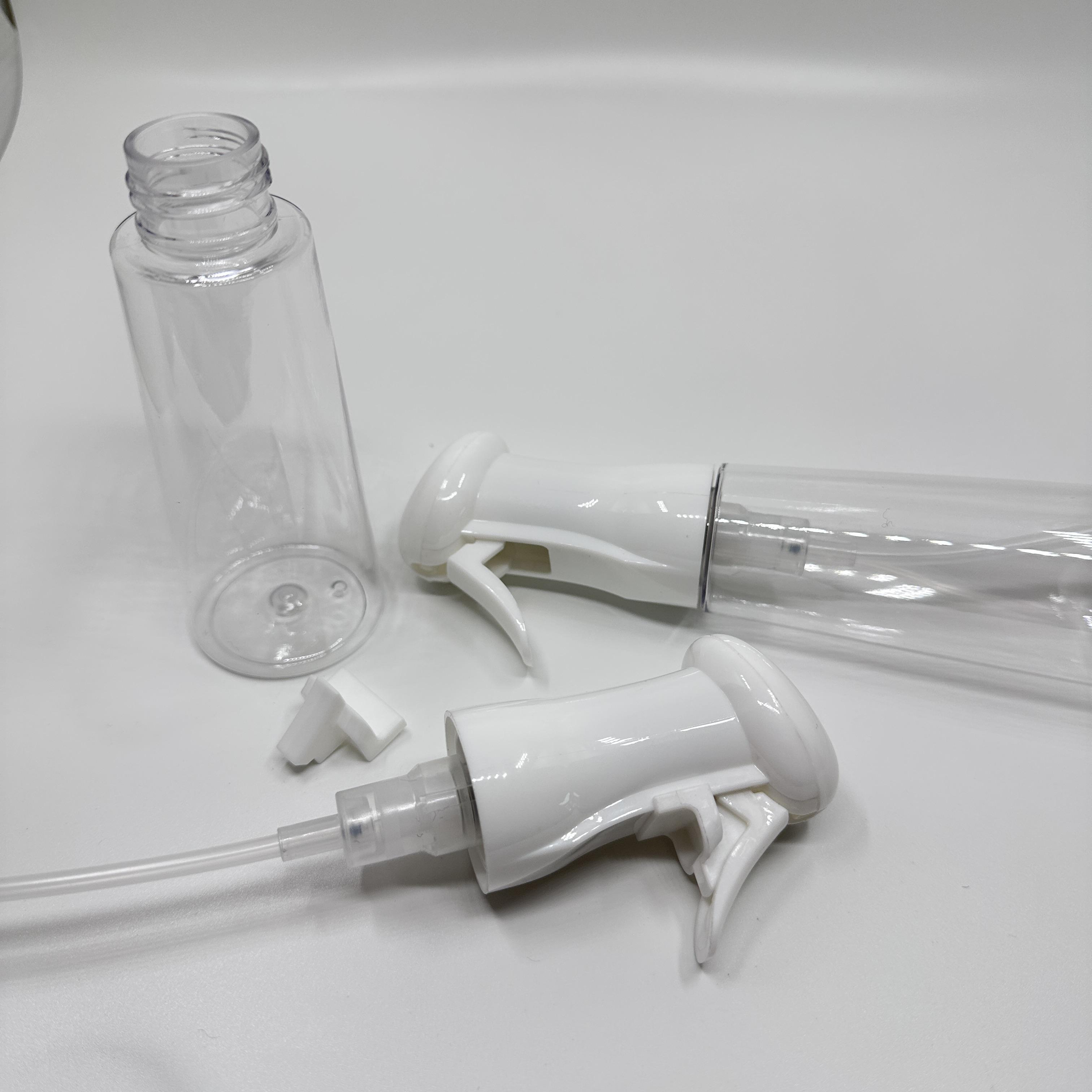
Output per stroke isn't a fixed number you can look up. The pump model sets the chamber volume, the orifice sets how fast the dose escapes, and the swirl geometry sets how finely it breaks up. Then your formula pushes back: viscosity, alcohol content and surfactant load all change what actually leaves the nozzle. There is no universal ml-per-stroke range or dose tolerance to quote here, because the same pump on a 70% alcohol fragrance and on a thickened body mist will dispense different amounts.
So you measure it. Weigh the dispensed mass over a set number of strokes on the real formula, divide, and repeat across a few bottles from the batch. Tedious? Yes. Cheaper than tooling a pump that doses wrong.
A trigger sprayer moves far more liquid per squeeze than a fragrance pump, and throws it as a coarse, directional jet — the shape you want for a kitchen cleaner or a plant spray, not for a scent. An airless pump keeps the formula sealed from air and pushes out cream or gel through a one-way valve, so it can't make a mist at all. Three different jobs, three different mechanisms.
PauPack supplies pumps and closures alongside its bottles, and its fine mist sprayer bottlesshow how actuator choice pairs with a given glass body: PP197 at 50ml amber, PP310 in 100ml, 150ml and 200ml, PP316 in 80ml, 120ml and 200ml.
Which buyers should specify a fine mist sprayer — and who should not
Water-thin liquids. That's the whole test. If your formula pours like water or moves like an eau de toilette, a fine mist sprayer earns its place on the bottle.
- Fragrance and body spray: alcohol thins the formula, so the actuator's swirl chamber can break it into a quick-drying cloud instead of a wet stripe down the glass.
- Skincare mist, toner, hydrosol: the PP316 clear glass mist bottles in 80ml, 120ml and 200ml suit this, and the light dose per stroke is why a skincare mist reads as a step rather than a soak.
- Room and linen spray: 100ml to 200ml amber, like PP310, gives you light protection and a nozzle that won't spit.
- Garden and foliar work: on larger bottles, specify output per stroke and droplet softness before you commit. A trigger sprayer is the better tool when volume matters more than droplet size; a mist sprayer is for light, even coverage on seedlings and cuttings.
Skip it for thick gels, high-viscosity oils and anything with suspended particles. They clog the orifice and land in patches. An airless pump or a lotion pump is the honest answer there.
The six measurements that decide spray rate, dip tube length and closure fit
Six numbers on a drawing will get you a usable sample. A photo and a capacity won't. Record these before you send an RFQ, then check each one against the GPI (Glass Packaging Institute) neck-finish drawing. The Glass Packaging Institute neck-finish drawings give the thread dimensions and tolerances for each standard finish, and that's the reference your pump supplier will work from.
| Measurement | Rule of thumb | Why it matters |
|---|---|---|
| Neck finish | 18/415, 20/410, 24/410, or a 15 mm crimp | Decides which pump family fits at all. A 15 mm crimp rules out screw pumps entirely. |
| Closure fit | Within the GPI tolerance for that finish | A half-millimetre of thread mismatch shows up as back-off on the shelf or leakage in transit. |
| Dip tube length | Tube end sits 2–3 mm above the bottle base | Too long and the tube curls into the corner and blocks. Too short and the pack quits priming at low fill. |
| Dip tube inner diameter | 1.0–2.0 mm | Sets flow and prime speed. Thin tubes prime slowly; fat ones dose heavily. |
| Spray rate | Average of ten strokes, repeated three times, weighed | Gravimetric figures are the only way to compare two pumps on the same bench. |
| Fill line and headspace | Measured from the neck seat, not eyeballed | Headspace affects priming and leak behaviour as much as the pump does. |
Fill that table in once and the sampling conversation changes — you're arguing about 1.2 mm of tube, not about "a finer mist". Send the drawing with the numbers and ask for the pump that matches the neck finish first.
A 7-step bench test path for spray rate, prime and pattern
Put the pump on the bottle it will ship with. Fill to the fill line you'll actually run in production, with the formula you'll actually sell — not water, not a lab substitute. Water primes faster than a 20% ethanol fragrance and tells you nothing useful.

- Prime count.Actuate from new and count the strokes to the first full mist. Write that number down against the bottle item number. If it comes in high, or jumps around between units, put it next to the pump supplier's stated priming behaviour and next to the reference pack you already approved. A pump that hangs on well past your reference usually has an air leak at the closure or a dip tube sitting against the base.
- Weigh ten strokes, three times.Spray into a tared beaker, divide grams by ten for the per-stroke mass, and repeat on a rested pump. Log all three averages on the same sheet as the prime count. What counts as a pass isn't something you eyeball on the bench: the tolerance band, and how many units go through the test, get agreed in writing with the pump supplier and written into your AQL/QC plan.
- Pattern at 15 cm.Two short bursts onto a tissue held at 15 cm. You want a centred, roughly circular bloom with no heavy streaks and no wet ring at the edge.
- Hold at 45° for 24 hours.Invert, rest the pack at an angle, and leave it. Any bead of formula at the crimp or the thread is a closure-fit failure, not a pump failure.
- Actuation force and return.Press steadily and slowly release. The actuator should come back on its own every time; a sticky return will show up as a customer complaint about the second spray.
- 48 hours with formula in the pack.Check the actuator tip for dried crust, the dip tube for clouding, and the gasket for swelling. Do this before you order, not after.
- Log it all.Record the prime count, per-stroke mass, pattern notes and any leak against the bottle item number. That sheet is your reference when compatibility testing moves to a second supplier.
Steps 2 and 4 are the ones that fail. If the inverted pack drips at the crimp, check the neck finish before you blame the pump.
Worked bench example
Take the target dose from your brief. Say it's 0.10 ml per stroke on a formula sitting near 1.0 g/ml — that's illustrative arithmetic, nothing more, and it doesn't describe any pump on the market. Ten strokes should weigh about 1.0 g. Tare the beaker, spray ten, weigh, write it down. Rest the pack and run it again, then a third time.
Averages of 0.98 g, 1.01 g and 0.99 g are the kind of run you'd take forward to the pattern check. A set of 0.95, 1.08, 0.97 deserves a question: scatter that wide often means air ingress between the dip tube and the gasket. Either way, the accept/reject line is the supplier's to state in writing and yours to apply from the QC plan. Get it signed off before you run the test, so the result is a decision and not a debate.
How many packs you put through this, and how many may fail, comes from your AQL plan rather than from one unit on the bench. PauPack publishes AQL sampling guidance that covers setting those limits.
Which pump materials touch your formula — and does it matter?
Yes, it does. Formula touches five parts: the dip tube, pump body and chamber, spring, gasket and actuator. Most fine mist pumps use LDPE for the tube, PP for the body, chamber and actuator, and stainless steel for the spring. All-plastic pumps swap that spring for POM. Gaskets are where the choice gets strict: water-based mists generally use silicone; solvent or alcohol-rich systems require EPDM or nitrile. LDPE gaskets only after your supplier confirms compatibility with the formula.
Which one will your juice attack? A solvent-rich fragrance can swell a silicone gasket; citrus terpenes soften an LDPE dip tube over months. Metal-sensitive formulas go for the POM-spring pump. And the bottle is part of this club: PET is lighter and cheaper than glass, but it can interact with what's inside and changes the closure and pump fit you can use. See PET versus glass bottles for skincare.
So specify with a reason. Ask for the wetted-material list and a compatibility sample. A cheap tube that hazes your juice costs more than the upgrade. PauPack's plastic pump sprayer bottle pageshows the pump-and-bottle pairing.
Which PauPack bottle fits which pump: six spray models compared
Six glass spray bottles sit in the PauPack range, and they don't swap freely. What decides whether a fine mist sprayer fits is the neck finish — the thread or crimp dimension the pump grips. Body diameter doesn't enter that calculation at all, which is why the table below is a shape-and-size comparison, not a pump-compatibility chart.
| Model | Capacity | Body diameter | Colour |
|---|---|---|---|
| PP249 Luxury Sprayer Bottle | 50ml, 100ml | 30mm, 40mm | Golden-gradient frosted |
| PP198 200ml Boston Bottle | 200ml | 55mm | Clear |
| PP197 Amber Glass Spray Bottle | 50ml | 35mm | Amber |
| PP310 Amber Glass Bottle | 100ml, 150ml, 200ml | 40mm, 45mm, 50mm | Amber |
| LG-50 Luxury Glass Perfume Spray Bottle | 50ml | Customisation | Customisation |
| PP316 Clear Glass Mist Bottle | 80ml, 120ml, 200ml | 35mm, 40mm, 45mm | Clear |
Diameter still earns its column. It's how the bottle reads in the hand and on a shelf: 30mm on the 50ml PP249 is a slim profile that disappears into a washbag, 55mm on the Boston bottle fills a palm. Build a gift set and matching diameters across two or three SKUs give you a carton that stacks without wobble.
So request the neck-finish drawing for every model and every capacity on your shortlist before you choose a pump. Ask for the 50ml and the 100ml of PP249 separately, and for 100ml, 150ml and 200ml of PP310 separately. PauPack publishes a neck finish chart for buyers, and it's the document that decides this, not a caliper across the body.
Start with PP310for an amber fragrance line: 100ml, 150ml and 200ml, all amber, with the 40mm, 45mm and 50mm bodies stepping up in proportion so the family reads as one shelf story. PP316suits clear toners and setting sprays, where the clear glass mist bottles in 80ml, 120ml and 200mlgive you three heights in one look. Perfume briefs go to LG-50, a 50ml glass perfume bottle with a customisable body diameter and colour.
PP249 sells skincare gift sets on that gold gradient. PP197 is a tester or handbag size. PP198 is the 200ml workhorse for body mist and room spray. All six carry a USD 1.00 website list price, so the choice comes down to shape, colour and capacity — then to a drawing you haven't seen yet.
Eight stages before release: the quality checks behind a spray pack
A pre-shipment report is only as good as the stages it covers. Eight, in this order.
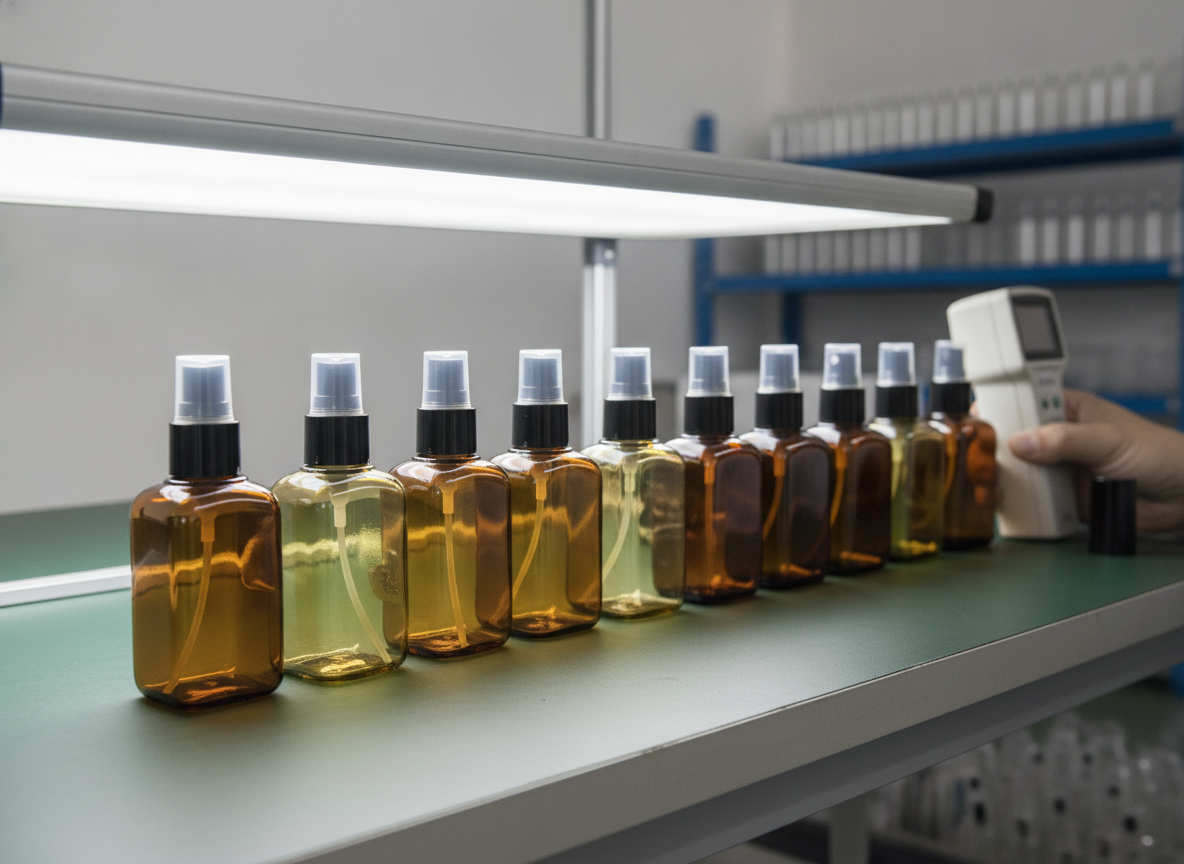
- Colour matchagainst the approved standard under D65 light, because glass and coating batches drift and a client will see it before you do.
- Incoming component inspection by AQL sampling to ISO 2859-1:1999, Sampling procedures for inspection by attributes — Part 1: Sampling schemes indexed by acceptance quality limit (AQL) for lot-by-lot inspection. That's how you accept or reject a pump lot without opening every carton.
- Assembly plus dip tube cut check; a tube 3mm short starves the pump at the last fifth of the bottle.
- Prime and spray-rate check on the filled pack, since the number that matters is output per stroke, not the pump's catalogue figure.
- Leak and vacuum check, because a closure that passes at atmosphere can still weep when the headspace cools in an airfreight hold.
- Drop test on filled packs, following the distribution sequences in ASTM D4169-22, Standard Practice for Performance Testing of Shipping Containers and Systemsor ISTA 3A, Packaged-Products for Parcel Delivery System Shipment. ISTA reissues 3A every few years, so match the version your lab actually runs.
- Formula-in-pack compatibility, held at 40°C and at 4°C for the stated period, then re-checked for weight loss and odour.
- Retained samples and documentation, which cosmetics buyers file against ISO 22715:2006, Cosmetics — Packaging and labelling, and, in the EU, Regulation (EC) No 1223/2009 of the European Parliament and of the Council of 30 November 2009 on cosmetic products.
Ask for the AQL level and the sample size in writing. A report that lists "passed" with no lot number tells you nothing.
From RFQ to delivery: how capacity and timing run on a spray project
Six steps: RFQ sheet, sample, approval, tooling, production, dispatch. Nothing exotic. The weeks vanish in the handoffs between them.
Start with a filled RFQ. Name the bottle (PP316 at 120ml, say, or PP310 at 100ml), the pump output you want, the closure, the artwork and a target quantity. PauPack publishes RFQ sheets and an MOQ discussion; the MOQ figure that matters comes back on your quote, sized to that bottle and that fine mist sprayer rather than pulled off a generic grid.
PauPack has published two pieces that do the sequencing for you. "Packaging Prototype Process: 7 Gates to Tooling" walks a project from prototype through the tooling decision, gate by gate, and "Custom Bottle Delivery: A Ten-Week Plan" is the delivery-planning frame to work backwards from your launch date. Take the order of operations from both. Committed timing for your order comes in the quote, and again in writing when the PO is placed.
So where does a spray project stall? Artwork approval and colour match, almost every time. Both sit on your desk, not the factory's. Sign the decoration proof before the sample lands and you keep the calendar.
What drives fine mist sprayer cost — and where the real risks sit
The pump platform is the first line. A generic fine mist sprayer and a licensed actuator can differ by more than the glass bottle carrying them. Then tooling: actuator shell, closure insert, and whether the neck takes a screw thread or a crimp. Crimp is cheaper per unit and needs no thread tooling. Screw lets the end customer refill, and you'll pay for that.
Gasket and dip tube are small parts with big swings. A swollen gasket or a tube cut 5mm short turns a cheap pump into a rework order.
A licensed pump and a generic one look the same on the shelf. What the licence buys is dosage consistency: the millilitres per stroke stay inside a stated band, run after run, and that figure is quoted through the pump maker's own channel. Go generic and the variance lands on your fill line.
- Over-specified droplet fineness, because choking the orifice to get a "finer" look drops your output and forces tighter QC on every batch.
- A gasket that swells in the formula: the seal fails months into stability, so the whole pump spec returns to sampling.
- A dip tube cut wrong, since it either strands liquid in the bottle or fouls the base and primes badly.
PauPack product pages list a website price of USD 1.00 for the spray bottles; project cost is quoted separately by bottle, pump, tooling, decoration and quantity.
Can you customise a fine mist sprayer pack without a huge order?
Big-brand spray packs come out of tooling budgets most launches never see. True. It's also beside the point.
Most of what reads as "custom" is decoration and closure choice, not a new mould. LG-50, the 50ml perfume spray bottle, lists body diameter and colour as customisation. PP249 comes in 50ml and 100ml; PP316 in 80ml, 120ml and 200ml. The pattern repeats across the range — pick the capacity that fits the launch, then spend on the finish: coating, fragrance decoration across four surfaces, labels, boxes.
Closures sit in the same catalogue. Pumps, caps, droppers and sprayers are supplied alongside the bottles, so the fine mist sprayer and the bottle are chosen together instead of married after the fact. That matters when a sample leaks or the actuator feels wrong; you're not negotiating between two suppliers.
OEM and ODM runs sit alongside that set. PCR resin, refillable formats and PLA are listed options, so a small launch can lead with a recycled-content claim instead of a new bottle. Pump-to-bottle fit is where samples stall. Check the refillable fine mist sprayer fitguide before you commit.
Key takeaways and how to get a quote
Five things decide whether a spray pack leaves your bench approved:
- Settle the neck finish before the bottle. One wrong thread and no pump fits, and the neck finish chart answers it in a minute.
- Cut the dip tube to bottle height, stopping a few millimetres off the base. Too long and it curls; too short and you leave product behind.
- Test spray rate on your own formula, never on water. Viscosity moves output more than the orifice does.
- Name the gasket in writing. Nitrile, EPDM and silicone age differently against fragrance oils and acidic actives.
- Sample one fine mist sprayer properly before you compare five. Prime and pattern first, price after.
Email info@paupacking.com or message WhatsApp +8618906237258 (No 30, Lou Yang Road, Wu Zhong District, Suzhou, Jiangsu, 215121, CN). Your RFQ should carry the bottle drawing, fill volume, formula type, neck finish and annual quantity — that's what turns a quote into a real one.
Frequently Asked Questions
What does a fine mist sprayer pack cost?
Project cost is quoted per project, so the figure follows the brief: pump grade, glass weight, decoration and volume. Those four move the number far more than the pump alone. Frosted finishes and gold gradients cost real money; a clear bottle with a stock pump doesn't.
What MOQ applies to a spray order?
PauPack publishes an MOQ discussion and an RFQ sheet rather than a fixed figure, because the number follows bottle size, pump choice and how much decoration you add. Ask against one specific item: a 100ml PP310 amber bottle with a label is a different order from a custom-coloured LG-50.
How long is lead time on a spray project?
PauPack sets out delivery planning in "Custom Bottle Delivery: A Ten-Week Plan" and commits no figure in advance. Sampling, the seven prototype-to-tooling gates and decoration each take their own slice of the calendar. Buyers who lose weeks usually lose them at sample approval, not in production.
Screw closure or crimp?
Screw closures suit skincare, refills and anything the end user might open; crimp closures suit fragrance and give tamper evidence in one stroke. Decide by how the customer uses the bottle. Crimping also removes the gasket question entirely, since the seal is formed against the neck.
What spray rate should I ask for?
There's no universal ml-per-stroke target to copy off a spec sheet. A rate that flatters an alcohol fragrance will over-wet a thick serum, and the same pump delivers differently the moment the juice changes. So set the number yourself, by bench-testing the actual formula: spray it, count strokes, watch how much lands on the area you care about. Too wet, too dry, or right?
Then line up pump samples side by side — same bottle, same fill level, same stroke count — and compare what each one does. Ask the supplier for measured output with the stroke count and the test method written down, so two quotes can be read against each other. The target you end up with belongs to your formula and your user, nobody else's.
How is dip tube length set?
Cut the tube so it sits 2–3 mm above the bottle base, close enough to draw nearly everything, short enough that it never curls against the glass and starves the pump. Measure from the neck seat down, not from the shoulder.
Which gasket do I need?
The gasket is the thin seal inside the closure, and it's the cheapest place to fail. Water-based mists generally take silicone. Solvent and alcohol-rich systems require EPDM or nitrile, and LDPE goes in only after your supplier has confirmed compatibility with the formula. Test the gasket with your actual juice, not with water.
Can a fine mist sprayer work for plants?
Yes. Foliar feeding and rooting cuttings both work: a fine mist sprayer for plants, in a 100–200ml amber bottle, lays down a light even layer without soaking the soil the way a watering can does. A trigger sprayer moves more liquid per squeeze. Pick the mist when droplet size is what you're after, seedlings and ferns rather than a full drench.
Can I customise without a huge order?
Modular choice is how small launches happen: an existing bottle from the range, a stock sprayer, one decoration method, one label. Perlucent glass, a coloured pump and a printed box read as a custom pack. Tooling only enters the picture when the bottle shape itself has to change.
How do I check the closure fits?
Match the neck finish (thread type, diameter and height) before you sample anything. A pump that threads on but seats high will leak at the shoulder, and no amount of torque fixes it. Send your bottle drawing with the RFQ and let the pump be specified against it.