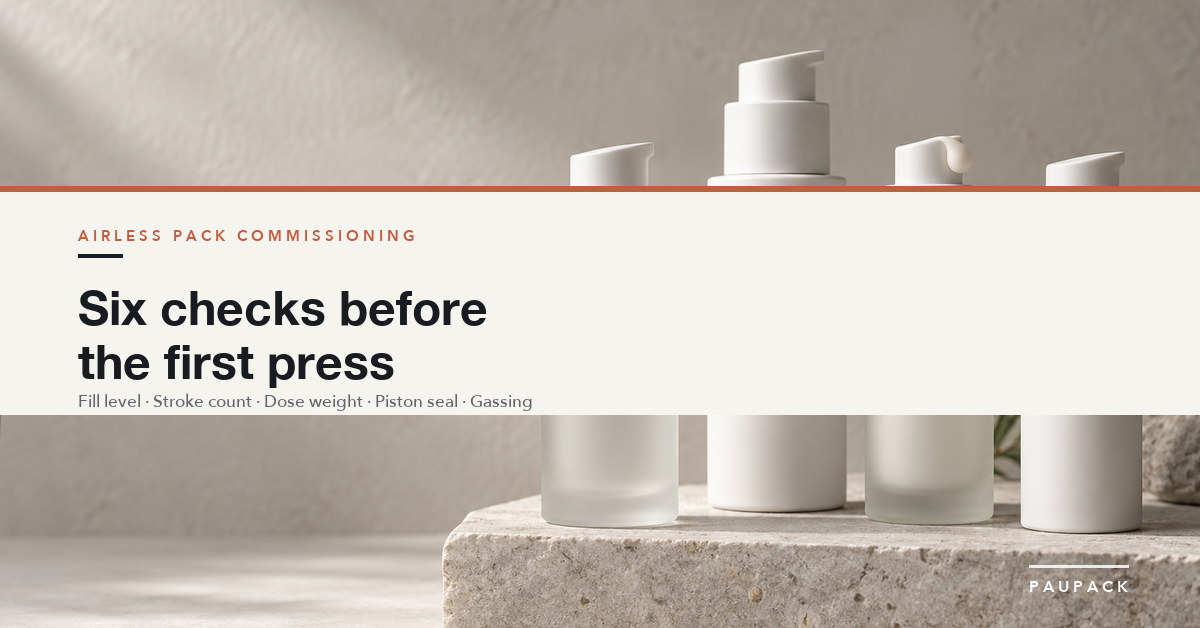


Airless packaging is not one standard bottle with one standard pump. The useful choice depends on formula behavior, dispensing expectations, filling equipment, decoration, order quantity and the level of component customization a brand can support.
For buyers comparing airless pump bottles wholesale, the fastest route is to define a formula-risk profile before reviewing shapes and colors. This prevents a visually attractive package from moving too far through sampling before the brand has checked dosage, priming, compatibility and filling procedures.
Build a Formula-Risk Profile Before Selecting the Bottle
Begin with four questions:
- How sensitive is the formula to repeated consumer exposure?
- How easily does it move through a pump system?
- What dose should one actuation deliver?
- How will the product be filled, primed, stored and transported?
The answers create a practical screening brief. A light serum, rich cream, gel and lotion may require different pump behavior even when the marketing team wants one coordinated packaging family.
| Product scenario | Packaging priority | Sample question |
|---|---|---|
| Lightweight serum | Controlled dose and clean presentation | Does the pump deliver consistently after storage? |
| Daily lotion | Comfortable actuation and repeat use | Is the dose suitable for the intended application area? |
| Rich cream | Product movement through the dispensing path | Does the formula dispense without excessive force or interruption? |
| Travel format | Closure security and compact proportions | Does the complete pack tolerate handling and transit conditions? |
An airless system can support a controlled user experience, but the bottle name alone does not prove formula compatibility or preservation performance. The product owner should validate the actual formula in the final package.
Decision 1: Match the Dispensing Architecture to the Use Case
Ask the supplier to explain the component system rather than presenting only an assembled bottle. Review the actuator, pump, bottle body, internal moving components, base and any overcap or locking feature.
Key buying questions include:
- Is the package intended to dispense upright only?
- How many initial actuations are normally required during priming?
- Does the actuator include a lock, overcap or other transport feature?
- What dosage options are available for the selected neck and pump system?
- Which components change when the capacity changes?
- Can the same visual family cover several capacities without changing the user experience?
Brands planning a coordinated skincare line can compare airless options with PauPack's broader health and beauty packaging, lotion bottle range and glass cream jars.
Decision 2: Separate Material Choice from Surface Appearance
Two bottles may look similar after coating but behave differently during filling, decoration, handling and recycling. Request the material specification for the bottle and matching components, then confirm which surfaces receive color or decoration.
Evaluate:
- Base material and any available recycled-content options
- Wall structure and areas that remain visible after assembly
- Color variation between production lots
- Compatibility of printing, labels, coating and hot stamping
- Scuff resistance during assembly, packing and transport
- Whether decoration affects component movement or fit
Do not approve color from a screen image. Use physical samples under consistent lighting and record an accepted range when exact color matching is not technically practical.
Decision 3: Check the Filling Process Early
The packaging brief should reach the filling partner before the final bottle is chosen. A filler may need dimensional data, filling direction, headspace guidance, assembly sequence and instructions for priming or final closure.
Create a short process map:
- Receive and inspect components.
- Prepare the bottle for filling.
- Fill the target quantity.
- Assemble or close the package.
- Check dose, appearance and leakage.
- Apply secondary packaging and lot identification.
If the package requires a special assembly step, include that labor and equipment effect in the commercial comparison. A low component price can be offset by slow assembly, additional handling or avoidable rejects.
Decision 4: Approve Dosage, Priming and Repeat Use

Pump evaluation should use the intended formula, not water alone. Record the target dose and acceptable variation with the technical teams involved in the product.
During sample review, observe:
- Initial priming behavior
- Dose consistency across repeated actuations
- Actuation force and consumer comfort
- Product residue around the nozzle
- Recovery after storage in relevant orientations
- Performance near the expected end of use
- Cap, lock or overcap retention after repeated handling
Use enough samples to compare more than one unit. One well-performing sample cannot demonstrate production consistency.
Decision 5: Create a Decoration Plan That Protects Function
Decoration should support recognition without covering critical assembly areas or creating interference between moving parts. Map the printable area, label panel, seam positions and grip surfaces before artwork is finalized.
A disciplined sequence is:
- Approve the functional component set.
- Confirm the decoration method on the real material.
- Review artwork size and position.
- Test handling and packing abrasion.
- Approve a decorated reference sample.
PauPack's custom bottle design service can support the transition from packaging brief to production-ready artwork and component specifications.
Compare Wholesale Quotations in Three Levels
When requesting airless pump bottles wholesale, ask for quotations that separate three levels. This makes the cost of differentiation visible.
| Quotation level | Typical scope | Best use |
|---|---|---|
| Stock component | Existing bottle, standard color and standard pump | Fast feasibility checks and focused launches |
| Decorated stock | Existing bottle with printing, labeling, coating or selected color | Brand differentiation without new structural tooling |
| Custom development | Modified or new components, special finishes or unique structure | Larger programs requiring stronger packaging ownership |
Compare the same capacity, pump, overcap, decoration, packing, inspection and delivery assumptions. Ask the supplier to identify separate minimums for bottle production, color, decoration, cartons and custom components.
Build a Sample Approval Pack
The approval pack should contain more than a signed bottle. Include:
- Component names and material references
- Key dimensions and capacity
- Pump and dosage reference
- Approved color and artwork position
- Appearance standards and known acceptable variation
- Filling and assembly notes
- Packing configuration
- Test results and retained samples
Use PauPack's quality management and services pages when preparing the inspection and project-support portion of the RFQ.
Final Sourcing Recommendation
Choose the simplest system that meets the formula, consumer and brand requirements. Confirm function before decoration, involve the filler early, compare quotations on equal assumptions and preserve an approved physical reference.
The strongest airless pump bottles wholesale project is not the one with the largest option list. It is the one where the formula, pump, filling process, finish and commercial plan have been approved as one system.
Frequently Asked Questions
What information should be included in an airless bottle RFQ?
Include the formula type, target capacity, dose, quantity, material preference, color, decoration, filling method, assembly needs, tests, packing, destination and launch timing.
Do airless bottles work with every skincare formula?
No. Formula movement, viscosity, pump design, dosage and filling procedure must be evaluated together using the actual product.
What changes the MOQ for wholesale airless bottles?
MOQ can change with the bottle model, capacity, material, color, pump, overcap, decoration, carton and any custom component or tooling requirement.
What should be tested before bulk production?
Test the filled package for priming, dosage, repeat use, leakage, storage, decoration durability, assembly, packing protection and the intended consumer experience.