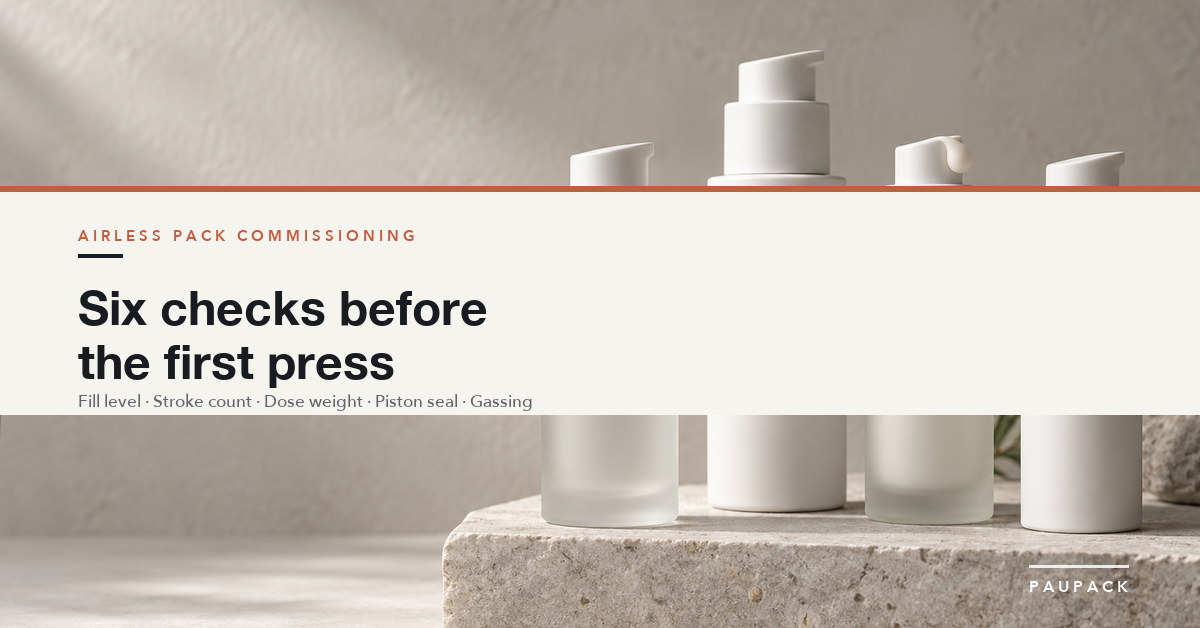


Airless dispenser packaging should be audited before the first prime, when the package still looks deceptively simple. The bottle, piston or pouch route, pump engine, actuator, closure, dip tube where applicable, decoration and filling process form one operating system. PauPack uses six decision cards to expose what the empty sample cannot answer.
Decision Card A: Name the Formula and Use Boundaries
Product owners should define viscosity range, sensitivity, particulates, dose objective, storage orientation, expected use period and compatibility program. Share only the information needed for qualified evaluation. PauPack records these boundaries without claiming that a generic platform is compatible with every formula.
Decision Card B: Identify the Airless Architecture
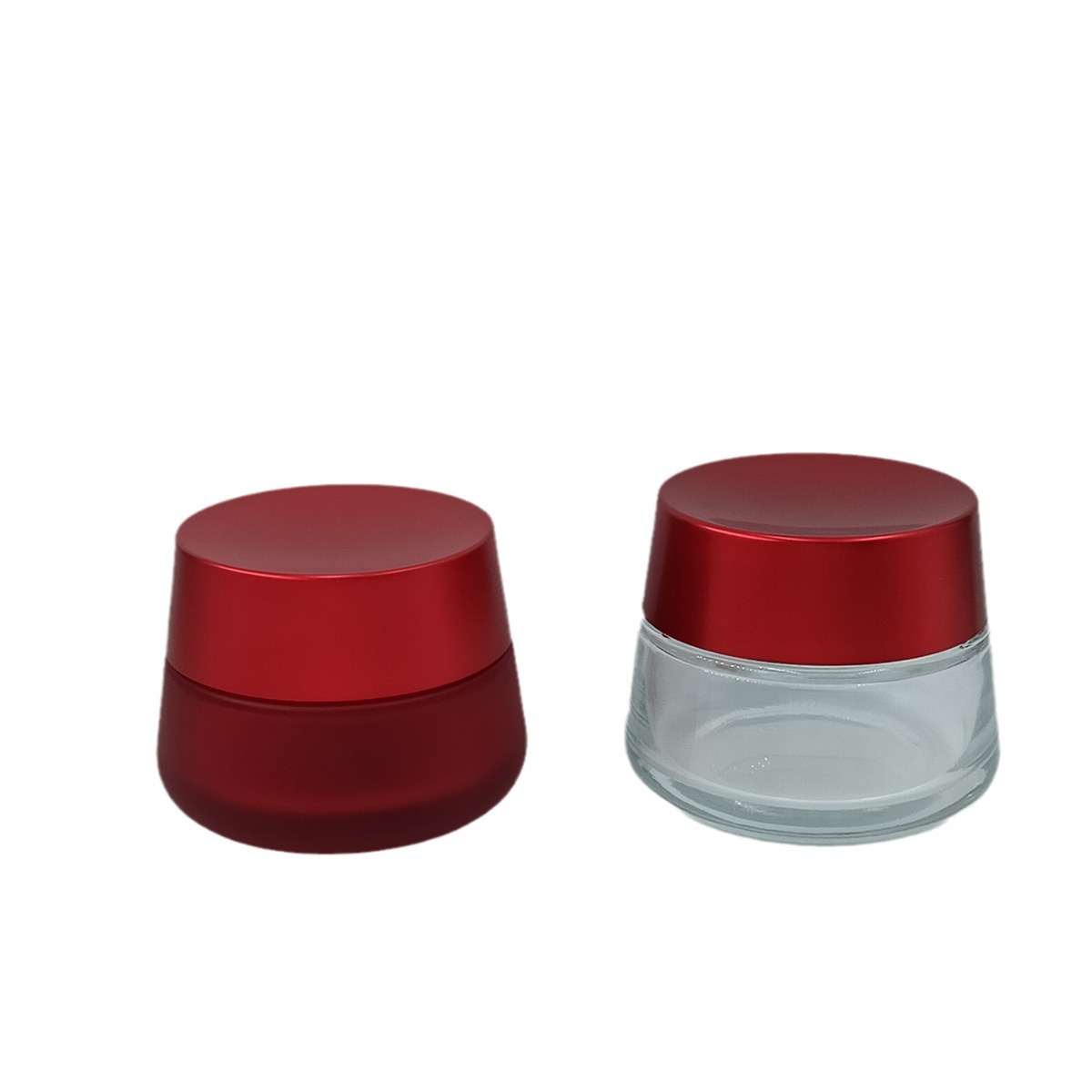
Distinguish piston, pouch or other platform construction, and identify the product-contact components. Record nominal and usable fill, bottle dimensions, pump route, actuator, overcap, base, travel position and assembly codes. Similar exteriors can conceal different operating principles, materials and filling requirements.
Decision Card C: Define the First-Prime Experience
Set an observation method for the number of actuations to first dispense, dose behavior, flow continuity, actuator feel and visible product path. Use production-relevant filled samples and record condition, temperature and sample identity. PauPack separates priming observations from compatibility or long-term performance conclusions.
Decision Card D: Measure the End of Use
Residual product, interrupted dispensing and piston travel can influence consumer perception and sellable claims. Qualified teams should define the method and acceptable boundary for the actual formula. The packaging brief should also state whether the package is expected to dispense upright only and how users will store it between uses.
Audit rule: “airless” describes an architecture; it does not eliminate the need to identify components, fill correctly and validate the actual product.
Decision Card E: Map Filling and Assembly
Confirm bottom-fill or top-fill route where applicable, equipment contact, fill speed, headspace or deaeration assumptions, closure application and inspection points. Ask which components arrive preassembled and which are installed by the filler. PauPack's health and beauty portfolio can be shortlisted only after the operations route is visible.
Decision Card F: Protect the Brand Surface
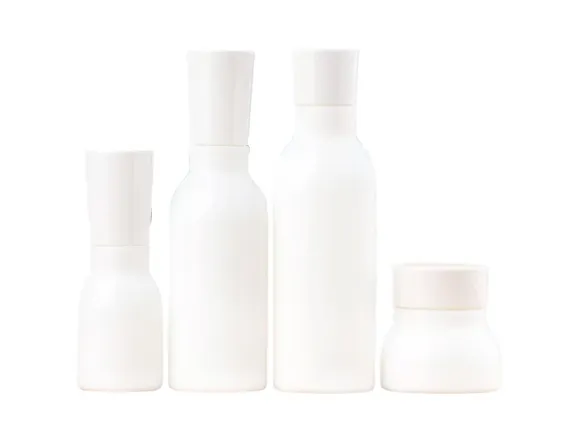
Define print, coating, label or sleeve areas, actuator color, cap fit and physical finish masters. Review how filling equipment, guides and dividers contact decorated surfaces. PauPack's design support connects artwork to real seams, curves, moving parts and protected zones.
The Six-Card Comparison Table
| Card | Evidence | Decision |
|---|---|---|
| Formula | Use and compatibility brief | Evaluation boundary |
| Architecture | Drawing and component list | Platform identity |
| Prime | Filled actuation record | Start-of-use experience |
| End use | Residual observation | Dispensing objective |
| Operations | Line trial | Filling readiness |
| Brand | Decorated packed master | Visual release |
Who Should Buy This System—and Who Should Pause
Airless dispenser packaging suits skincare and treatment products whose user experience benefits from controlled dispensing and a defined package architecture. Buyers should pause when the formula is not ready for evaluation, the filler cannot support the platform or the forecast cannot absorb component and decoration minimums. A conventional pump or tube may offer a simpler operational route.
Inspect Workmanship at Moving Interfaces
Review actuator alignment, pump attachment, piston or pouch condition, bottle walls, base seating, cap retention and decoration. Define cosmetic defect boundaries separately from dispensing failures. PauPack recommends retained passed and failed samples so teams can compare evidence rather than argue from descriptions.
Build a Filled-Sample Program
Use stages: identified empty components, fill and assembly trial, prime and dose observations, storage or handling studies defined by qualified owners, decorated master and packed reference. Every stage needs a question and exit criterion. A beautiful empty sample should never release a system whose filling and dispensing route remains unknown.
Connect Quality Evidence to Destination Responsibilities
ISO 22715 addresses cosmetics packaging and labelling requirements, while the FDA Cosmetics Labeling Guide provides U.S.-focused information. These references do not certify an airless system or its formula compatibility. PauPack uses them to explain why net contents, artwork space and package identity remain part of the qualified destination review.
Price the Operating System, Not the Empty Shell
Compare bottle, pump, actuator, cap, decoration, assembly, inspection, packing, trials, losses and residual components. Include filling-line setup and possible repeat trials. PauPack models delivered sellable units across forecast scenarios so a lower component price does not hide operational cost or leftover inventory.
Plan Lead Time by the Longest Component
Stock bodies, custom colors, pumps, decoration and cartons may have different minimums and production windows. Ask which component controls the critical path and which tasks can run in parallel after stable inputs are released. Record customer approval time and change impact rather than showing only a supplier production estimate.
Define OEM/ODM and Change Ownership
State who owns the platform selection, formula evaluation, artwork, component nomination, filling trial, inspection, packed approval and complaints. Require notification before changes to materials, pump engine, actuator, gasket, piston or pouch, decoration supplier and case design. PauPack's project services keep those responsibilities visible.
Retain the First-Prime Reorder File
Archive drawings, component codes, filled-use results, artwork, physical masters, packing and approved deviations. Link production and complaint records to the same identities. PauPack's quality process and product catalog provide the broader sourcing and release context.
Send PauPack the Six Cards
Send the formula family, fill size, dispensing objective, architecture preference, filling route, finish, quantity and destination. A strong airless dispenser packaging inquiry lets PauPack compare systems on evidence, operational readiness and commercial risk. The result is a package the brand can explain, the filler can run and purchasing can reorder.
Use a Formula-to-Platform Shortlist
For airless dispenser packaging, compare two or three architectures against the same formula and operations brief. Record product-contact materials, dose route, usable fill, first prime, residual objective, filling equipment and component minimums. PauPack does not let a preferred silhouette bypass the technical questions; every shortlisted platform answers the same decision cards.
Design a Consumer-Use Observation
Ask representative reviewers to handle the identified filled unit under the intended orientation. Record cap removal, actuator access, first prime, dose control, grip, stability and signs that the package is nearing empty. PauPack translates these observations into measurable requirements for airless dispenser packaging rather than treating comments such as “smooth” or “premium” as complete specifications.
Build an Operations Readiness Score
Score component receiving, storage, filling, assembly, coding, decoration protection, inspection and packing. Add the owner and missing evidence beside each score. A platform can perform well in a small hand-filled trial yet remain difficult for the intended line. PauPack uses the readiness score to decide whether airless dispenser packaging needs another line trial or a simpler route.
Prepare a Complaint Evidence Kit
Customer service and quality teams should know which photos, lot codes, fill history and returned samples to collect. Common symptoms such as no dispense, intermittent dose, damaged actuator or decoration scuff need different investigation paths. PauPack ties complaints about airless dispenser packaging to component and production identity before deciding whether the cause involves product, filling, component, transport or use.
Review the System Before Every Scale Change
A pilot, first commercial order and high-volume reorder may use different equipment, case counts or suppliers. Review what evidence transfers and what must be repeated. PauPack keeps airless dispenser packaging stable by controlling scale-up assumptions, not by assuming a passed sample automatically proves every future production condition.
Give the Launch Team a Stop Rule
Define which observations stop filling or release: unidentified parts, abnormal priming, damaged actuators, visible leakage, incorrect decoration or a packing deviation. State who decides containment and restart. PauPack prefers explicit stop rules because they protect the approved system while giving operators a fast, practical response when production evidence differs from the expected condition.
Approve the Last Dose as Deliberately as the First
Observe how the identified filled package behaves near the end of its use cycle under the defined method. PauPack records dose continuity, consumer cues and residual observations so the release decision covers the complete experience rather than only a successful first prime.
Frequently Asked Questions
What does airless packaging mean?
It describes a dispensing architecture; the exact piston, pouch, pump and product-contact route must still be identified.
Does airless packaging suit every formula?
No. Qualified owners should evaluate the actual formula, components and intended conditions.
Why measure first prime?
The first dispensing experience depends on filling, pump design, product behavior and assembly.
What is residual product?
It is product remaining when the package no longer dispenses as intended under the defined method.
Should filling equipment be reviewed early?
Yes. Platform architecture can require specific filling, deaeration, assembly and inspection routes.
What should a decorated master control?
It should identify color, gloss, registration, component match, protected zones and accepted variation.
Which costs are easy to overlook?
Line trials, assembly loss, decoration setup, residual components, inspection and protective packing are often separate.
When is a conventional pump a better choice?
It may be better when operations, formula readiness, forecast or cost cannot support an airless platform.
What changes should trigger review?
Review formula, materials, pump, actuator, piston or pouch, filling, decoration, packing or supplier changes.
What protects a repeat order?
Controlled component codes, drawings, filled results, masters, packing references and change rules protect it.