

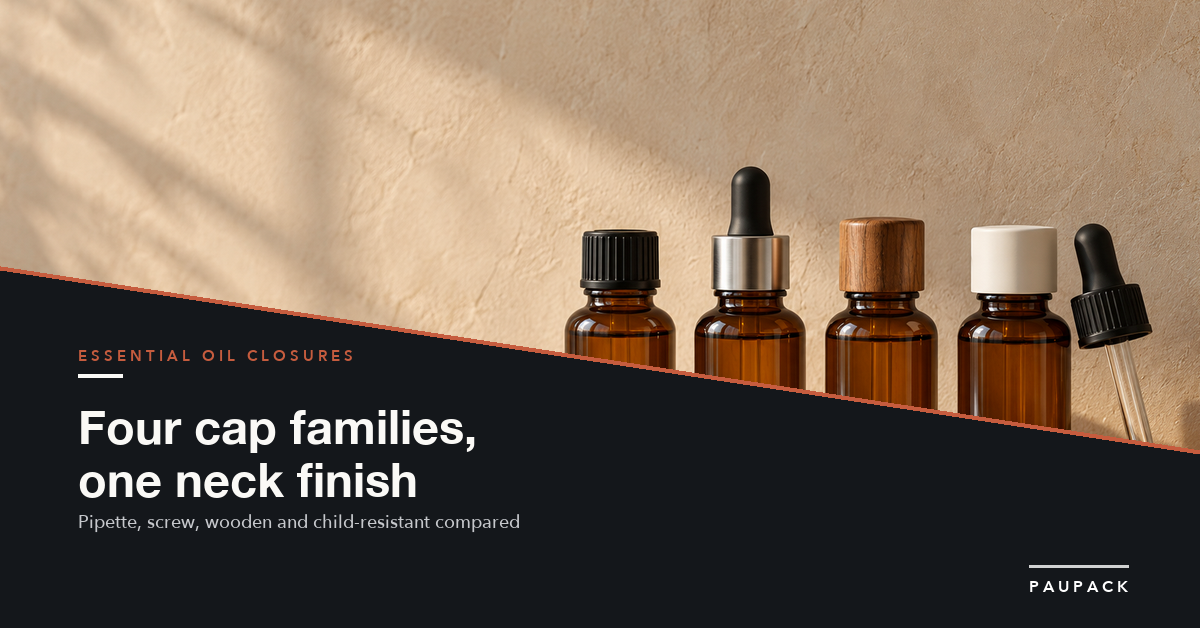
Dropper cap types fall into four families, and it is the neck finish rather than the look of the cap that decides which one will fit. Buy from a photograph and you end up with a cap that threads on smoothly and still leaks.
PauPack supplies dropper bottles and closures to essential oil, aromatherapy and botanical skincare brands, and we watch the same mismatch go past every month: a premium wooden cap ordered against a bottle whose 20-410 neck only takes a 20-410 closure. What follows is the picture family by family, the measurements that have to agree, and how we test an assembly before a production order goes in.
The Four Dropper Cap Types in Commercial Use
Four assemblies close almost every dropper bottle on the market today. Put them side by side and they do not read as variations on a theme — the mechanisms differ, and so does the tooling behind them.
Three of the four sit in PauPack's standard component stock. The fourth gets quoted against the project, which is usually why we can build a sample in days instead of weeks.
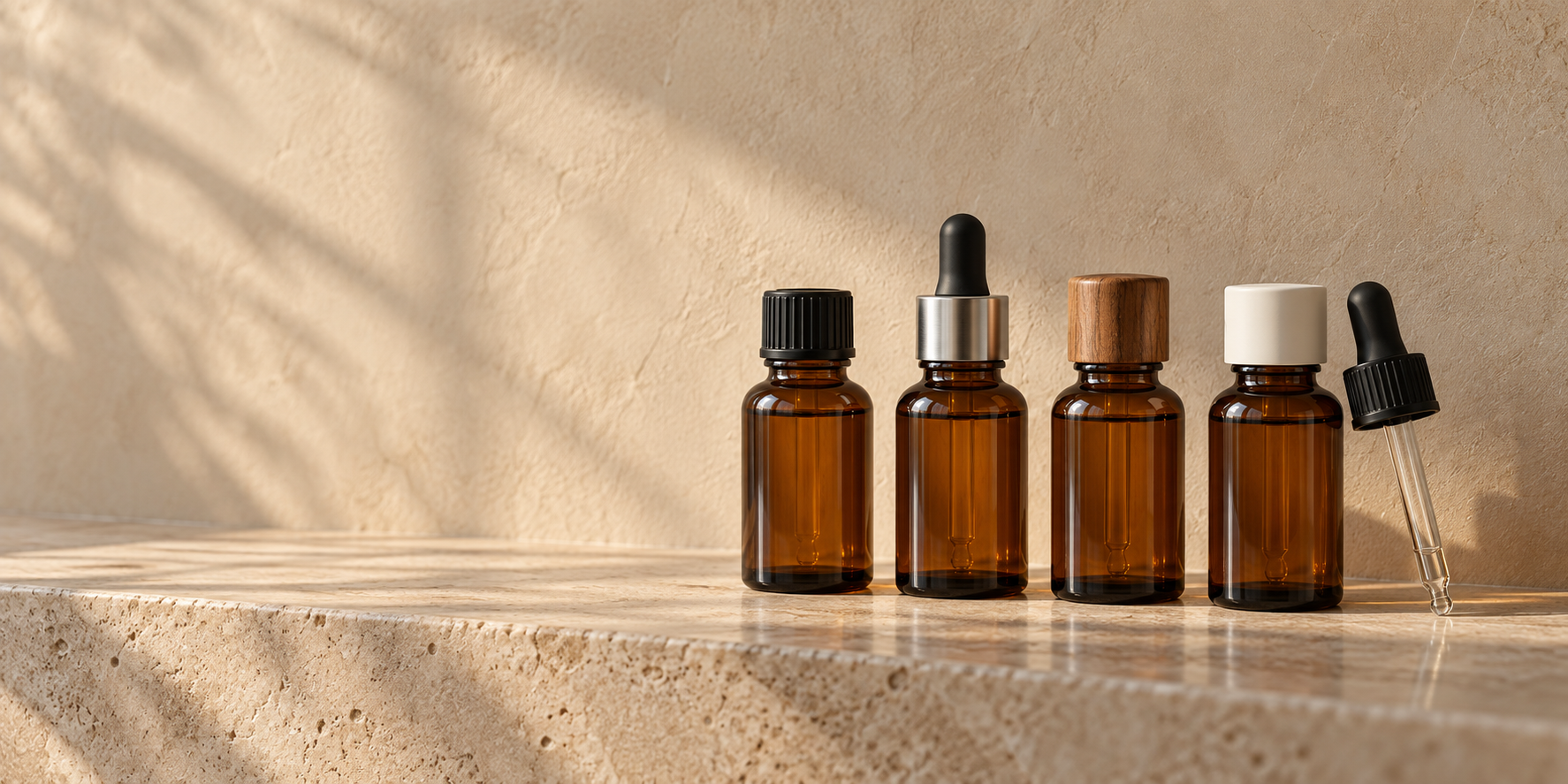
| Family | Typical use | Strength | Watch out for |
|---|---|---|---|
| Glass pipette with aluminium collar | Retail essential oils, serums | Consistent drop, premium finish | Higher unit cost, longer lead time |
| Glass pipette with PP collar | Value oils, large ranges | Low cost at any volume, colour range | Thread flash if the mould is worn |
| Ribbed or smooth screw cap, no pipette | Refill and bulk formats | Simple, easy to clean, low height | No dose control at all |
| Wooden or bamboo overcap | Gift sets, home fragrance | Warm shelf presence | Swells in humid climates |
Neck Finish: The Measurement That Decides Everything
A neck finish is two numbers, written like 18-415 or 20-410. The first is the outer neck diameter in millimetres, the second describes the thread. Put a 20-410 cap on an 18-415 bottle and no amount of torque will rescue it.
Three more dimensions sit behind those two and matter just as much. T is the outer neck diameter, E is the inner bore, and H is the height from the sealing surface to the top of the neck. A collar that seals inside the neck lives or dies on E. One that seals on the rim depends on H instead.
This is the part of the job a supplier either does or skips. PauPack keeps the neck drawing for every bottle we mould, measures a sample from each run against it, and will not quote a cap until the neck is confirmed. The dropper bottle range is dimensioned on that basis.
Drop Size and Dose: What the Pipette Actually Delivers
Fill a standard glass pipette to its upper mark, hold it straight and squeeze, and you get roughly 0.05 ml per drop. Nearly every dosing line on an essential oil carton is built on that figure: twenty drops to a millilitre, ten to a half.
Move three things and the figure moves with them. A wider bore pipette drops more at a time. A thicker oil comes out slower, often in bigger beads. A bulb with more internal volume refills further and delivers a longer stream.
Which is why the dose on the label belongs to the whole assembly rather than to the bottle. Swap a plastic pipette for glass, or a 60 mm pipette for a 75 mm one, and somebody has to re-read the carton text. The 10 ml dropper bottles PauPack quotes for sampling ship with a pipette matched to the carton, for exactly that reason.

Materials: What Each Oil Does to Each Cap
Essential oils are solvents, and they do not behave. A cap that sails through a water-based serum can swell, cloud or crack on a citrus oil inside a single season. Nine times out of ten the trouble starts at the bulb rather than the collar.
| Component | Common material | Behaviour with oils | Practical note |
|---|---|---|---|
| Pipette | Borosilicate glass | Inert to terpenes | Preferred for citrus and blends |
| Bulb | Nitrile or silicone rubber | Nitrile hardens in citrus oil, silicone resists longer | Match the grade to the formula |
| Collar | Anodised aluminium or PP | Both resist oils; aluminium holds finish better | Aluminium takes more thread precision |
| Inner cone | LDPE or PP | Soft grades seal better, hard grades resist more | Soft cone suits repeat opening |
The comparison we publish on aluminium versus PP caps comes from the same test bench, and the amber glass dropper bottles page covers how the glass colour interacts with the same oil. The bulb grades PauPack holds in stock are chosen against citrus and resin blends rather than against a single reference oil.
Tamper-Evident and Child-Resistant Versions
Two extras sit on top of the four families. A tamper-evident band snaps away on first opening and tells the customer nobody has been inside. A child-resistant release turns a one-step cap into a two-step action.
Both reach further than the cap itself. The band adds collar height, and if your carton was drawn tight that new height turns into a carton problem, so PauPack quotes it together with the carton dimensions instead of after them. A child-resistant cap introduces a measurable opening force, and the child-resistant closure types piece sets out where that force comes from and why panels still get run before a launch.
Selling into the United States? A dropper bottle holding a regulated substance may need a closure that meets the protocol in the Poison Prevention Packaging Act. That requirement follows the pack as sold, so bottle, cap and label are all in scope.
How Dropper Cap Types Are Selected in Practice
Good selection runs from the formula outward, not from the shelf inward. Four questions get you most of the way:
- What is the dose the label promises, in millilitres or drops?
- What does the formula do to rubber and to soft polymer over a shelf life?
- Does the market require a child-resistant or tamper-evident function?
- Which neck finish do the intended bottles share across the range?
Answer those four and the dropper cap types tend to pick themselves. When two answers pull against each other, the formula wins: a cap that changes shape inside the bottle will not be rescued by a nicer finish. PauPack walks the same four questions before any quotation leaves the building, because correcting a wrong family costs far more than correcting a wrong colour.
Testing a Dropper Assembly Before Production
Five checks catch nearly every failure we see, and all four dropper cap types go through the same ones. Under an hour on a filled sample:
| Check | Method | Pass condition |
|---|---|---|
| Leak resistance | Fill, close to specification, invert for 24 hours | No weeping at the collar or thread |
| Dose repeatability | Five consecutive pipette fills, weighed | Spread inside the dose tolerance |
| Torque | Measure closing torque on ten units | Inside the cap supplier's window |
| Compatibility | Store filled units at elevated temperature | No swelling, clouding or hardening |
| Function | Open and close 30 times by hand | Band intact, pipette undamaged |
PauPack runs them on the assembly as shipped, bottle included. That is the only way to catch an interference coming from the glass rather than from the cap.
Matching the Cap to the Bottle Range
One neck finish across the whole range makes life easier — easier to buy, easier to pack, easier to explain. Two or three body sizes can share a collar and a pipette, which leaves one spare component on the shelf instead of three.
Stretch the range far enough and the break usually comes at pipette length rather than at the neck. A 10 ml bottle wants a short pipette to reach the base, a 30 ml bottle wants a long one, and the collar does not change at all. That is how dropper, roll-on and spray formats get planned across one bottle family without new tooling.
Bulb, Collar and Cone: The Parts Buyers Forget
Ask a brand to specify one of the dropper cap types and you will usually get a family name and nothing else. Yet three parts decide how that cap behaves over a shelf life — bulb, collar, inner cone — and none of them show up in a catalogue photo.
The bulb sets how much air the pipette can pull, so it caps the dose. The collar carries the thread and takes the torque. The cone is the piece that actually seals against the neck. Soft LDPE forgives an imperfect glass rim, while hard PP shrugs off chemical attack but seals less generously. PauPack records all three on the assembly drawing, so a reorder cannot quietly change grade.
What Dropper Cap Types Cost, and Where the Money Goes
The gap between the cheapest and the dearest dropper cap is wide, and plastic is rarely the reason. Pipette material, collar finish and order volume account for most of it.
An anodised aluminium collar costs more than a moulded PP one because metal is drawn to a tighter tolerance and finished in a bath rather than pulled from a tool. Same story with glass pipettes against plastic. Below roughly 10,000 units, tooling and set-up swamp everything else, which is why dropper cap types that look like twins on paper end up poles apart on price at small volumes.

Minimum Order Quantities and Lead Times
Stock collar colours and standard pipette lengths move fastest, usually two to four weeks from a confirmed order. A new colour, a printed collar or an odd pipette length drops into a tooling or finishing schedule, and those runs come with higher minimums.
Two habits shorten the wait. Settle the neck finish before the bottle mould is cut, since a neck change after tooling is the most expensive mistake in the project. And where the pack carries a regulated substance, expect the assembly to be qualified as a container closure system rather than as loose parts, which is the approach described in the USP container closure chapter. PauPack quotes dropper cap types with the lead time and the minimum quantity on the same line, so a launch date can be tested before the order is placed.
Ordering Notes That Prevent a Mismatch
Most arguments about dropper cap types start with a specification nobody wrote down. Seven lines head off nearly all of them:
- Neck finish, written as a number, not described as standard.
- Pipette length and type, including where the 1 ml mark sits.
- Collar material, finish and colour reference.
- Bulb material and durometer.
- Dose volume promised on the carton.
- Tamper-evident or child-resistant function, or an explicit no.
- Closing torque window and the test method used to check it.
PauPack puts those seven lines on the quotation, which means the factory is measuring against the same list the brand is. Where a range mixes wooden overcaps and pipette collars, as it does in our wood cap dropper bottles work, the list also records which caps are decorative and which are the sealing closure.
Dropper Cap Types: Questions Buyers Ask Us Most
Which dropper cap types suit essential oil bottles?
For retail oils, start with the glass pipette and an aluminium or PP collar. It gives you a repeatable drop and looks clinical on the shelf. Wooden and ribbed plastic caps give up some of that precision in exchange for a different shelf story, which is why home-fragrance and gift lines reach for them. In our own books, the pipette family covers the large majority of oil packaging.
What does 18-415 and 20-410 mean on a dropper cap?
Two numbers, two jobs. The first is the neck diameter in millimetres, the last describes the thread style and pitch. A cap marked 18-415 fits an 18 mm neck with that thread and nothing else, so a cap and bottle that look identical in a photograph can be hopelessly incompatible in the hand.
Is a glass pipette better than a plastic one?
Glass holds its shape and shrugs off essential oils, so the drop size stays where you put it. Plastic is lighter and cheaper in small runs, though citrus terpenes and high-limonene oils can cloud some polymer grades over a shelf life. PauPack checks both against the formula instead of against a general rule.
Do dropper caps need a liner or a gasket?
Most dropper assemblies seal on a cone inside the collar, not on a flat liner, so the cone's quality matters more than whether a liner is present at all. Add a tamper-evident band and the band is what breaks on first opening, while the cone underneath still does the sealing.
How much does the cap change the dose?
A standard glass pipette drops about 0.05 ml, which makes a 1 ml dose roughly twenty drops and a 0.5 ml dose roughly ten. Widen the bore and you can double that, so the dose printed on the carton has to match the dropper that ships inside it.
Can the same dropper cap be used on different bottle sizes?
As long as the neck finish matches, several of the dropper cap types will close a whole family. A 10 ml, 15 ml and 30 ml bottle can share one neck and one cap, which is what most brands do: the range stays consistent and the component count drops.
What is a child-resistant dropper cap?
It is the same pipette assembly with a push-and-turn or squeeze-and-turn release on top. The cap gets taller and heavier, so the carton height moves with the closure, and the two have to be tested together before anything ships.
Why do aluminium collars cost more?
Anodised aluminium is drawn to a tighter tolerance than moulded plastic, holds a bright finish without extra decoration, and will not flash at the thread. You are paying for metal and an anodising bath rather than for a mould, and it stings most at very small volumes.
How is a dropper cap tested before production?
On a filled and inverted unit we check leak resistance. Across five consecutive pipette fills we weigh the drop volume. Then closing torque, and finally the compatibility of bulb and collar against the real formula. Oil brands usually leave that compatibility check running for two weeks at elevated temperature.
What should be specified before ordering dropper caps?
Neck finish, pipette length, collar material and finish, dose volume, tamper-evident or child-resistant function, and bulb colour. Seven lines wipe out almost every mismatch, and they cost nothing to write down.