

Essential oils are powerful, but delicate—storing them wrong can ruin their scent, safety, and shelf life in weeks.
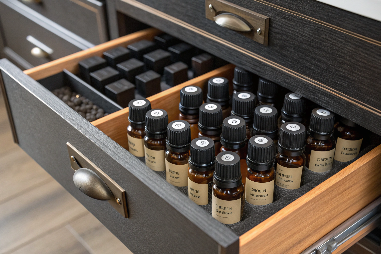
The best way to store essential oils is in dark glass bottles, away from heat and light, ideally in a cool, stable environment like a drawer or storage box.
If you're a brand owner, spa supplier, or aromatherapy seller, proper storage isn’t just about longevity—it’s about product integrity and customer trust. Here's everything you need to know.

How should I store my essential oils?
Have oils ever smelled “off” after a few months? That’s oxidation—and it’s totally preventable.
Essential oils should be stored in tightly sealed, dark glass bottles in a cool, dry place to preserve their therapeutic properties and prevent degradation.
Here’s a complete breakdown of best practices:
Temperature Control
-
Keep oils at a stable, cool room temperature (around 15-21°C / 59-70°F)
-
Avoid direct sunlight, heat sources, or temperature swings
-
No bathroom storage—too humid and unstable
Light Protection
-
UV rays degrade essential oils quickly
-
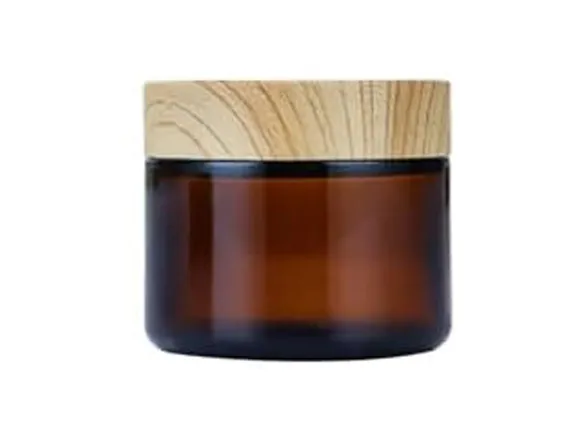
Use amber or cobalt blue bottles to block light exposure
-
Store in opaque cases, drawers, or boxes when not in use
Air Exposure
-
Oxygen starts oxidizing oils as soon as the bottle is opened
-
Always close the cap tightly
-
Avoid transferring oils to bigger containers with extra air space
| Storage Factor | Why It Matters | PauPack’s Solution |
|---|---|---|
| Glass Bottle | Prevents chemical leaching | Amber/cobalt glass options |
| Tight Seal | Stops oxidation | Screw caps, tamper-evident |
| Dark Color | Blocks UV light | Custom-colored bottles |
| Stable Temp | Preserves potency | Suggest storage accessories |
At PauPack, we help brands maintain product quality with professional-grade glass bottles—available with roller tops, droppers, and mist sprayers, all optimized for long-term essential oil stability.
What is the 30 50 20 rule for essential oils?
Blending essential oils without structure can lead to overpowering or flat scents. That’s where the 30/50/20 rule steps in.
The 30/50/20 rule is a fragrance blending guide that suggests using 30% top notes, 50% middle notes, and 20% base notes to create a balanced, long-lasting scent.
Let’s define each part:
-
Top notes (30%) – The first impression (e.g., citrus oils like lemon or grapefruit)
-
Middle notes (50%) – The heart of the blend (e.g., lavender, geranium, chamomile)
-
Base notes (20%) – The long-lasting anchor (e.g., patchouli, vetiver, sandalwood)
Application in Storage
Base note-heavy blends tend to last longer—but all oils need proper packaging to maintain balance. If any component oxidizes, the whole blend shifts in scent and safety.
That’s why we at PauPack design our bottles to:
-
Minimize oxygen exposure
-
Protect light-sensitive components
-
Enable easy blending and testing (via droppers or roller caps)
Should essential oils be kept in dark bottles?
Yes—and not just for aesthetics. It’s a science-backed storage strategy.
Essential oils should always be stored in dark bottles like amber or cobalt blue glass to protect them from damaging ultraviolet (UV) rays.
Here’s what light does to oils:
-
Breaks down volatile compounds
-
Alters scent and therapeutic properties
-
Accelerates oxidation
| Bottle Type | UV Protection | Use Case |
|---|---|---|
| Amber glass | ✅ High | Best all-around storage |
| Cobalt glass | ✅ Moderate | Good for display or blends |
| Clear glass | ❌ None | Use only for shelf-stable blends (e.g., alcohol base) |
At PauPack, we provide fully customizable glass essential oil bottles with dark finishes, frosting, and silk-screen branding. That way, your packaging protects as well as it promotes.
Should you keep essential oils in the fridge?
It’s a common question—and the answer is, it depends.
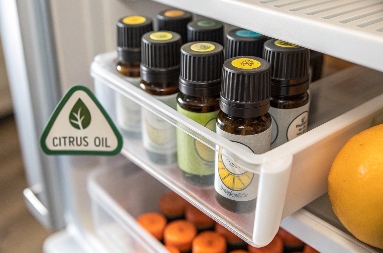
Refrigeration can help extend the shelf life of essential oils, especially citrus oils, but it's not required for all types.
Pros of Fridge Storage
-
Slows oxidation
-
Extends freshness of lighter oils (like lemon, orange, grapefruit)
-
Helps with stability for long-term storage
Cons and Considerations
-
Oils may become too thick to use
-
Risk of condensation if improperly sealed
-
Not necessary for base note-heavy oils (e.g., vetiver, patchouli)
Pro tip: If you refrigerate, label your oils clearly and bring them to room temperature before use.
PauPack helps brands develop storage guides as part of their packaging design. When we produce custom essential oil kits, we also advise on temperature-safe bottle materials and label durability—ideal for refrigerated or travel-safe usage.
Conclusion
Proper essential oil storage isn’t just a technical detail—it’s a brand’s silent promise of quality. From amber glass bottles to airtight seals, every element matters. PauPack supports that promise by offering packaging designed to preserve, protect, and elevate your oils.