

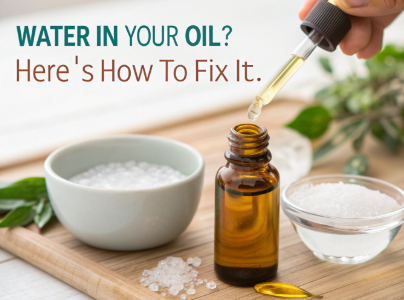
Accidentally introduced water into your essential oil bottle? Whether from condensation, improper sealing, or production mishap, water contamination—even in small amounts—can ruin purity, scent, and shelf life.
To remove water from a small amount of essential oil, use a pipette to carefully separate the layers, dry with a desiccant (like anhydrous sodium sulfate), or allow natural separation and decant the pure oil.
Here’s how to safely salvage your essential oil without compromising quality.

How to remove water from essential oils?
Essential oils and water don’t mix—but separating them takes care.
To remove water from essential oils, allow the mixture to settle, then pipette or decant the oil layer off the top. For precision, use drying agents like sodium sulfate.
Dive Deeper: Step-by-Step Removal for Small Batches
Method 1: Gravity Separation
-
Let the oil sit undisturbed in a narrow-neck glass container.
-
After several hours, oil will float on top; water sinks below.
-
Use a glass dropper to pipette the top oil layer into a clean bottle.
Method 2: Use a Drying Agent
For tiny residual moisture:
-
Add anhydrous sodium sulfate (1–2 pinches for <10ml)
-
Gently swirl and let sit for 1–2 hours
-
Filter through a coffee filter or fine mesh to remove drying agent
At PauPack, we advise brands to use lab-grade tools and drying techniques when salvaging high-value essential oils, especially citrus or floral types prone to water instability.
How do you remove water content from oil?
The method depends on how much oil and how critical purity is.
Water content in oils can be removed by decanting, drying agents, or vacuum distillation—depending on quantity and application.
Dive Deeper: Options by Scale
| Method | Best For | How It Works |
|---|---|---|
| Decanting | Small volumes | Separation by density (oil floats) |
| Drying agents | Lab or artisan use | Binds water chemically |
| Vacuum distillation | Large or industrial | Low-pressure evaporation |
Essential oil purity is vital for shelf life, scent, and safety. PauPack works with aromatherapy brands to maintain low moisture thresholds in every batch, especially for long-haul exports and professional blends.
How to remove water from an oil system?
If you’re dealing with a storage or production system, you need a more technical fix.
In oil systems (like tanks or machinery), water is removed using drain valves, coalescers, or desiccant filters. In small-scale setups, gravity settling or suction pipettes are used.
Dive Deeper: Techniques for Larger Volumes
-
Drain separation: Gravity-based removal from the bottom of a tank
-
Coalescing filters: Trap water droplets and separate them out
-
Dehydrating filters: Use silica or calcium chloride to absorb moisture
If you're producing or bottling oils commercially, PauPack recommends oil-compatible filling systems with moisture control and inert gas blanketing to prevent water intrusion during packaging.
How to make essential oil water soluble?
Sometimes you want to mix—not separate.
To make essential oils water-soluble, use solubilizers like polysorbate 20, PEG-40 hydrogenated castor oil, or natural dispersants like lecithin. These emulsify the oil into water.
Dive Deeper: Turning Oil Into Mist
Use this for:
-
Room sprays
-
Skincare toners
-
Bath blends
Standard Ratio:
-
1 part essential oil
-
2–4 parts solubilizer
-
Mix thoroughly before adding to water
| Solubilizer Type | Use Case |
|---|---|
| Polysorbate 20 | Gentle, for body/face |
| PEG-40 castor oil | High emulsifying strength |
| Lecithin | Natural, but less stable |
At PauPack, we help brands formulate and fill water-based essential oil sprays, using the right combination of solubilizers, preservatives, and UV-protective packaging.
Conclusion
Water in your essential oil? Don’t panic—separate with care using pipettes or drying agents. And if you want to mix instead of remove, use solubilizers. At PauPack, we help brands handle both with packaging and production support designed to preserve purity drop by drop.