

Packaging matters—especially in the essential oil industry. A leaking bottle, faded label, or bland box can cost a brand its credibility.
Yes, businesses actively invest in essential oil boxes because packaging plays a critical role in brand image, product safety, and market differentiation.
In the world of essential oils, the box isn’t just a container—it’s the handshake, the promise, the shelf appeal. But what exactly drives this investment? Let’s break it down.

Who is the target market for essential oils?
Everyone loves a good scent, but not everyone buys essential oils. So, who does?
The primary buyers of essential oils include wellness-conscious consumers, beauty and skincare enthusiasts, aromatherapy practitioners, and natural living advocates, with a strong overlap in the female 25–55 demographic.
Understanding your market helps you choose the right box—literally. Different audiences value different things.
Targeting by Use Case
| Use Case | Buyer Type | Packaging Priorities |
|---|---|---|
| Aromatherapy | Wellness professionals, spas | Premium look, dropper control, safety seals |
| Skincare & Cosmetics | Beauty brands, DIY creators | Custom branding, clarity, eco-materials |
| Gift Sets | Retailers, gift brands | Visual appeal, protective inserts, elegance |
| Health Stores | Natural health consumers | Informative labels, batch numbers, eco-cert. |
At PauPack, we’ve helped businesses tailor packaging to their audiences—from minimalistic white label boxes for indie skincare brands to luxurious wooden boxes for aromatherapy gift sets. It's not one-size-fits-all, and neither should your packaging be.
What They Value Most
-
Brand alignment: Colors, fonts, and textures must reflect your product’s vibe.
-
Durability: No crushed corners or flimsy flaps.
-
Sustainability: Many buyers actively seek eco-conscious brands.
-
Regulatory compliance: Especially in EU/US markets, proper labeling and tamper-evidence are key.
Whether your audience is boutique wellness stores or eCommerce power sellers, the box can—and should—speak their language.
What is the 30 50 20 rule for essential oils?
You may have heard this "rule" mentioned in essential oil circles—but what does it mean?
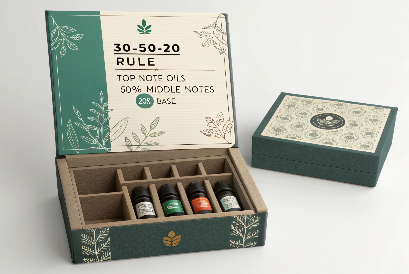
The 30-50-20 rule is a guideline for essential oil dilution: 30% top note oils, 50% middle notes, and 20% base notes—to create a balanced aromatic profile.
It’s not about boxes—but it connects directly to how a brand should structure their product lineup and education, and thus how packaging supports that.
Packaging for Education
If you're selling essential oils in balanced blends, your box becomes a mini-classroom. Here’s how to use that:
-
Printed inserts: Explain your scent structure and benefits inside the box lid.
-
QR codes: Link to video demos or ingredient origins.
-
Color coding: Visually separate top, middle, and base blends.
At PauPack, we’ve helped brands integrate educational elements into their boxes—not only to inform but to engage. In a crowded market, smarter packaging becomes part of the product experience.
Aromatherapy Meets Aesthetics
Many consumers buy oils by scent preference, not note structure. But brands that educate build trust—and trust leads to repeat purchase.
So if you sell blends based on the 30-50-20 structure, make sure your box visually reinforces the value behind the bottle.
Is the essential oil business profitable?
It smells like money—but is it?
Yes, the essential oil business can be highly profitable, with profit margins ranging from 100% to 300%, especially for private label or branded products.
But profitability depends on positioning, packaging, and scale.
Where the Profits Are
| Segment | Typical Margin | Volume Potential | Packaging Impact |
|---|---|---|---|
| Raw oils (bulk) | 10–20% | High | Functional packaging only |
| Private label brands | 100–200% | Medium–High | High-value packaging adds perceived value |
| Gift sets & bundles | 150–300% | Medium | Premium boxes = premium pricing |
| Subscription kits | 200%+ | Medium–High | Consistent branding = retention |
At PauPack, we’ve seen clients double their average order value just by improving their essential oil packaging—like upgrading from generic cartons to embossed kraft boxes with foam inserts.
The Packaging-Price Connection
Great packaging can justify higher prices. It tells your customer: “We care about quality.” That emotional reassurance = higher cart value.
For example:
-
A $5 oil in a plastic bottle with a generic label? Commodity.
-
That same oil in an amber glass bottle with a custom box and QR-tracked batch ID? $15–$20 retail.
The bottle is the product. The box is the story. Smart brands invest in both.
Who buys the most essential oils?
Let’s talk scale. Who are the real bulk buyers?
The largest purchasers of essential oils are B2B businesses such as cosmetic companies, fragrance manufacturers, wellness brands, and aromatherapy distributors.
If you’re a supplier, your best customers are likely not individuals but businesses like:
B2B Buyer Profiles
| Buyer Type | Use Case | Packaging Needs |
|---|---|---|
| Skincare brands | Add to formulations | Consistent bottles + logo-ready boxes |
| Spas & wellness clinics | In-room and retail sales | Branded display boxes, refill kits |
| Online retailers (Amazon) | Consumer kits, bundles | Compact, protective, giftable |
| Diffuser brands | Pair with devices | Coordinated, elegant packaging |
| Distributors/wholesalers | Resale to smaller retailers | Bulk-friendly, stackable, labeled |
Many of these buyers will evaluate your packaging capabilities before they even touch the oil. It’s not just about scent—it’s about scalability and professionalism.
PauPack Knows Global Buyers
We’ve supplied essential oil packaging to brands in over 52 countries. Our clients range from indie startups on Shopify to wholesale leaders supplying dozens of SKUs monthly.
With our eco-conscious materials, custom sizing, and regional compliance (ISO, FDA, BPOM), we’re positioned to serve B2B buyers who need reliable, scalable packaging solutions—not just pretty boxes.
Conclusion
Essential oil packaging isn’t an afterthought—it’s a business driver. The box protects, educates, and sells. Smart businesses know: invest in the box, and the bottle follows.