

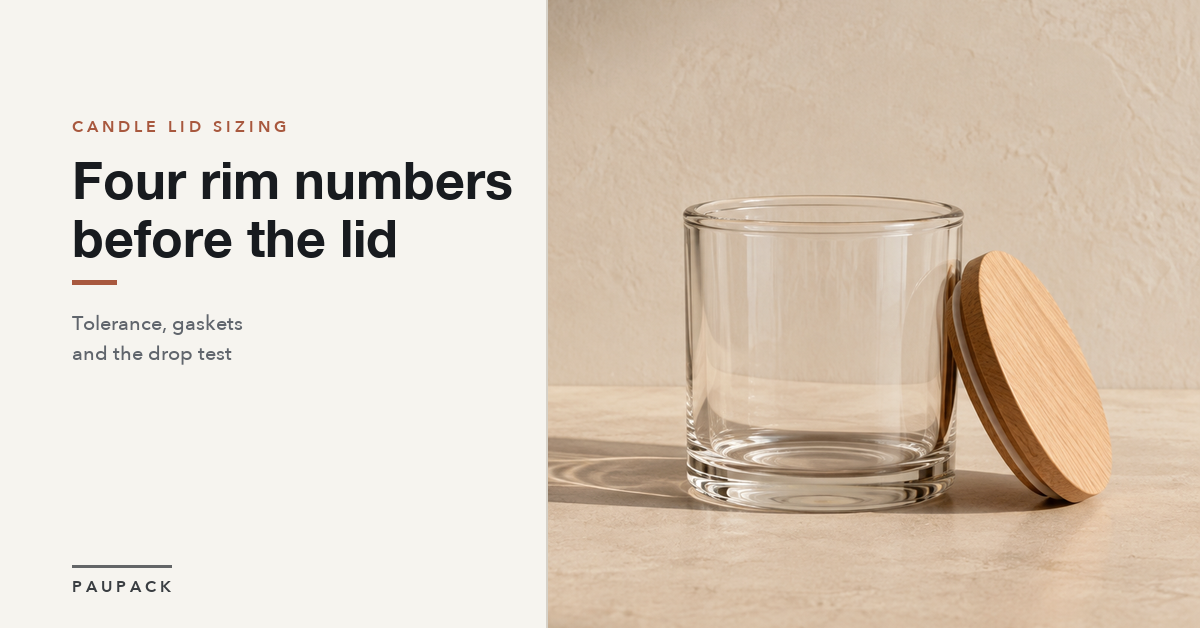
Candle lid sizing is one of those jobs that looks like a shopping decision and behaves like an engineering one. Buy the jar, buy the lid, and the two meet at the rim where a fraction of a millimetre decides how the product feels in a customer's hand.
PauPack supplies candle vessels and closures to brands that sell through retail, and the questions below are the ones that come back in every project. If you read only one section, read the measurement table: nearly every lid complaint we hear starts with a number that was never taken.
Candle Lid Sizing Begins at the Rim
Retailers sell jars by capacity. Moulds do not care about capacity. An 8 oz vessel from one tool can have a rim diameter 1 mm larger than an 8 oz vessel from another, and both are described honestly in their own catalogues.
Start with the glass on the bench, a pair of calipers and a flat surface. Measure the opening, then measure it again on a second jar from the same carton. Repeatability is the first thing to check, because if three jars from one box disagree, no lid specification will save the order.
Measure Four Numbers Before You Shop
| Number | How to take it | What it decides |
|---|---|---|
| Inner diameter at the rim | Calipers across the opening, four directions | Plug or gasket diameter |
| Outer diameter at the shoulder | Widest point where the lid skirt will pass | Whether the lid clears without scraping |
| Rim height above the shoulder | From the flat surface to the top of the rim | How deep the skirt has to be |
| Wall thickness at the rim | Section a reject jar on a wet saw | Chipping risk and gasket land width |
The fourth measurement sounds excessive. It stops being excessive the first time a lid with a tight plug chips a rim during assembly, and you spend a week working out whether the fault sits with the glass, the lid or the bench.
Wood, Metal and Glass Lids Do Not Age the Same Way
Wood moves. A lid machined in a humid workshop and shipped into a dry heated warehouse can lose enough moisture to loosen its fit, and the customer notices a lid that used to feel snug. PauPack asks where the goods will be stored before cutting a wood plug, and sizes to the drier end of the range when the destination is a climate-controlled store.
| Lid material | Movement over time | Sizing note |
|---|---|---|
| Wood | Shrinks in dry air, swells in damp air | Cut to the destination climate, not the workshop |
| Metal | Stable, but dents | Tolerance holds; protect the rim in transit |
| Glass | Stable and heavy | Weight helps seating, so torque is less critical |
| Bamboo | Moves along the grain | Seal it, or accept a looser fit in winter |
Gaskets: Soft Landing, Not a Seal
A candle lid works better as a dust cover than as a closure. Wax needs no vacuum, and a lid that grips too hard turns into a wrestling match on a cold morning. A 1 mm to 2 mm gasket in closed-cell foam, cork or silicone gives the lid a soft landing and keeps the wax surface clean without creating a pressure seal.
Gasket compressibility matters more than thickness once the lid is machined. PauPack keeps a small library of gasket samples and posts three or four to the brand with the lid sample, because the choice is easier to make with a thumb than from a data sheet.
Threaded, Push Fit or Plug Fit
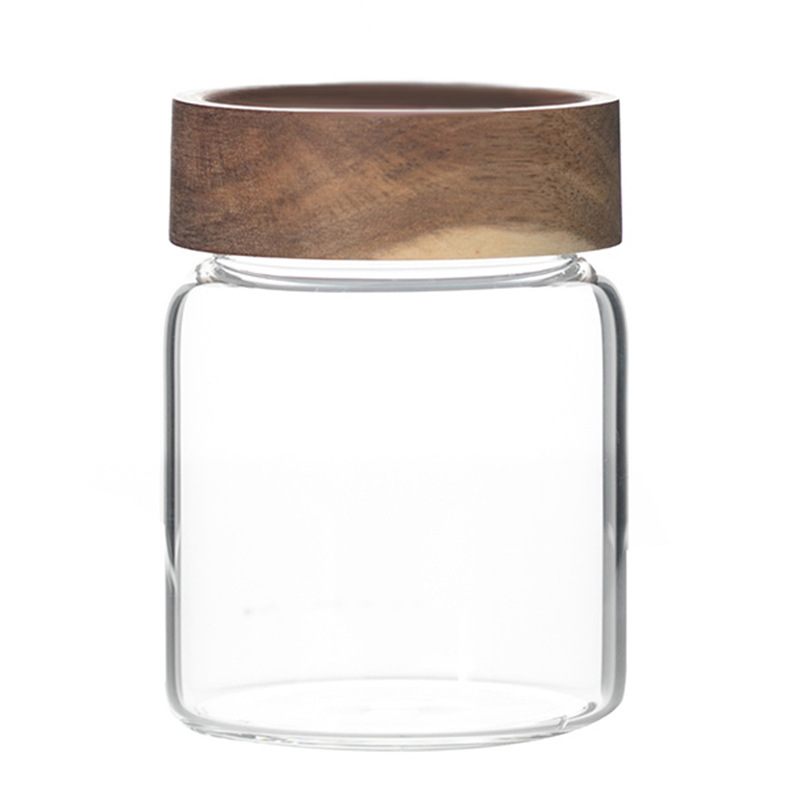
Threaded finishes hold lids through handling and shipping, which is why travel sizes usually get them. The trade is cost, because the glass mould needs a thread and the lid needs a matching profile, and both then have to hold tolerance together.
Push and plug fits are cheaper and look cleaner on a wide-mouth vessel. Their weakness is lateral movement: the lid can shift sideways in the carton and show a smear of wax on the rim when the customer opens the box. A shallow recess in the gasket usually solves it.
PauPack supplies both and usually recommends a split line. Standard retail candles travel in trays, so a plug fit with a cork gasket is enough. Gift sets and travel tins get the thread, because the customer expects to throw them in a bag. Candle lid sizing gets simpler once the travel case is separated from the shelf case.
The Drop Test and the Ship Test
Two tests settle almost every candle lid sizing argument. Drop the closed candle from 300 mm onto a hard floor four times, on the side edge as well as flat. Then pack a full carton the way it will ship and run the transit test your retailer specifies.
Look for three things afterwards: chips at the rim, lids that have walked off the jar, and wax that has touched the lid. Any of the three sends the pack back to the bench, and all three are cheaper to find in your own warehouse than in a retail DC.

Fragrance Load, Wax and the Sealing Surface
High fragrance loads soften some gasket materials over months of sitting on a shelf. Citrus-heavy blends are the usual suspects. The symptom is a lid that feels looser in month three than it did on the pallet, and by then the customer is holding the product.
Ask for compatibility data against the fragrance load you actually use, not against a generic soy wax. PauPack keeps loaded samples on a shelf for eight weeks during development, checks the gasket and the engraved surface at the end, and reports what moved. Candle lid sizing that ignores the fragrance load is only half specified.
Branding on the Lid
The lid is often the best branding surface on the whole pack. A wood lid takes laser engraving with good contrast, a metal lid takes debossing, and a glass lid takes frosting or a screen-printed disc. Keep at least 6 mm of clear diameter for the mark itself and check it at two metres, which is roughly how far a shopper stands from a shelf.
Lead Time and the Tooling Question
If the lid profile already exists and only the plug diameter has to change, sizing is a sampling exercise and it moves quickly. A new lid profile is a tooling project, and the schedule then depends on the material and the finish rather than on the design.
Confirm the route early. PauPack reviews the jar sample and the intended material, then says plainly whether you are adjusting a plug or opening a mould. Brands that assume the first and need the second lose a month, usually at the worst moment in a launch.
Decorating the Vessel Around the Lid
Lids and vessels are decorated as a set, and sizing decisions show up in the artwork. A frosted band that runs to the rim disappears under a skirt. A lid that sits 2 mm proud hides the top of a printed label. PauPack plans the decoration with the lid on the jar so the two never argue on the shelf.
Related reading is on the candle jar range and the glass diffuser bottle range, and the guide to candle jar types covers vessel shapes and capacities in more detail.
Where Candle Lid Sizing Goes Wrong
Almost always in one of three places. The measurement came from a catalogue rather than a jar. The destination climate was never discussed. The gasket was treated as an accessory and chosen last, after everything else had been fixed.
PauPack builds the sample set with the gasket installed and the decoration applied, so the pack that goes to the drop test is the pack that ships. Buyers who want the wider context can read the notes on custom candle jars for branding and the candle jar manufacturer overview, which cover the choices either side of the lid.
The Consumer Safety Side of Candle Packaging
Candle packaging carries warning text, and the surface that holds it has to be planned with the lid. The CPSC candle pages explain how the agency looks at candle fires and what it expects from products sold in the United States, and the wider statutory background sits on the CPSC statutes page.
Practical advice from the factory: leave room on the base or the side wall for the warning panel before the artwork is approved, keep it clear of the frosting band where contrast drops, and check it under shop lighting rather than on a monitor.
What PauPack Measures on Your Sample
Send one jar and one lid and PauPack returns a one-page sheet with the four rim numbers, three candidate gasket options, a recommendation on plug diameter for your market, and photographs of the lid seated. The quality management process keeps that sheet with the project so a repeat order does not start from zero.
Where the vessel is part of the same order, the accessories supply service combines jar, lid and gasket on one specification and one shipment. Send the jar sample, destination market and storage climate, and the sizing question is usually settled in a single round.
Questions Buyers Ask About Candle Lid Sizing
What is candle lid sizing in practice?
It is the habit of measuring the vessel opening rather than the vessel name. Two jars sold as 8 oz can differ by a millimetre at the rim, and a millimetre is the difference between a lid that drops on and a lid that sits proud on one corner.
Do I measure the inner or the outer diameter?
Both, and you use them for different jobs. The inner diameter at the rim sets the plug or gasket size. The outer diameter at the shoulder sets whether a lid with a skirt will clear the glass without scraping decoration.
Why do wooden lids move after delivery?
Wood takes on and gives off moisture with the air around it. A lid machined in a humid workshop and shipped to a dry warehouse can shrink enough to loosen its grip. PauPack asks for the destination climate and shims the plug accordingly instead of cutting to a single nominal size.
Should a candle lid seal tightly?
No. A burning candle needs air, and a lid that seals like a jam jar also traps fragrance and can pull a vacuum that makes the lid hard to remove. The usual target is dust and scent protection with enough leakage to let the wick breathe once the lid is off.
What thickness gasket belongs under a candle lid?
Thin, and consistent. A 1 mm to 2 mm closed-cell or cork gasket gives a soft landing without lifting the lid off the glass. Anything thicker starts to work like a spring and the lid rocks when the customer presses the edge.
When is a threaded lid better than a push lid?
When the customer will travel with the candle, or when the vessel is tall and the lid is the only thing holding the wax surface clean. Threads cost more on the glass side, so brands often use a threaded finish for travel sizes and a push or plug fit for the standard line.
How do I test a lid before placing a bulk order?
Drop test and ship test, in that order. Drop the closed candle from 300 mm onto a hard floor four times and look for chipping at the rim. Then run a carton through the transit test your retailer expects and check whether lids have walked off the jars in the case.
Does fragrance oil attack the gasket?
It can. High-load fragrance blends and citrus-heavy profiles soften some gasket materials over months of storage, and the first sign is a lid that grips less than it did on arrival. Ask for a compatibility check against the actual fragrance load rather than the wax alone.
Can the lid carry my branding?
Yes, and it is often the better surface. A wood lid takes laser engraving, a metal lid takes debossing or a printed disc, and a glass lid takes frosting or screen print. Keep at least 6 mm of clear diameter for a readable mark at retail distance.
How long does custom candle lid sizing take?
Sampling is fast if the vessel already exists, because the work is measurement and plug adjustment. Expect tooling only when the lid is a new moulded or machined profile. PauPack confirms which route applies after seeing the jar sample and the target lid material.