

Bottle mold development is not a single tooling purchase. It is a chain of decisions that turns a commercial idea into controlled geometry, production evidence and a repeatable asset. PauPack keeps a red-pen development diary: each entry records what changed, why it changed, who approved it and what the next sample must prove.
Diary Entry 01 — Write the Job of the Bottle
Define product category, fill target, use orientation, channel, destination, annual demand and launch window. State what must be unique and what can remain standard. The strongest brief explains the commercial job of the shape without prescribing untested engineering details. PauPack also records who owns product compatibility, regulatory review, filling operations and final release.
Diary Entry 02 — Protect the Critical Interfaces
Identify neck finish, closure or pump, filling access, label or print panels, base contact and carton envelope. Separate dimensions that control function from those that mainly control appearance. PauPack's design service helps translate silhouette sketches into a controlled drawing and interface list.
Diary Entry 03 — Challenge the Concept Before Tooling
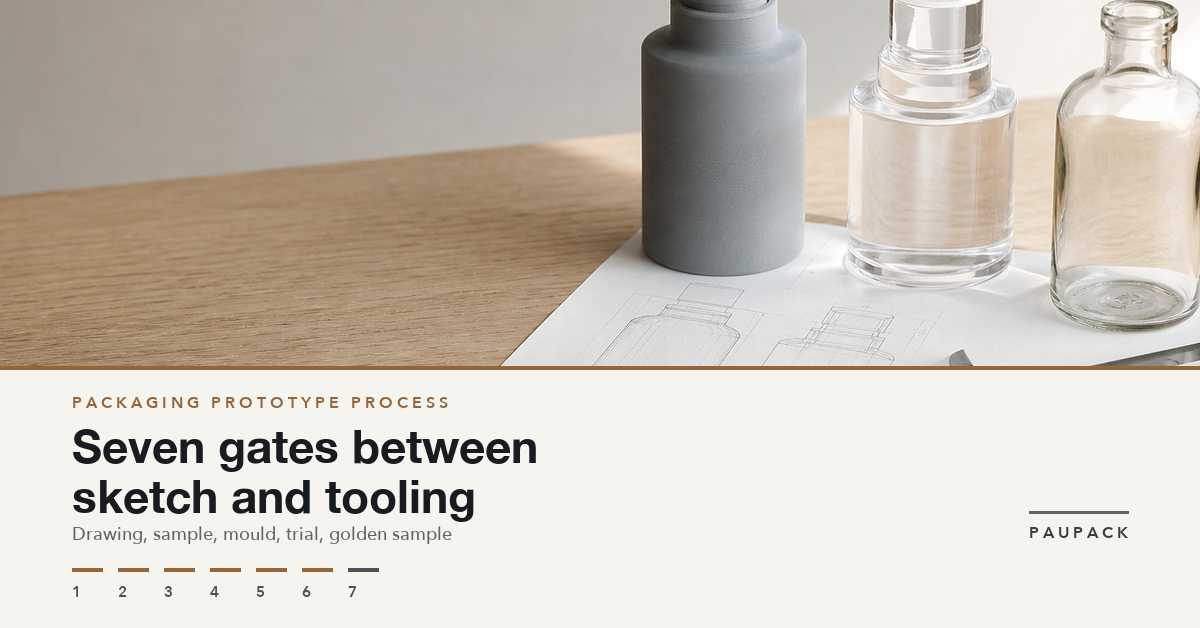
Review grip, stability, wall transitions, decoration zones, component proportion and packed footprint using drawings, renders or prototypes appropriate to the decision. A prototype may communicate form without proving production quality or final material behavior. Label every sample with its purpose and limitation so visual enthusiasm does not become premature technical approval.
Diary Entry 04 — Freeze Tooling Ownership and Change Rights
The commercial agreement should state who pays for tooling, who owns it, where it is held, expected maintenance responsibilities, permitted use, storage period and what happens if the supplier relationship changes. It should also define which drawing revision authorizes tool construction and how post-release changes are priced and approved.
Diary rule: a red mark is not a decision until the revision, owner, reason and downstream impact are recorded.
Diary Entry 05 — Review the Tooling Route
Ask which tools, inserts or gauges are involved, which operations are completed in-house and which depend on specialist partners. The manufacturer should explain the sample path and measurable outputs without exposing protected know-how unnecessarily. PauPack connects tooling milestones to buyer decisions rather than promising a universal schedule for every geometry.
Diary Entry 06 — Treat First Samples as Questions
First samples should answer named questions about geometry, interfaces, appearance and manufacturability. Record sample lot, process status, drawing revision, measurements, observations and deviations. Do not merge comments from different versions. PauPack uses numbered issue logs so the next sample proves whether each decision was implemented.
The Red-Pen Change Ledger
| Change request | Evidence to examine | Possible downstream effect |
|---|---|---|
| Move the shoulder | Volume, wall transition and label panel | Tooling, fill line, artwork |
| Change the neck | Closure drawing and assembly | Components, testing, equipment |
| Add a heavy base | Weight, stability and distribution | Cost, cycle, parcel weight |
| Expand decoration | Surface geometry and handling | Process route, yield, packing |
Diary Entry 07 — Separate Appearance From Function
Measure critical dimensions using defined methods, then review seams, base, surface, glass distribution and decoration areas against written references. A mark may be visually unacceptable without affecting function; another condition may look minor but interfere with sealing or line handling. PauPack keeps defect classes and functional evidence distinct.
Diary Entry 08 — Match Components on Production-Intent Geometry
Fit the exact closure, pump, stopper, liner or applicator. Review assembly, opening, dispensing and user handling under conditions defined by qualified owners. Component identity matters because a similar-looking alternative may change height, sealing, torque, dose or carton fit. Record every matched set used in the decision.
Diary Entry 09 — Approve Decoration and the Packed Product
Run artwork and finish trials on production-relevant bottles. Define color, registration, gloss, protected zones and accepted variation with physical masters. Then approve dividers, case count, orientation and pallet assumptions. PauPack's quality management process links the decorated master to the packed reference.
Diary Entry 10 — Build Quality and Capacity Into Release
Before mass production, agree on inspection methods, defect definitions, sample basis, deviation ownership and retained evidence. Confirm realistic capacity, loss assumptions, component availability, packing window and freight booking. The ISO 2859-1:2026 standard describes acceptance sampling by attributes, but the buyer and supplier must still define applicable classifications, methods and contractual acceptance rules.
Read Cost as a Portfolio, Not One Tooling Number
Include design work, prototypes, tooling, gauges, trials, samples, decoration setup, component development, inspection, packing and future maintenance. Model these costs over forecast scenarios rather than dividing them by an optimistic lifetime volume. PauPack also compares a custom shape with stock or semi-custom alternatives so the team can see what brand value the tool must earn.
Know When This Route Is—and Is Not—Appropriate
Bottle mold development suits programs with stable demand, a meaningful geometry requirement and enough time for controlled evidence. It may not fit a small test launch, a highly uncertain formula or a date that cannot support samples and corrections. A decorated stock bottle can be the more strategic first step when the market question matters more than permanent geometry.
Close the Diary With a Reorder Baseline
Archive final drawings, tooling terms, component codes, masters, inspection criteria, packed approval, deviations and change-notification rules. Compare planned and actual milestones. PauPack's manufacturing overview, project services and product portfolio provide the commercial context for this controlled baseline.
Start the Next Page With PauPack
Send PauPack the product use, target capacity, closure route, reference shapes, decoration hierarchy, forecast and destination. A useful bottle mold development project does not hide uncertainty; it converts uncertainty into dated questions and evidence gates. That diary becomes a durable asset for production, supplier management and future redesigns.
Add a Decision Gate for Intellectual Property
Before bottle mold development advances, confirm ownership of drawings, reference designs, artwork and confidential inputs. Record which files the supplier may use, who can approve access and how obsolete revisions are controlled. PauPack keeps these commercial protections beside the tooling agreement so project speed does not depend on informal file sharing.
Create a Geometry-to-Operations Map
Connect each important feature to filling, closing, labeling, coding, conveying, packing and consumer use. A recessed panel may help decoration but complicate label application; a broad shoulder may strengthen shelf presence but affect filling clearance. PauPack uses this map during bottle mold development to reveal operational tradeoffs while they are still drawings rather than finished tooling.
Define the Evidence Needed for a Tooling Change
Some revisions require an updated drawing and dimensional sample; others may affect components, decoration, filling or packed performance. Name the evidence before authorizing work. In bottle mold development, this prevents a small visual request from bypassing the interface or process checks it actually changes. Every approved revision should replace obsolete references in the project file.
Model Reorder Economics After Development
Custom geometry may carry future maintenance, minimum run, color, decoration and storage assumptions. Compare them with forecast volatility and component availability. PauPack evaluates bottle mold development as a long-term supply decision, not simply a first-order design fee. The team should know how an alternate supplier, reduced demand or regional SKU split would affect the asset.
Run a Closeout Review With Planned Versus Actual Evidence
Compare initial milestones with actual drawing cycles, sample rounds, corrections, approvals and costs. Separate supplier delays from scope changes and customer response time. PauPack uses the difference to improve the next bottle mold development plan. The closeout also identifies open maintenance, retained samples and documents that must remain available for the tool's useful life.
Preserve the Approved Negative Space
Document not only the final shape but also the areas intentionally left clear for gripping, labeling, coding, equipment contact and packing protection. These quiet zones are easy to lose during later artwork or cost changes. PauPack keeps them in the controlled drawing and decoration brief so the finished bottle still performs the operational job that justified the tool.
Frequently Asked Questions
What should be decided before tool construction?
Approve the bottle job, critical interfaces, controlled drawing, ownership terms, budget and sample plan.
Does a prototype prove production quality?
No. Its material and process determine which design decisions it can support.
Who owns a custom bottle mold?
Ownership depends on the written commercial agreement and should never be assumed from payment alone.
Why separate critical and reference dimensions?
Critical dimensions control function or assembly, while reference dimensions mainly communicate design intent.
How should sample comments be managed?
Use numbered issues with revision, reason, owner, due date, evidence and final disposition.
What can change tooling cost?
Geometry, cavities, inserts, surface requirements, gauges, trials and later revisions can affect cost.
When should components be tested?
Use production-intent geometry before final release and repeat review after relevant interface changes.
Why approve a packed sample?
The carton and dividers can affect breakage, scuffing, decoration and delivered cost.
When is stock glass a better choice?
It may be better for small tests, uncertain demand, short launches or projects without a unique geometry need.
What protects the first reorder?
Final drawings, tooling terms, component codes, masters, inspection rules and change control protect it.