

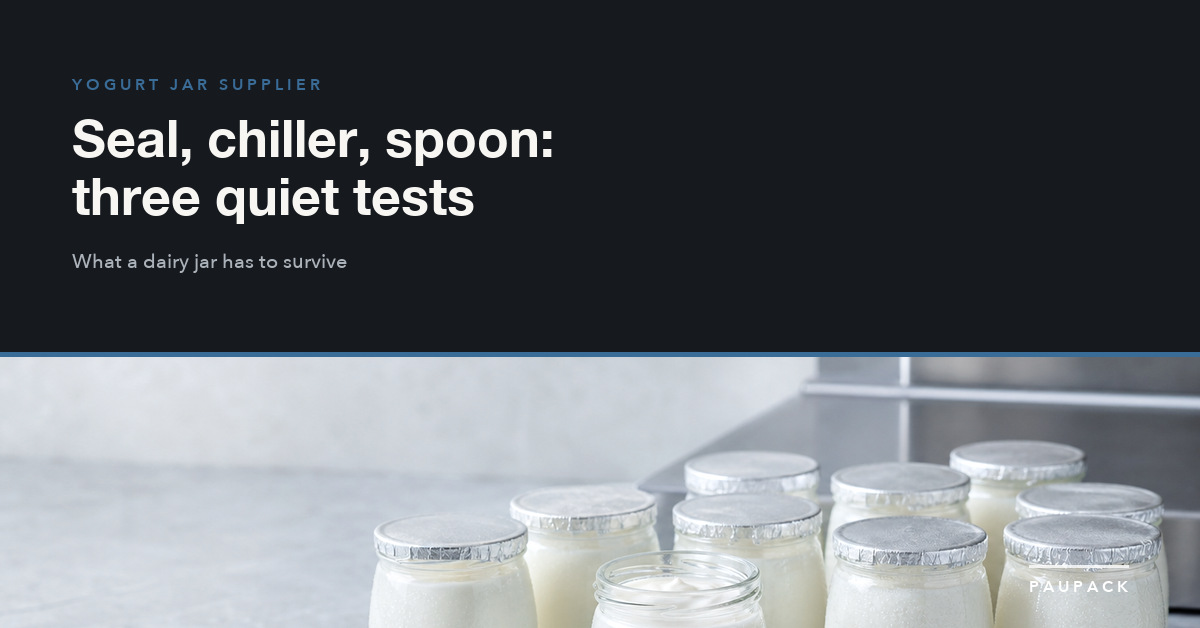
A yogurt jar supplier is judged twice: once on the purchase order, and again in a chiller cabinet six weeks later when the seal has to peel cleanly in front of a customer. Dairy packs fail quietly, and most of the failure traces back to a specification that was agreed on a bench instead of in a cold room.
PauPack produces glass dairy jars and dessert jars for brands that fill cold, warm and hot, and the brief we ask for is the same in every case: fill temperature, seal system, chilled distribution and the way the customer eats the product. This page sets out what a yogurt jar supplier should be able to answer before you commit a mould.
What a Yogurt Jar Has to Survive Before It Reaches a Chiller
Between filling and the first spoonful the jar meets a warm fill or a cold fill, a sealing head, a conveyor, a case packer, a chiller, a truck and a customer's hand. Each stage loads a different part of the pack, and a jar specified for only one of them will look fine in a sample and fail at scale.
The three loads that decide most dairy jar specifications are seal peel force, thermal shock and drop resistance at low temperature. A yogurt jar supplier who talks about all three before talking about price is usually the one whose second delivery matches the first.

Four Specs to Fix Before You Contact Anyone
Fill weight, fill temperature, seal type and distribution temperature. Those four numbers turn a catalogue enquiry into a quotation, because every other decision follows from them.
Fill weight sets the volume and the fill line. Fill temperature decides whether the jar needs extra annealing or a heavier base. Seal type decides the neck finish, because a foil lid and a lug cap need different lands. Distribution temperature decides how hard the thermal shock test should be. PauPack asks for all four in writing and repeats them on the drawing.
Glass Choice: Flint, Amber and the Cost of Clarity
Flint glass is the default for dairy because the product is the visual. A white yogurt in a clear jar reads as fresh, and the mould cost does not carry a colour changeover on every run.
Amber glass appears when the dessert carries a light sensitive topping, or when a functional yogurt wants a pharmacy look. It costs more and it hides the product, so the marketing argument has to be strong. PauPack quotes both routes when a brand is unsure, because the difference shows up clearly on a size ladder.
The Neck Finish and the Lid Pairing
Most dairy jars use a wide neck so a spoon fits. The finish is usually a twist-off profile for a foil lid, a lug finish for a metal cap, or a threaded finish when the jar is reusable.
| Neck finish | Typical closure | Best for | Watch out for |
|---|---|---|---|
| Twist-off | Foil or film lid | Single serve and retail cups | Peel force drift after chilling |
| Lug | Metal twist cap | Family size and reuse | Cap denting in case pack |
| Threaded 43 to 63 mm | Screw lid, plastic or glass | Reusable dessert jars | Torque window after washing |
| Wide-mouth 63 to 82 mm | Foil lid plus overcap | Thick yogurt and pudding | Film sag on large diameters |
Whichever finish is chosen, the supplier should show a dimensional report rather than a drawing. A finish that is 0.3 mm out on diameter can still seal, but the peel force will move, and a customer notices peel force long before they notice a tolerance.
Foil and Film Seals for a Clean Peel
The seal is where a yogurt jar supplier earns or loses the account. Aluminium foil with a lacquer suited to glass gives the most predictable peel, and the lacquer has to match the fill: a yoghurt with fruit acid behaves differently at the seal ring from a plain set yogurt.
Test the seal on filled production units at production temperature. Pull one lid per hour for the first four hours, then one per shift, and photograph the peel ring. A seal that leaves fibre or film residue fails, even if the pressure hold looks perfect on the gauge.
Heat, Chill and Thermal Shock
Yogurt is often filled warm and then chilled quickly, which is the exact pattern that cracks glass. The jar needs enough annealing and enough wall thickness at the shoulder to take the gradient, and the test has to reproduce the plant cycle rather than a gentle laboratory one.
| Stage | Typical condition | What is inspected |
|---|---|---|
| Warm fill | Around 45 to 60 degrees Celsius | Fill line against the printed net weight |
| Rapid chill | Down to chiller temperature | Cracks at the base and shoulder |
| Shock cycle | Warm jar into cold water, and the reverse | Any new fault after ten cycles |
| Chilled drop | Case drop at chiller temperature | Breakage pattern and film breach |
A supplier who tests thermal shock at room temperature is not testing the risk. PauPack runs the shock and drop sets at chilled condition, because glass behaves differently at four degrees than it does at twenty-two.
Spoonability, Shoulder Radius and the Customer's Hand
A dairy jar is a piece of tableware for ninety seconds, and that ninety seconds decides repeat purchase. A shoulder that is too tight keeps the last 15 grams of yogurt out of reach, and a rim that is too thick makes the spoon catch.
PauPack reviews this on a filled jar in the sample room rather than in a render. Scoop the product out with a normal dessert spoon and see where the spoon stops. If the answer is more than a millimetre or two above the base, the shoulder radius is wrong for the format.
Decoration That Survives Condensation
Every decorated dairy jar spends its first minutes out of the chiller wet. Direct print, labels and sleeves all react differently to that, and the check is simple: chill a decorated sample, wipe it with a paper towel three times and inspect for lifting, smearing or edge curl.
PauPack also checks adhesion after a wash cycle when the jar is meant to be reused. A reusable dessert jar that loses its print in the sink has ended the relationship the brand was trying to build, so a reusable yogurt jar supplier has to answer for decoration life as well as for glass.
Case Pack, Nesting and Chiller Freight
Dairy jars are heavy and mostly air, so the case and the pallet pattern decide freight as much as the jar weight does. Nesting depth changes the case height, and case height changes how many pallets fit a truck.
PauPack quotes case dimensions with the jar order and checks the pallet pattern before the first delivery, because a 10 mm change in case height can cost or save a layer. Dividers are worth the money on large diameters: they slow the line slightly and they prevent rim contact damage that shows up as chipped lids on the shelf.
What a Yogurt Jar Supplier Should Show You
A glass inspection report with the sampling plan that produced it, a dimensional report on the neck finish, a thermal shock record and a food-contact declaration covering the glass, the lid lacquer and the liner.
PauPack follows the quality management process for this, and it holds the records with the project rather than in a folder nobody can find later. The regulatory side is public: the food ingredients and packaging pages explain how contact materials are regulated in the United States, and the food labeling and nutrition section covers what the net weight and ingredient panels have to say.
MOQ, Print Runs and Seasonal Flavours
Dairy ranges move fast and skew seasonal, which is hard on tooling economics. The practical answer is to keep the jar common and vary the lid, the label or the sleeve, so a seasonal flavour does not need its own mould.
PauPack prices a size ladder as one quotation, with the shared neck and lid called out separately. That way a brand can see whether a second size really costs what the yogurt jar supplier claims, and whether the seasonal line should borrow a stock jar rather than wait for tooling. Read the bulk pickling jar sourcing notes for the same logic applied to a shelf-stable product.
What to Send for a Dairy Jar Quote
Send the fill weight and target volume, the fill temperature, the seal or cap you intend to use, the distribution temperature and the annual volume split by flavour. Add the decoration direction if it is already decided.
PauPack replies with a jar and lid combination that fits the line, the tooling it needs, the test plan that proves the seal and the case pack for freight. Start from the glass yogurt jar range and the accessories supply service if the lids and liners need to be quoted on the same drawing, or send the brief and PauPack will come back with the shortest route to a filled sample.
Questions Buyers Ask Before Choosing a Yogurt Jar Supplier
What should a yogurt jar supplier quote before anything else?
The jar drawing, the fill temperature, the seal type and the annual volume. Without the fill temperature the supplier cannot recommend a glass weight, and without the volume there is no honest MOQ. PauPack asks for those four before it prices a dairy jar.
Can the same jar hold yogurt and pudding?
Usually yes, and it is the cheapest way to widen a range. Both are filled cold or warm, both need a clean peel seal and both benefit from a shoulder that a spoon can reach. The decoration and the lid colour are what separate the two products on the shelf.
Does yogurt need amber glass?
Rarely. Dairy is not light sensitive in the way an oil or a vitamin is, so flint glass is normal and cheaper. Amber is chosen when the dessert contains a light sensitive topping or when the brand wants a pharmacy aesthetic for a functional yogurt.
How do I check the seal on a yogurt jar?
Fill a full tray at production temperature, seal it, then pull one lid every hour for the first four hours and inspect the peel ring. A seal that tears the film or leaves residue fails, even when it holds pressure in a bench test.
Will a yogurt jar survive the cold chain?
It should survive the cold; the risk is the change. Thermal shock appears when a warm jar meets cold air or a cold jar meets a warm wash, so PauPack runs a shock cycle and a drop test at chiller temperature rather than at room temperature.
What lid material suits a dairy jar?
Aluminium foil lids dominate for a reason: they seal to glass reliably, peel cleanly and take print well. Rigid plastic lids and glass lids are chosen when the jar is meant to be reused for a second product after the yogurt is finished.
How much headspace should a yogurt jar have?
Enough for the fill nozzle and the seal, and no more. Yogurt is dense, so a large headspace simply looks like a short fill. PauPack sets the fill line from the actual net weight and checks it against the printed claim.
Are decorated yogurt jars worth the cost?
Only when the decoration survives condensation. A jar that leaves a chiller and sits on a breakfast table will be wet for several minutes, so print and label adhesion should be tested after a chill and wipe cycle, not on a dry sample.
Does a smaller jar reduce cost?
It reduces material and freight, and it can raise unit cost because the neck and lid stay the same size while the run gets shorter. PauPack prices a size ladder together so a brand can see where the cost actually bends.
What evidence should a yogurt jar supplier provide?
A glass inspection report, a dimensional report on the neck finish, a thermal shock record and a food-contact declaration for the materials in the lid and liner. PauPack keeps that set with the project so a reorder starts from evidence.