

Syrup bottle dosing accuracy comes down to four things working in step: the pour path, the fill level, the graduations on the cup and the viscosity of the batch. Move one of them and the dose on the label stops matching what leaves the bottle.
PauPack supplies oral liquid bottles, closures and dosing cups to pharmaceutical, herbal and wellness brands, and the same question comes back in every audit: how do you know the dose is right? The honest answer is that nobody can confirm syrup bottle dosing accuracy from a bottle drawing. It has to be measured, on filled units, against a balance.
This piece sets out where dosing error really enters a pack, how to measure it properly, what a realistic acceptance band looks like, and the specification lines that stop a second order drifting away from the first.
Syrup Bottle Dosing Accuracy Is a System, Not a Bottle
A dose travels a chain. The shoulder collects the liquid, the neck shapes the stream, the lip breaks it off, the cup catches it, and the user stops pouring at a printed line. Every link adds a little error, and the total is what the patient actually swallows.
Long chain, so a supplier quoting only the bottle cannot promise a dose. PauPack quotes bottle, closure and cup as one assembly, then tests a filled pack rather than a single component.
Four Sources of Error in a Dosing Pack
- Pour path. A wide mouth and a shallow lip let the liquid arrive in a sheet, faster than the eye can follow.
- Fill level. Fill to nominal volume and the bottle runs short towards the end, so the last doses sit under the mark.
- Graduations. A cup moulded at the wide end of its tolerance holds more than the printed mark admits.
- Viscosity. Thick product clings and drains slowly, so the cup reads low while the volume delivered was right all along.
Only the middle two are manufacturing problems in the usual sense. The other two are design decisions taken months earlier, and those are the expensive ones once tooling is cut.
Measuring Dose: Weight Beats Volume Every Time
Volume checks look simple and are quietly unreliable. Every meniscus read through curved glass is a judgement call, and two operators will never agree to the same millimetre. Any syrup bottle dosing accuracy figure that comes off a sight glass is an opinion with a number attached.
Weighing takes the judgement out. Fill the dosing device, weigh it, subtract the empty weight, divide by the batch density measured that same day. What comes out is a dose in millilitres that anyone can reproduce on the same balance.
Three habits keep that method audit-proof. A balance resolved to 0.01 g. Density taken from the batch itself, never from a nominal figure in the dossier. And sampling across the run, because the first bottle off the line is the worst one to trust.
A Worked Example Across Five Fill Stations
What follows is a compressed version of a real trial: a 100 ml amber PET oral solution bottle, a 5 ml cup mark, a batch density of 1.28 g/ml.
| Fill station | Mean dose | Range across 20 units | Deviation | Reading |
|---|---|---|---|---|
| Station 1 | 5.02 ml | 4.94 to 5.11 | +0.4% | Within band |
| Station 2 | 4.97 ml | 4.89 to 5.06 | -0.6% | Within band |
| Station 3 | 5.31 ml | 5.18 to 5.44 | +6.2% | Cup tolerance suspect |
| Station 4 | 4.99 ml | 4.90 to 5.09 | -0.2% | Within band |
| Station 5 | 4.88 ml | 4.71 to 5.02 | -2.4% | Wide spread, check pour lip |
Two things fell out of that run. Station 3 was drawing from a cup mould sitting at the top of its dimensional tolerance, so every dose came out high by the same margin. Station 5 had a worn pour lip that let the stream break early.
Neither fault showed up on an inspection report. Both were obvious inside twenty weighings per station, and neither cost anything to fix beyond a new cup mould and a new lip insert.
Why the Neck Diameter Moves the Dose
Most buyers pick a neck because of the closure and think about dosing afterwards. The neck is what sets how fast the liquid arrives.
Tilt two bottles the same way and a 24 mm mouth pours roughly twice the flow of an 18 mm mouth. Fine if an adult is measuring 15 ml into a wide cup. A problem if it is a 2.5 ml paediatric dose that asks someone to stop pouring inside a fraction of a second.
PauPack matches the neck to the dosing method first and to the filling line second. When a narrow neck causes a filling headache, the answer is usually a different nozzle, not a wider bottle.
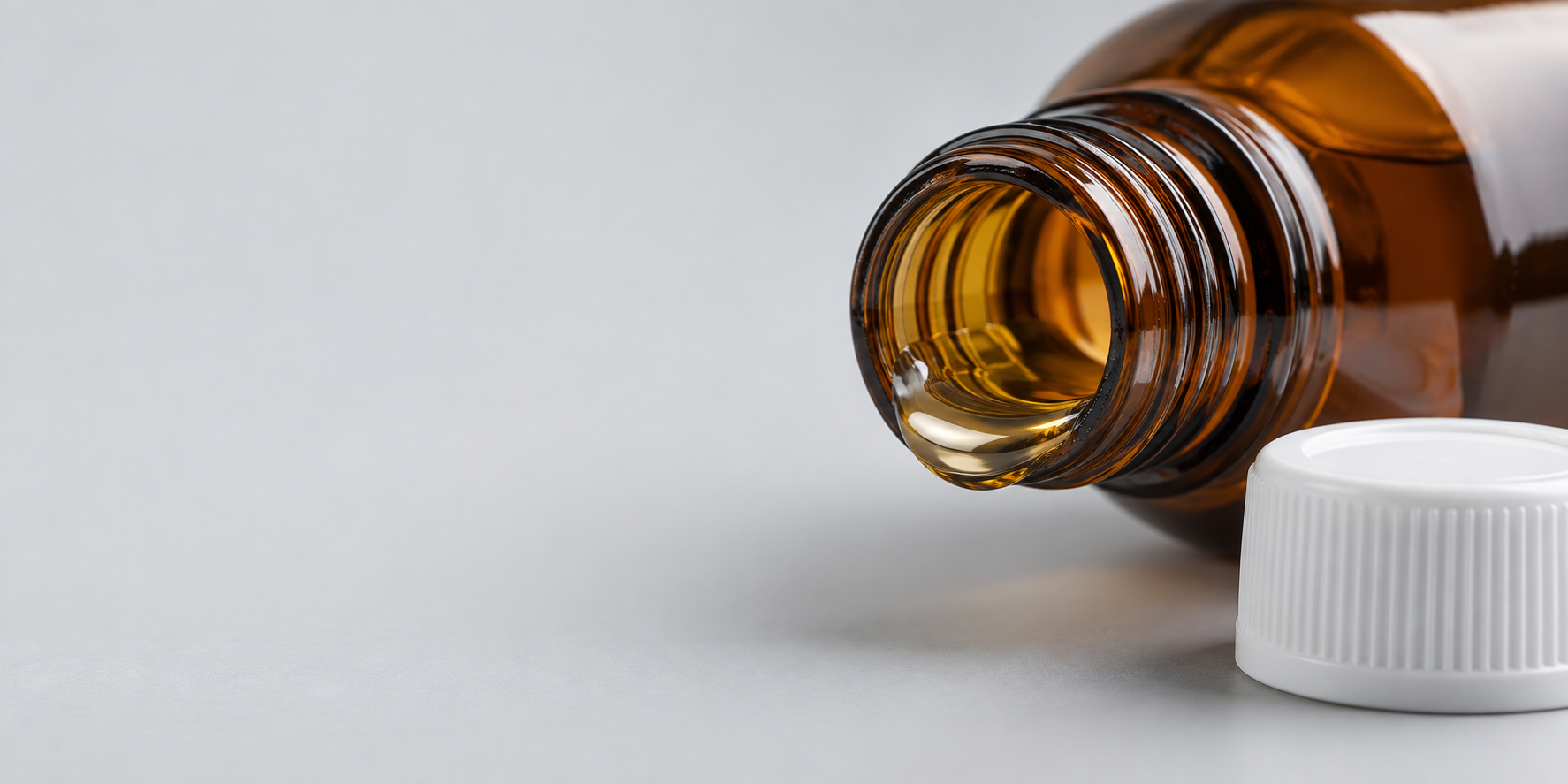
Where Syrup Bottle Dosing Accuracy Usually Fails
Audit a pack that has drawn a complaint and four patterns cover almost everything. A cup that measures wide. A fill set to nominal volume. A pour lip worn by the capper. A product whose viscosity shifted between the trial batch and the production batch.
Just one of those is a component specification problem. The rest belong to the process, which is why a dosing review beats a component inspection, and why the same checks show up on our packaging quality control checklist. Syrup bottle dosing accuracy is a process outcome long before it becomes a measurement result, and treating it as a signed certificate leaves the drift invisible.
Overfill Is Not Accuracy
Every dosing discussion reaches the same shortcut sooner or later: put more syrup in and let the dose look after itself. Here is why it fails.
A heavier fill does nothing for the precision of a single dose. If the cup is too wide, every dose is still too big, and the bottle just empties sooner against a label promising a fixed number of doses.
Then there is cost and compliance. Extra product gets paid for on every unit, and in regulated markets the net content declaration has to be backed by the average fill. PauPack would rather fix the pour path and the graduations, then set the fill to deliver what the carton claims.
What Regulators Expect from a Container Closure System
Regulated oral liquids are qualified as a container closure system, which is a formal way of saying bottle, closure and product get tested together. The USP container closure chapter sets that expectation for drug products, and the same logic transfers without strain to herbal and wellness syrups sitting outside the pharmaceutical framework.
Where a syrup pack also carries a child-resistance claim, the test happens on the finished pack rather than on the cap. The Poison Prevention Packaging Act governs that in the United States, and the sequence it implies is the one PauPack already runs: assemble, fill, test, approve.
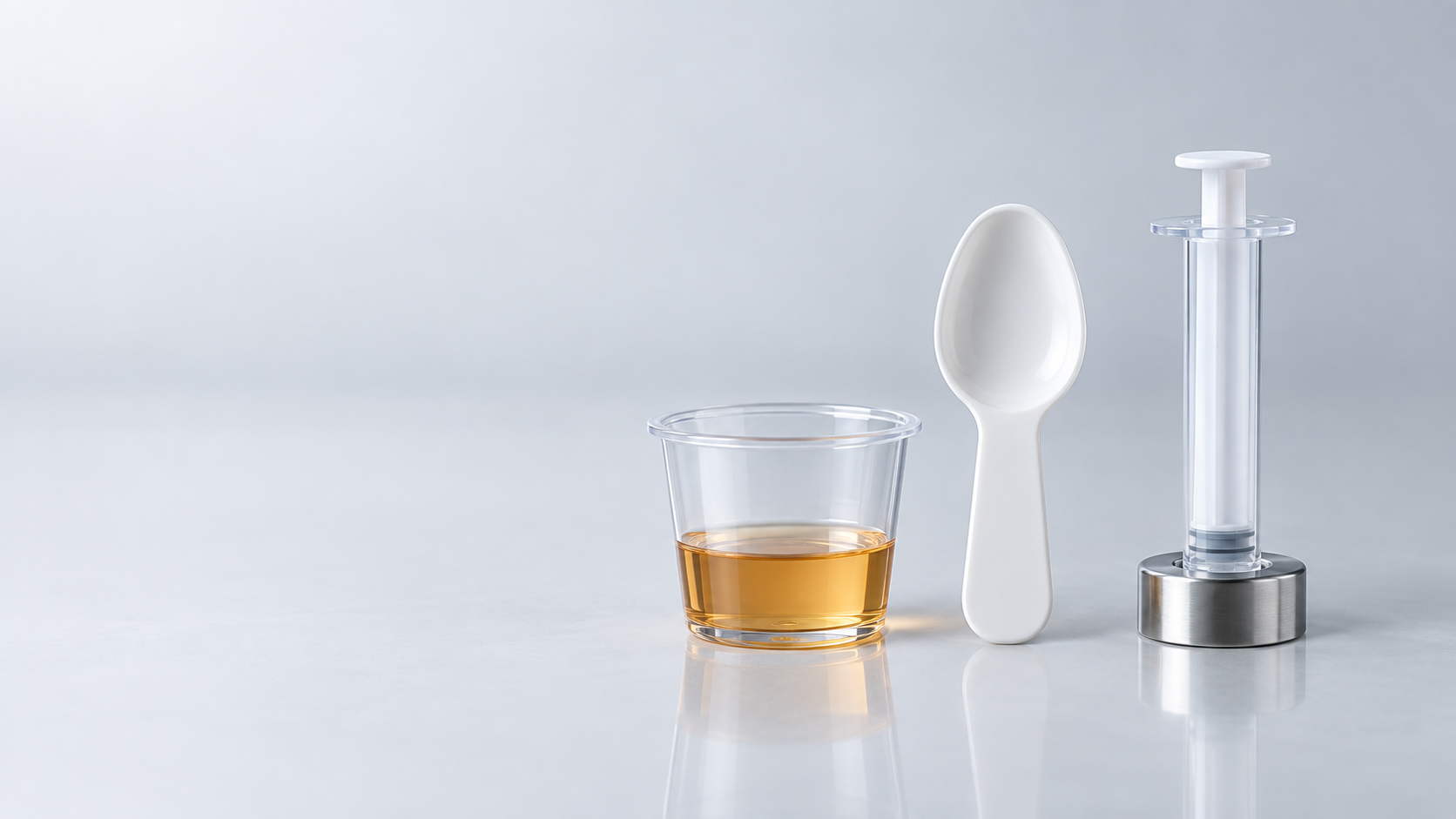
Dosing Cups, Spoons, Droppers and Syringes Compared
Each device suits a different dose and a different patient. This is the guidance PauPack gives when a brand is weighing them up.
| Device | Dose range | Typical deviation | Best for |
|---|---|---|---|
| Graduated dosing cup | 5 ml to 30 ml | Plus or minus 5% | Adult cough and tonic syrups |
| Dosing spoon | 2.5 ml to 10 ml | Plus or minus 8% | Simple, low-cost packs |
| Oral syringe | 0.5 ml to 10 ml | Plus or minus 2% | Paediatric and precise dosing |
| Dropper with mark | 0.5 ml to 2 ml | Plus or minus 3% | Concentrates and tinctures |
The device has to fit the bottle too. A syringe wants a neck wide enough to take the barrel and a bottle deep enough to reach the last of the liquid, which makes it a moulding decision rather than an accessory purchase. The medicine syrup bottles PauPack produces are dimensioned for that, and the accessory options sit beside them under accessories supply.
Setting an Acceptance Band the Line Can Actually Hold
A tolerance that looks elegant on paper and cannot be held on a filling line is worse than a wider one that is met every day of the week. Narrow numbers invite adjustments, and adjustments are very good at hiding real drift.
PauPack builds the band from the components outward. Cup tolerance first, then pour path variation, then balance uncertainty, and whatever is left over belongs to the filling line. If the total overshoots the target, the cup is where the money should go: cheapest part to re-tool, and the one the patient reads directly. Write the band in millilitres on the trial sheet as well, so syrup bottle dosing accuracy can be compared across products without an argument about conversion.
When one range covers several products, set a band per viscosity class instead of a single number for the family. A cough syrup at 1.28 g/ml and a herbal tonic at 1.05 g/ml will not behave the same in the same cup, and pretending otherwise hands you a specification nobody can pass.
What PauPack Prepares Before a Dosing Trial
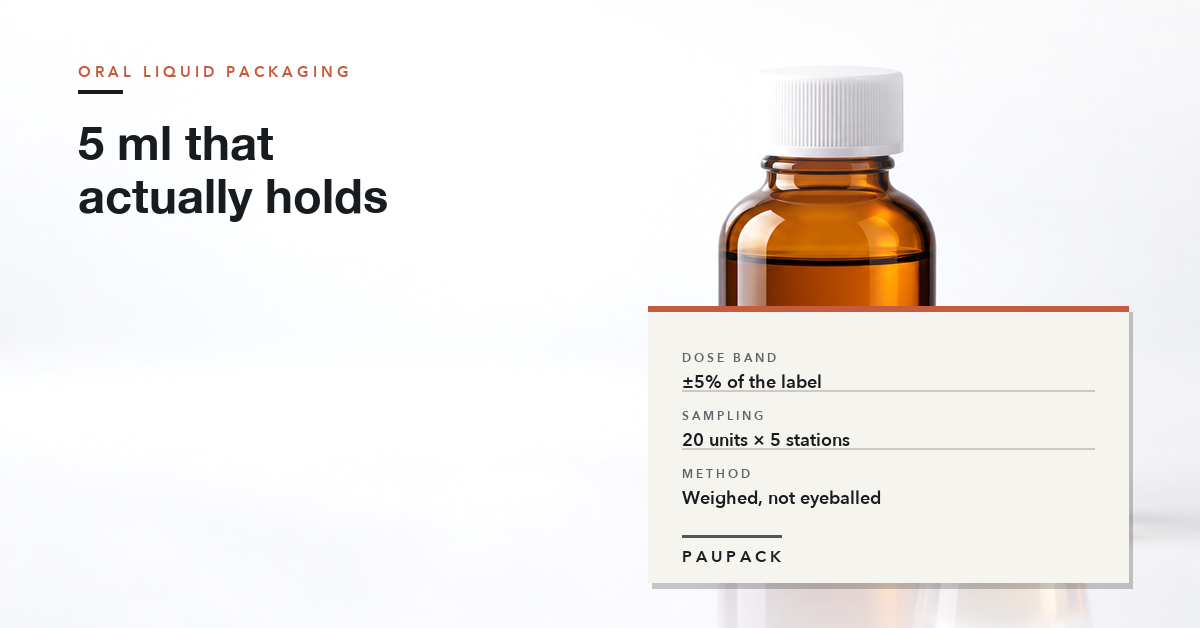
A dosing trial needs filled units, a calibrated balance and the density of the batch in front of it. PauPack assembles samples with the intended closure and cup, fills to the intended weight, and then runs twenty weighings per station at the thin, nominal and thick ends of the product range.
The report records the mean, the range and the deviation for each station, together with the density figure used for the conversion. That single sheet answers most audit questions without a second round of testing, and it links directly to the checks in our medicine bottle quality test and child-resistant closure notes.

Seven Numbers for a Dosing Specification
Write these down before tooling is cut and most dosing arguments never happen.
- Nominal fill volume and the deliverable volume the pack realistically gives.
- Number of doses promised on the carton.
- Dose volume in millilitres, and the device used to measure it.
- Cup or syringe graduation tolerance, taken from the drawing.
- Neck finish and pour lip geometry.
- Batch density used for any weight-to-volume conversion.
- Acceptance band and the sampling plan that proves it.
PauPack puts those lines on the quotation and repeats them on the trial report, so brand, factory and auditor end up reading one document. Worth more, frankly, than a tighter number nobody can hold.
Syrup Bottle Dosing Accuracy: Questions Buyers Ask
What is a realistic tolerance for syrup bottle dosing accuracy?
On an oral solution with a graduated cup, plus or minus 5 percent of the stated dose across a production run is a realistic working band, and the cup itself usually eats 2 to 3 points of that. Switch to a dropper or an oral syringe and plus or minus 3 percent becomes reachable, because the mark sits against a narrower column of liquid.
Does the bottle neck affect how accurately a dose pours?
More than most buyers expect. A wide neck dumps liquid out in an uncontrolled sheet, so the cup fills faster than anyone can watch the mark. A narrower pour lip slows the flow and keeps the last millilitre manageable, which is why syrup bottle dosing accuracy in PauPack trials is always read alongside the neck specification rather than against the bottle on its own.
How should dose accuracy be measured in a factory?
By weight, on a calibrated balance, with the batch density written on the same sheet. Reading a meniscus through curved glass adds error that has nothing to do with the bottle. Weigh twenty units per batch and convert to millilitres with the measured density.
Why does my 100 ml bottle only deliver 95 doses?
Usually because the bottle was filled to its nominal volume rather than its deliverable volume. The last 3 ml to 6 ml either sits below the dip tube or refuses to pour out of a flat shoulder. So either the label states the doses the pack really gives, or the fill weight goes up.
Is overfilling a valid way to improve dosing accuracy?
No. Overfilling costs money, can push the pack outside its declared net content, and does nothing at all for the precision of a single dose. Syrup bottle dosing accuracy comes from the pour path, the graduations and the fill level, not from pouring in more syrup.
What is the difference between accuracy and precision here?
Accuracy is how close the average dose lands to what the label promises. Precision is how tightly the individual doses bunch together. A line can be both precise and inaccurate, which is exactly what a cup moulded slightly oversized gives you: every dose wrong by the same amount.
Do dosing cups need their own tolerances?
Yes, and they are easy to forget. A moulded cup carries its own dimensional tolerance, and one that is 4 percent wide pours 4 percent more than the mark claims. PauPack asks for the cup drawing and checks the fill line against it before approving anything.
How does viscosity change the dose?
A thick syrup clings to the cup wall, so the line reads low even when the delivered volume is right. A thin syrup drains away completely. The same cup can read differently across one product family, which is why a single set of graduations rarely fits a whole range.
Should the label state millilitres or spoonfuls?
Millilitres, with the cup inside the pack. Household spoons vary far too much to count as a dosing device, and a label that only offers spoonfuls leaves the patient guessing. Regulated markets expect the dosing device to be in the pack and to match the label.
How does PauPack verify a dosing pack before release?
We fill a batch, weigh twenty doses at every fill station, convert to volume using the batch density, and record the cup mark against what was actually delivered. Thin, nominal and thick batches get tested separately, because one viscosity sample hides how the range behaves.