

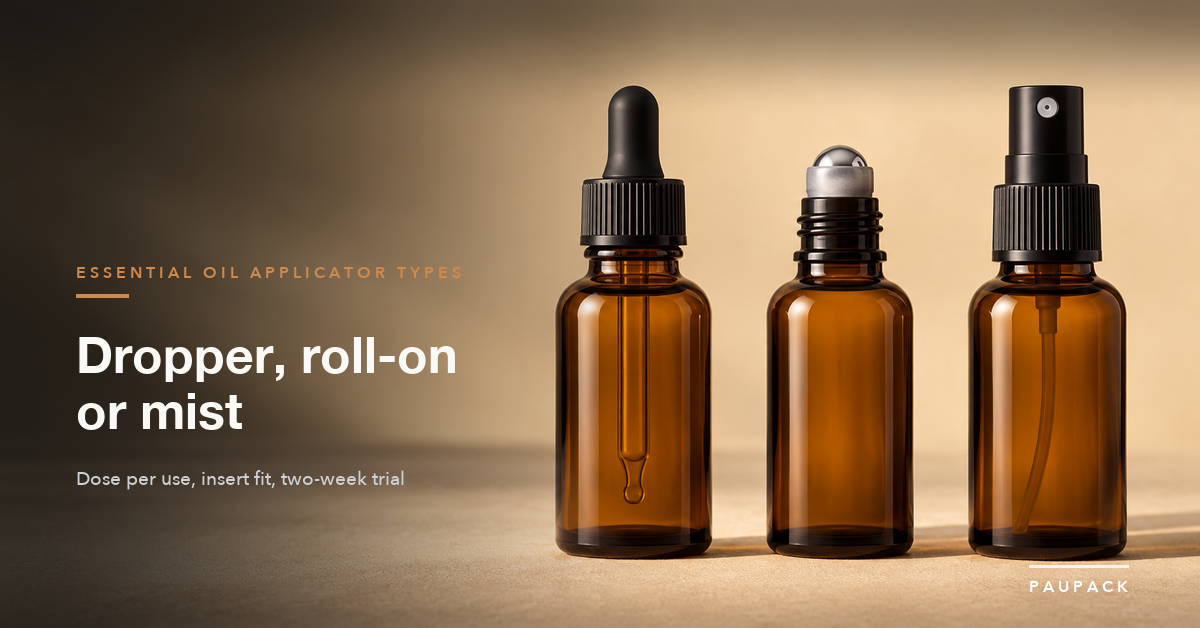
Essential oil applicator types are usually chosen from a mood board, and they should be chosen from a dose. A roll-on, a dropper and a fine mist deliver very different amounts of oil per use, and the customer notices the difference long before they notice the bottle design.
PauPack runs applicator bottles for aromatherapy, wellness and private label brands, and this page works through the four formats, the inserts inside them, and the questions that decide which one belongs in your range. If you are building a kit, read the section on mixed format orders last, because it changes the MOQ arithmetic.
Essential Oil Applicator Types Start With Dose, Not Trend
Ask how much oil one use should deliver, and how the customer applies it. A drop on a wrist, a stroke along a pulse point, and a mist across a pillow are three different products even when the liquid inside is identical, and that is why essential oil applicator types cannot be swapped at the last minute.
Once the dose is fixed, the format usually chooses itself. The rest of the work is the insert, the closure and the decoration, which is where the failures actually happen.
The Four Formats Buyers Order Most
| Format | Typical dose | Suits | Watch out for |
|---|---|---|---|
| Dropper bottle | 1 to 3 drops per use | Single oils, tinctures, blending | Collar sealing and residue on the pipette |
| Roll-on | Roughly 0.05 to 0.1 ml per stroke | Pre-diluted blends, travel sizes | Ball and housing fit, dribbling when loose |
| Fine mist spray | A measured mist, hard to count | Room, linen and pillow products | Spray pattern and over-application |
| Open neck with insert | Controlled pour or drop | Refills, large formats, massage oils | Insert matching the viscosity |
Those four cover most of the category. The conversations that matter are about the third column and the fourth, not the first.
Dropper Bottles: Control and Contamination
A dropper gives the customer a number to work with. One drop, two drops, and the blend is repeatable. That is why single oils and blending kits stay with droppers even when roll-ons are cheaper.
The cost is contact. The pipette touches the skin or the blend bowl, then goes back into the bottle. Brands that sell into clinical or practitioner channels usually specify a dropper with a glass pipette and a collar that seals cleanly, and add a note about wiping the tip.
PauPack's dropper bottle range covers both amber and clear glass, and the collar is specified with the bottle neck rather than bought separately, which is what keeps essential oil applicator types comparable on price.
Roll-On Bottles: Dose Per Stroke
The ball sets the dose. A 7 mm ball delivers a broader stroke than a 5 mm ball, and pre-diluted blends usually want the larger one because the customer is covering an area rather than counting drops.
Then comes the housing fit, which decides whether the pack leaks. A ball that sits too loosely dribbles when the bottle is warm, and the customer blames the blend. Ask for the retention force the housing was tested to rather than a general statement that the fit is standard, because this is the one place where essential oil applicator types differ most in quality at the same price.

Spray and Mist: Pattern, Propellant and Inhalation
Fine mist works where the customer wants coverage rather than precision. The performance is measured in spray pattern and output per stroke, and both change with viscosity, actuator orifice and pump chamber.
Test the pattern on paper, not on a hand. Photograph the mark at 20 cm and again at 30 cm, and compare the pump options side by side. PauPack ships three actuators with a mist bottle sample for that reason, because the difference is visible in a photograph and almost invisible in a specification. The mist spray bottle range covers the pump chambers used most often for aromatherapy sprays.
Closures, Inserts and the Part Nobody Specifies
| Insert | Best for | Failure mode |
|---|---|---|
| Standard dropper tip | Thin oils and blends | Too fast for thick carriers |
| Wide orifice reducer | Thick blends, massage oils | Over-pours if the bottle is squeezed |
| Euro dropper insert | Oil dispensing with a slow drop rate | Needs a matching neck finish to seat |
| Tamper-evident collar | Retail channels that expect evidence | Adds height and can clash with boxed sets |
The insert is the cheapest part in the pack and the fastest route to a complaint. Specify it with the oil, not with the bottle.
Viscosity and the Carrier Oil Change the Answer
Pure essential oils move quickly. Blends cut with fractionated coconut oil, jojoba or sweet almond move slowly, and the same insert that performs beautifully on a single oil can stall on a carrier blend. Dilution ratios also change the fill volume and the label claim.
Send the finished blend, not just the essential oil, when you ask for a recommendation. PauPack keeps carrier samples on hand to test drop rate and stroke volume before an essential oil applicator type is approved, and the essential oil bottle range covers the formats in amber and clear glass.
Child-Resistant Rules for Certain Oils
Some oils fall under child-resistant packaging rules in the United States. Oil of wintergreen and products with a high methyl salicylate content are the classic examples, and the requirement attaches to the pack that reaches the customer rather than to the oil on its own.
The framework is public. The Poison Prevention Packaging Act pages set out how the rules work in the United States, and the FDA cosmetics pages explain how the agency treats cosmetic and personal care products that may also fall in scope. Confirm the classification for your specific product before choosing a closure, because a change of closure after tooling is an expensive way to learn the rule. PauPack asks for the product classification in writing at the sample stage for that reason.
Decoration, Oil Residue and the Oily Surface
Oil ends up on the outside of every bottle in this category. A label with a soft adhesive lifts at the corner within weeks, and a spray frosting wears where the thumb grips. Fired-on organic ink and acid-etched frosting handle the residue better than most alternatives.
PauPack also asks brands for the carton wording that reminds the customer to wipe the bottle. It sounds trivial, and it reduces returns more than a heavier wall ever will.
Mixed Format Orders and the MOQ Arithmetic
Kits usually combine two or three essential oil applicator types in one box, which multiplies the number of moulds and decoration setups. That is fine as long as the MOQ is planned as a whole rather than per component.
Ask what the combined run looks like at the quantities you expect. PauPack prices kits across formats so the bottles, inserts and closures land on one bill, and the accessories supply service keeps the inserts and caps on the same order.
A Sample Trial You Can Run in Two Weeks
Fill ten bottles from production tooling with the real blend. Close five at the torque the line will use and lay them on their side in a warm room for a week. Use the other five normally, and count drops or strokes before and after.
Then open and close each bottle ten times and check the collar for residue. The quality management process holds the results with the project so a repeat order starts from the same numbers, and PauPack asks for the trial notes before recommending a closure change.
Sourcing Notes for Applicator Bottles
Prices for essential oil applicator types look similar in a quotation and diverge sharply in service. Ask who holds the insert tooling, how the ball retention is controlled, and what happens if a batch of caps arrives with inconsistent orifice diameter.
Background reading sits in the guide to the best bottle types for essential oils and the notes on drops per 10 ml roller bottle, with wider sourcing advice in the article on finding a reliable glass bottle supplier.
Send the oil type, blend viscosity, dose per use and market and PauPack will match the format, the insert and the closure, then send samples so the choice can be made by hand rather than from a table.
Questions Buyers Ask About Essential Oil Applicator Types
Which essential oil applicator types sell best?
Roll-ons dominate blends and travel sizes, droppers dominate single oils and tinctures, and fine mist sprays dominate room and pillow products. The pattern follows dose rather than fashion, so start from how the customer uses the product in a normal week.
What does the ball diameter change in a roll-on?
Two things: the dose per stroke and the leak resistance. A larger ball delivers more oil per pass and feels faster to use. A smaller ball is thrifty but can dribble if the housing fit is loose, which is the most common complaint on cheap roll-ons.
Do droppers leak in transit?
They can, and the usual cause is the collar, not the pipette. A collar that does not compress the gasket enough lets oil creep past the threads when the bottle lies on its side in a warm van. Test the closed bottle on its side for a week before approving the pack.
When should I choose a spray instead of a dropper?
When the dose is measured in mist rather than drops: pillow sprays, room blends, and any product the customer applies to a surface. Choose it for inhalation products too, with a clear label instruction, because a fine mist is easier to over-apply than a drop.
What insert suits a thick oil?
A wider orifice or a short dropper tip. Thick carrier blends and jojoba-heavy bases struggle through a narrow insert, and the customer reads that as a defective bottle rather than as a viscosity mismatch. PauPack sends several inserts with the samples so the difference can be felt.
Which applicator suits a 10 ml bottle?
A roll-on or a dropper, usually. At 10 ml the dose per use is small, so both formats work, and the choice comes down to whether the customer wants controlled drops or a fast stroke. Kits often mix the two.
Do essential oils need child-resistant closures?
Some do. Certain oils, including oil of wintergreen and products with a high methyl salicylate content, fall under the Poison Prevention Packaging Act in the United States, and the requirement attaches to the package rather than to the oil alone.
Can glass applicator bottles be decorated?
Yes, and the decoration matters more than usual because oil residue stays on the surface. Fired-on organic ink and acid-etched frosting hold up best. Self-adhesive labels need an oil-resistant adhesive and, better still, a wipe-down instruction on the carton.
What sample trial should I run before ordering?
Fill ten bottles from production tooling at the real viscosity, close them at the line torque, lay five on their side for a week at 35 degrees, and use the other five normally for a week. Note the dose per stroke or per drop before and after.
What does PauPack supply for applicator bottles?
The bottle, the applicator insert, the closure and the decoration on one specification, with a sample set that lets you compare two insert options. Send the oil type, the blend viscosity and the market and PauPack matches the format rather than the picture.