

A single drop can hold the essence of a plant. But without the right box, even the purest essential oil can feel incomplete, unprotected, or unremarkable.
Essential oil packaging boxes are custom-designed outer cartons that protect, organize, and present essential oil bottles—enhancing brand identity and extending shelf life through functional design.
They can house one bottle or a complete set, offer retail presentation or shipping protection, and are often tailored to match the bottle's size, material, and blend type. In short, they do much more than “hold”—they sell, secure, and speak.

What is the best packaging for essential oils?
The bottle matters—but the box finishes the story.
The best packaging for essential oils combines UV-blocking glass bottles with tightly sealed caps, placed inside custom-fit boxes made from sturdy, eco-friendly materials that prevent light, heat, and shock exposure.
A premium essential oil product needs packaging that considers both aesthetic and functional value. The wrong choice can shorten shelf life or reduce perceived quality. The right choice builds trust.
Key Components of Optimal Packaging
| Packaging Element | Material/Feature | Why It Matters |
|---|---|---|
| Bottle | Amber/Cobalt Glass | Blocks UV light and preserves potency |
| Cap/Closure | Dropper, Roller, Spray, Tamper-Evident | Prevents leakage, enables accurate dosing |
| Internal Fitment | Foam, Molded Cardboard | Prevents movement and breakage in transit |
| Outer Box | Kraft, Rigid, Magnetic, Drawer-Style | Protects and presents the product |
| Label/Print | Oil-resistant, Waterproof | Maintains professional appearance |
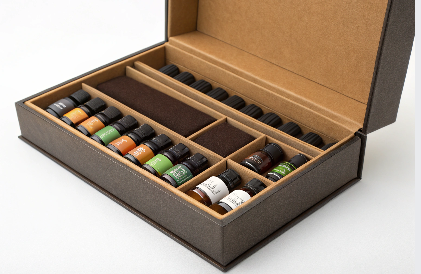
At PauPack, we develop packaging kits that integrate premium glass bottles with structural box inserts, printed usage guides, and blend notes—ideal for DTC brands and wellness product launches.
What is the 30 50 20 rule for essential oils?
This blending strategy impacts how you package and group your oils.
The 30/50/20 rule refers to the ratio of top, middle, and base notes in a balanced essential oil blend: 30% top, 50% middle, and 20% base.
For packaging, this rule helps organize oil sets and guides customers through scent crafting.
30/50/20 in Boxed Sets
| Note Type | Scent Duration | Example Oils | Placement Strategy |
|---|---|---|---|
| Top (30%) | Evaporates fast | Lemon, Peppermint | Front of box or clearly labeled |
| Middle (50%) | Lingers moderately | Lavender, Geranium | Centerpiece or “core” of collection |
| Base (20%) | Lasts longest | Sandalwood, Vetiver | Highlight as anchor scent |
PauPack offers 30/50/20-themed packaging sets with labeled compartments and printed blending guides to enhance user education and unboxing impact.
What are the materials used in oil packaging?
Choosing the right material isn't just a sustainability statement—it directly affects oil safety and brand credibility.
Essential oil packaging uses a combination of materials, including amber glass for bottles, recycled cardboard or rigid board for boxes, EVA foam or molded pulp for inserts, and specialty coatings for labels.
Each material serves a purpose—either to protect the oil physically, shield it chemically, or align with brand values like sustainability or luxury.
Common Materials in Oil Packaging
| Component | Material Options | Benefits |
|---|---|---|
| Bottle | Amber/Cobalt Glass | Non-reactive, UV-resistant |
| Box Exterior | Kraft paperboard, Rigid box | Eco-friendly, printable, sturdy |
| Insert/Tray | EVA foam, corrugated insert | Keeps bottle secure and upright |
| Label | Waterproof synthetic paper | Resists oil smudges and peeling |
| Print Coating | Matte/Gloss UV, Foil, Emboss | Adds luxury feel and durability |
At PauPack, we use FSC-certified materials and support plastic-free designs for brands that want sustainable solutions. Our boxes can also be flat-packed for efficiency or fully assembled for luxury impact.
What kind of plastic is safe for essential oils?
Plastic and oils don’t always mix—but when they do, it must be under strict conditions.
High-quality plastics like HDPE (High-Density Polyethylene), PET (Polyethylene Terephthalate), and PP (Polypropylene) are considered safe for short-term storage of diluted essential oils.
Undiluted essential oils can break down most plastics over time, causing leaching or chemical reactions. That’s why glass is always preferred for pure essential oils.
Safe vs Unsafe Plastics
| Plastic Type | Safe for Essential Oils? | Best Use Case |
|---|---|---|
| HDPE | Yes (diluted oils) | Short-term travel bottles, body sprays |
| PET | Yes (with light dilution) | Cosmetic packaging, pump bottles |
| PP | Yes (resistant to corrosion) | Lids, spray heads, inner caps |
| PVC | No | Reacts with oils, leaches chemicals |
| LDPE | No | Too soft, can absorb oil |
At PauPack, we match our clients with the right material for the right formulation—ensuring all packaging elements meet global safety standards and brand positioning needs.
Conclusion
Essential oil packaging boxes are more than cardboard—they are the protective shell, the brand ambassador, and the guide to a sensory experience. The right box—paired with safe materials and smart structure—elevates your product from ordinary to unforgettable.