

Custom packaging tooling cost is an investment decision disguised as one line on a supplier quote. The line can hide design engineering, molds, cavities, gauges, fixtures, prototypes, trials, revisions, maintenance, ownership and transfer assumptions. PauPack moves the discussion into an investment committee: every cost must point to a controlled asset, a decision it enables and a condition that can change the approved budget.
Committee Paper 1: Define the Differentiation
State why stock packaging cannot meet the brief. The reason may be capacity, geometry, closure interface, brand silhouette, line handling or a range architecture. PauPack asks what customers or operations will notice and what value the difference creates. Tooling without a clear purpose becomes an expensive way to reproduce an available shape.
Committee Paper 2: Freeze the Commercial System
Capacity, material, finish, closure, liner, decoration, label panel, filling process, case and destination must be visible before final tooling release. PauPack treats the bottle or jar as one interface inside a sellable pack. A mold approved before the cap, fill or line constraints are understood can create a beautiful component that production cannot use.
Committee Paper 3: Normalize the Tooling Scope
Ask whether the quote includes design files, engineering, prototype routes, production molds, cavity count, neck tooling, gauges, fixtures, trials, samples, revisions and documentation. Custom packaging tooling cost cannot be compared until suppliers are pricing the same scope. PauPack creates a line-by-line responsibility matrix and marks exclusions beside the quoted total.
The Tooling Investment Ledger
| Ledger line | Asset or activity | Approval evidence |
|---|---|---|
| Design | Drawings, models and engineering | Frozen requirements |
| Production tool | Mold, cavities and neck parts | Identified trial output |
| Control | Gauges, fixtures and masters | Inspection method |
| Learning | Trials, samples and revisions | Decision record |
| Lifecycle | Maintenance, ownership and retirement | Asset register |
Committee Paper 4: Separate Prototype and Production Routes
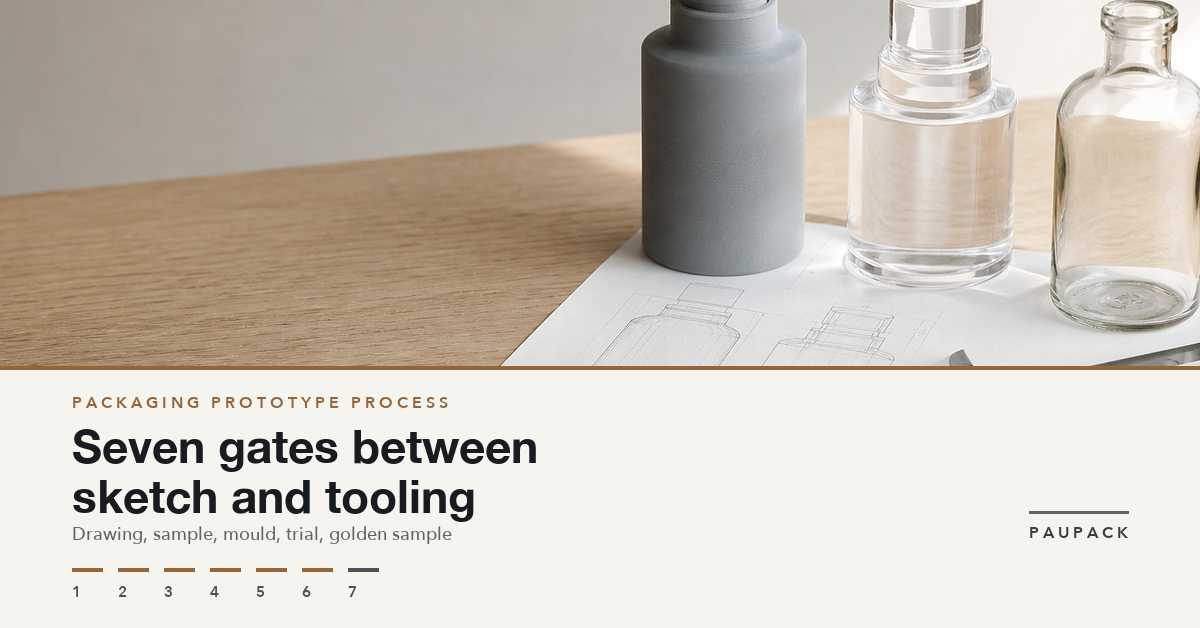
Machined models, 3D prints, pilot tools and production molds answer different questions. Label sample purpose and limitations. PauPack uses early routes to review hand feel, geometry, closure direction or artwork without pretending they prove production glass capability. Each stage ends with a decision to proceed, revise or stop.
Committee Paper 5: Price the Closure Interface
A new container may require a stock finish, custom finish or matched closure work. Include cap, liner, seal, pump, dropper, gauge and application implications. The lowest mold quote can become the highest project exposure if it creates a special finish with no resilient closure supply. PauPack keeps interface risk beside the custom packaging tooling cost ledger.
Committee Paper 6: Budget Controlled Revisions
Define the included revision rounds, what constitutes a design change, who approves it and how obsolete drawings or parts are handled. A change log should show cost, timing, evidence to repeat and remaining risk. PauPack avoids unlimited revision promises and also avoids treating every clarification as a new project.
Committee Paper 7: Model Production Output Carefully
Cavity count, cycle assumptions, yield, maintenance and scheduling influence output, but they need supplier-specific evidence. Ask what conditions support the quoted capacity and how a trial will be evaluated. PauPack does not convert a nominal machine rate into guaranteed sellable units. The investment memo shows assumptions, owners and sensitivity instead.
Committee Paper 8: Define Ownership and Access
Document who owns physical tools, drawings, gauges and digital files; where they are stored; who maintains them; what access or transfer is allowed; and what happens at end of life. Commercial and legal owners should review the agreement. PauPack keeps the asset identity and maintenance history with the project record.
Committee Paper 9: Add Decoration Tooling
Screens, plates, fixtures, masks, masters and color setups may sit outside the container mold quote. Separate them by process and SKU. A design with many colors can require repeated setups and inspection controls even when the glass is common. PauPack shows how artwork choices move custom packaging tooling cost and reorder flexibility.
Committee Paper 10: Include the Golden Case
Production readiness is not complete when the first acceptable bottle leaves the mold. Add closure assembly, decoration, filling, coding, labels, dividers, cartons and packed-product approval. PauPack closes tooling only when the sellable unit and case have identified references that quality and operations can use.
Run the Base, Downside and Delay Scenarios
For each scenario, show forecast, launch date, fixed investment, unit economics, residual components, margin exposure and the consequence of another revision. PauPack highlights when a stock route protects downside demand or when a distinctive custom form supports a repeatable multi-SKU plan. The committee sees tradeoffs rather than a single optimistic payback.
Investment rule: do not release the next payment because time has passed; release it because the previous decision gate produced the required evidence.
Gate 1: Release Geometry, Not the Whole Budget
The first gate confirms design intent, capacity boundary, finish direction, closure strategy, line constraints and the questions an early model must answer. Its output is a controlled drawing and a short risk list, not permission to start every downstream asset. PauPack keeps early learning reversible. When the geometry cannot support filling, labeling or case efficiency, the committee can revise before production tooling and decoration fixtures multiply the exposure.
Gate 2: Release Production Learning
The next gate identifies tool scope, trial quantity, inspection method, sample disposition and decision owners. Specify what an identified trial must demonstrate and which observations remain outside its scope. PauPack links custom packaging tooling cost to evidence as it is created, so another trial is funded for a named reason rather than because the first samples felt inconclusive. The ledger separates supplier correction, customer design change and optional optimization.
Gate 3: Release the Sellable System
Tool output must meet the closure, decoration, filling, coding, labeling and case before production approval. Use an identified golden unit and golden case, then select packed-product work around the intended route. ISTA's procedure overview helps qualified teams distinguish screening, simulation and development objectives. PauPack records the chosen objective and configuration instead of attaching a generic transport claim to an unfinished component.
Gate 4: Fund the Lifecycle
Approve maintenance, storage, repair responsibility, replacement parts, access and retirement alongside the first production order. Define reporting intervals and what happens when output, finish or ownership changes. PauPack calculates custom packaging tooling cost across expected programs and scenarios while keeping assumptions explicit. Record the next review date, expected production window and the evidence needed before another major repair or replacement decision. A low opening quote can lose its advantage when inaccessible tools, unclear maintenance or repeated uncontrolled revisions appear later.
Compare Offers on Recovery and Change Control
Normalize included trials, maintenance, replacement parts, repair, storage, ownership, revisions and commercial recovery. Ask what happens if the project pauses or the supplier cannot continue. PauPack treats custom packaging tooling cost as a lifecycle exposure, not a deposit that disappears after the first sample.
Build the Asset Register Before Production
Record tool name, code, drawing revision, location, ownership, commissioning date, maintenance, gauges, linked components and retirement status. Connect every production order to the current approved asset. PauPack's design service, manufacturing process and quality file use the same identity.
Ask PauPack for an Investment-Ready Tooling Memo
Send the design intent, capacity, material, closure, decoration, annual forecast, destinations, line constraints and timeline. PauPack can separate custom packaging tooling cost into assets, learning, controls and lifecycle exposure, then propose decision gates that protect both launch momentum and the option to stop before weak assumptions become sunk cost.
Frequently Asked Questions
What is included in custom packaging tooling?
Depending on the project it can include design engineering, molds or tooling sets, gauges, prototypes, trials, revisions and approval evidence.
Why is a single tooling price hard to compare?
Quotations may include different cavities, ownership, maintenance, revisions, sampling, gauges and production-transfer assumptions.
Who should own the tooling specification?
The buyer and supplier should document ownership, identified drawings, intended output, maintenance, access, change control and end-of-life handling.
When should decoration tooling be separated?
Separate molds, screens, plates, fixtures, masters and setup costs so changes can be assessed by the process they affect.
How should prototype rounds be budgeted?
Give each round a decision, quantity, method, owner and contingency instead of treating every sample as a final approval piece.
Does paying for a mold guarantee acceptable production?
No. Production readiness also depends on design, process capability, component interfaces, trials, inspection, packing and approved limits.
What should happen when the design changes?
Record the revision, affected tool or gauge, cost, schedule, evidence to repeat, obsolete items and the person approving the change.
How can buyers compare tooling offers?
Normalize scope, ownership, included trials, maintenance, output assumptions, revisions, gauges, documentation and commercial recovery.
When does tooling investment make sense?
It makes sense when the differentiated value, forecast, margin, timing and repeat-order plan justify the fixed investment and remaining risks.
What should a buyer send PauPack for a tooling estimate?
Send the design intent, capacity, material, closure, decoration, annual forecast, destinations, timeline and known production constraints.