

Big bottles, big potential—but just how many drops are inside?
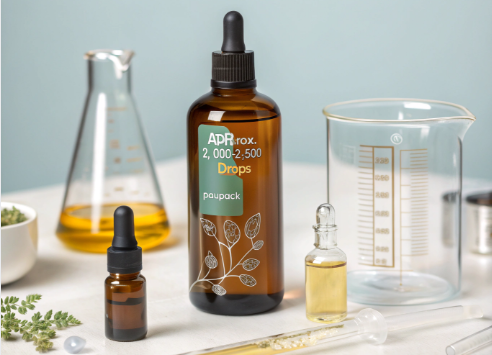
A 100mL bottle contains approximately 2,000–2,500 drops of essential oil, depending on the oil’s viscosity and the size of each drop.
If you’re blending room sprays, massage oils, or large-batch cosmetics, knowing the drop count helps you scale accurately and ensure formula consistency. Let’s break it down by use case and industry standard.

How many drops of essential oil are in one bottle?
One bottle—thousands of possibilities, but how many drops exactly?
In general, 1mL of essential oil equals about 20–25 drops, so a 100mL bottle contains 2,000 to 2,500 drops.
Dive Deeper: What influences drop count?
The total number of drops per bottle depends on:
-
Dropper size (varies by supplier)
-
Viscosity of the oil (thicker oils = larger drops)
-
Environmental conditions (humidity, temperature)
| Bottle Size | Approx. Drop Count |
|---|---|
| 10mL | 200–250 |
| 30mL | 600–750 |
| 50mL | 1,000–1,250 |
| 100mL | 2,000–2,500 |
At PauPack, we standardize dropper calibrations to ensure batch-to-batch consistency—so your customers get the same quality and performance every time.
How much is 100 drops of essential oil?
Not ready for full-scale production? Let’s zoom into micro-batch formulating.
100 drops of essential oil is roughly 4–5mL, which is a common amount used in test batches, DIY recipes, or highly concentrated perfume bases.
Dive Deeper: How to use 100 drops wisely
Knowing what 100 drops equates to helps in:
-
Formulating sample blends
-
Testing dilution percentages
-
Creating trial-size products
Here’s a quick guide:
| Drops | Approx. mL | Common Uses |
|---|---|---|
| 10 | 0.4–0.5mL | Spot treatments, perfume |
| 50 | 2.0–2.5mL | Massage oil samples |
| 100 | 4.0–5.0mL | Room sprays, body oils, trials |
Our 5ml and 10ml PauPack bottles are perfect for these use cases, with leak-proof droppers and airtight caps to preserve scent and purity.
What is the 30 50 20 rule for essential oils?
Still wondering how to balance scent and performance?
The 30-50-20 rule is a blending strategy for essential oils, with 30% top notes, 50% middle notes, and 20% base notes to create a balanced and long-lasting aroma.
Dive Deeper: Making sense of scent layering
This rule helps your blends smell better—and last longer. Each “note” in this formula contributes a unique quality:
| Note Type | % of Blend | Role in Aroma | Examples |
|---|---|---|---|
| Top | 30% | First impression | Lemon, Peppermint, Bergamot |
| Middle | 50% | Heart of the scent | Lavender, Geranium, Rosemary |
| Base | 20% | Long-lasting foundation | Patchouli, Vetiver, Myrrh |
When preparing large batches like a 100mL bottle, this ratio ensures your blend is harmonious and professional-grade. At PauPack, we assist clients with formulation support and offer packaging tailored to fragrance intensity and oil weight.
How many drops of essential oil are in 100ml of room spray?
Room sprays are everywhere—but getting the formula right takes math.
For a 100ml room spray, you typically use 20 to 50 drops of essential oil, depending on the desired scent strength and room size.
Dive Deeper: Scented spaces without overpowering
Most room sprays use a base of water and alcohol (or witch hazel) to help disperse oils evenly. Here’s a basic guide:
| Scent Intensity | EO Drops per 100mL | Suggested Use |
|---|---|---|
| Light | 20–30 | Small rooms, linen sprays |
| Moderate | 30–40 | Living rooms, offices |
| Strong | 50+ | Bathrooms, large areas |
Pro tip: Always shake before use to mix oils and base. PauPack’s fine mist sprayers deliver a smooth, consistent spray with no clogging—perfect for home, spa, or commercial aromatherapy applications.
Conclusion
A 100mL bottle holds up to 2,500 drops of essential oil—enough to power your formulations, from room sprays to skincare. Precision packaging starts with precision counting.